Soil color might seem simple at first glance, but it actually unlocks a world of information for scientists and industry professionals. You might expect these color charts to be all about visual matching, but the truth is much bigger. The Munsell Soil Color Book uses a three-part system—hue, value, and chroma—that eliminates guesswork and creates a universal language for soil analysis used by professionals in over 100 countries. This tiny detail changes how experts predict soil fertility, diagnose land quality, and even solve criminal cases.
Table of Contents
- Understanding The Munsell Soil Color Book System
- Why Accurate Color Matters In Your Industry
- Practical Applications For Professionals And Students
- Choosing And Using The Right Munsell Soil Color Book
Quick Summary
| Takeaway | Explanation |
|---|---|
| Use Munsell for precise soil color classification | The Munsell Soil Color Book offers a standardized system to document soil colors accurately across various fields. |
| Understand the three components: Hue, Value, Chroma | Recognizing these elements aids in clear communication of soil characteristics, reducing subjective interpretations. |
| Color indicates critical soil properties | Analyzing soil color can reveal organic matter content, moisture levels, and more, essential for environmental assessments. |
| Choose the right Munsell chart for your needs | Selection should consider factors like research discipline, geographic area, and intended use for effective color analysis. |
| Invest in technology for improved accuracy | Digital tools and smartphone apps that incorporate Munsell standards enhance field measurements and efficiency significantly. |
Understanding the Munsell Soil Color Book System
The Munsell Soil Color Book represents a sophisticated and standardized approach to color classification that has revolutionized how professionals across multiple disciplines analyze and communicate soil characteristics. Developed as a precise color communication system, this specialized tool enables scientists, geologists, agricultural researchers, and environmental professionals to document and interpret soil colors with unprecedented accuracy.
The Three-Dimensional Color Classification Method
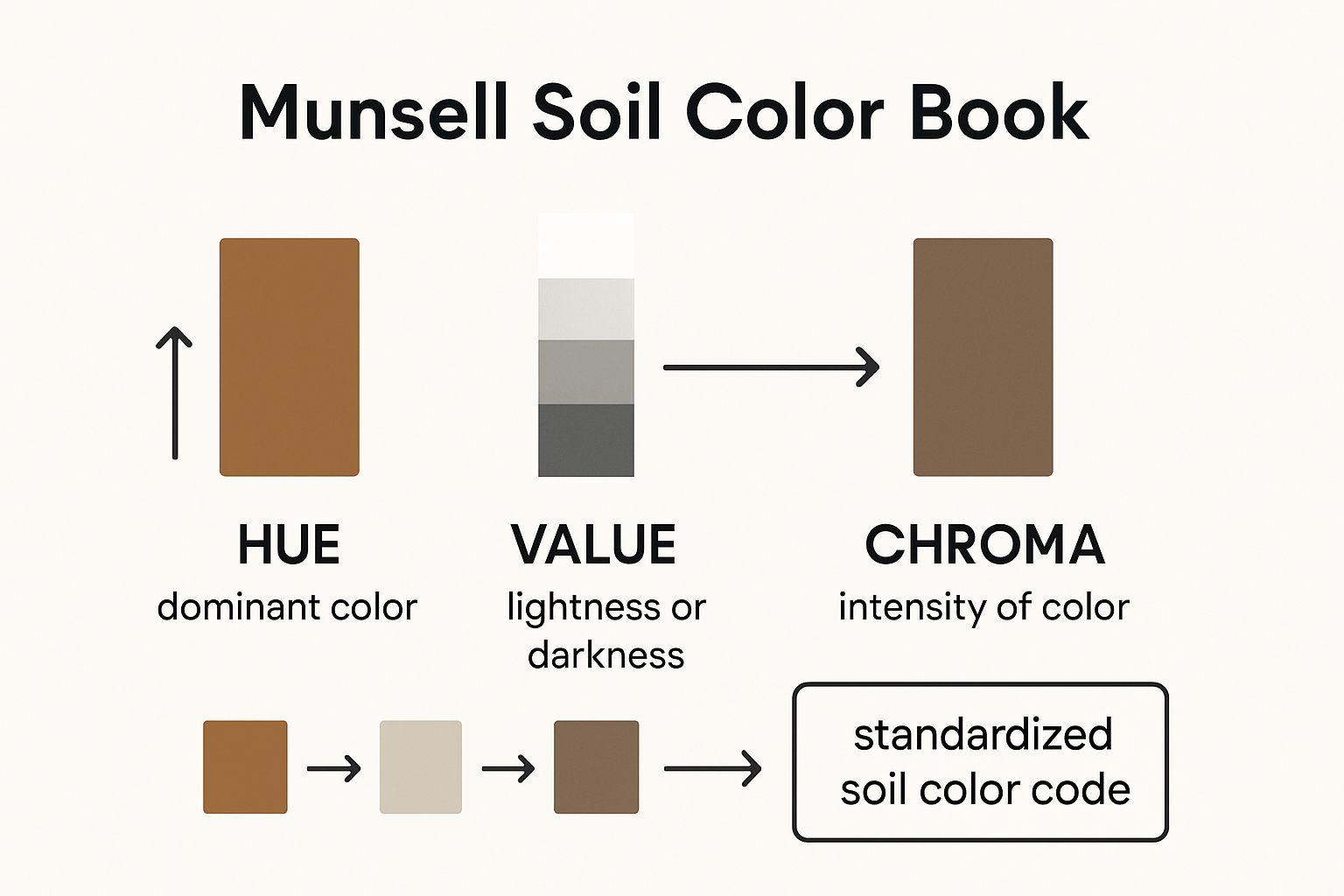
At the core of the Munsell Soil Color Book is a three-dimensional color identification system that breaks down color into three fundamental components: Hue, Value, and Chroma. Learn more about precise soil color classification techniques used by industry experts.
According to University of Georgia’s soil science department, these three dimensions provide a comprehensive framework for understanding soil color nuances:
- Hue: Represents the dominant spectral color (red, yellow, green, blue, etc.) that characterizes the soil’s basic color appearance
- Value: Indicates the lightness or darkness of the color, ranging from pure black to pure white
- Chroma: Measures the color’s intensity or saturation, determining how vivid or muted the color appears
This systematic approach allows researchers to record soil colors using a standardized notation that can be precisely replicated and understood globally. By assigning specific numerical and alphabetical codes to each color combination, the Munsell system eliminates subjective interpretations and provides a universally recognized method of color documentation.
Scientific and Practical Applications
LandPKS research highlights that soil color is far more than an aesthetic characteristic. It serves as a critical indicator of numerous soil properties, including organic matter content, mineral composition, moisture conditions, and potential agricultural productivity. Professional soil scientists utilize the Munsell Soil Color Book to:
- Assess soil health and fertility
- Determine drainage and moisture retention capabilities
- Identify potential environmental transformations
- Conduct geological and archaeological research
- Support agricultural and environmental management strategies
The precision of the Munsell system allows professionals to detect subtle color variations that might signify significant changes in soil composition. For instance, shifts in color can indicate variations in organic matter, presence of specific minerals, water saturation levels, and potential environmental stressors.
Modern technological advancements have further enhanced the utility of the Munsell Soil Color Book. Many researchers now use digital applications and smartphone tools that integrate the Munsell color classification system, enabling quick and accurate field measurements. These technological innovations have made color analysis more accessible and efficient, expanding the system’s applicability across various scientific and industrial domains.
The Munsell Soil Color Book continues to be an indispensable tool for professionals who require meticulous and standardized color documentation. Its comprehensive approach to color classification transcends traditional visual assessment, providing a robust scientific framework for understanding the complex and dynamic world of soil characteristics.
Why Accurate Color Matters in Your Industry
Accurate color representation transcends aesthetic considerations and becomes a critical operational parameter across numerous professional domains. From agriculture and environmental science to forensics and manufacturing, precise color measurement provides insights that drive decision making, quality control, and research outcomes.
Color as a Critical Diagnostic Tool
In scientific and industrial contexts, color serves as a fundamental diagnostic indicator revealing complex underlying characteristics. Explore professional color measurement techniques that transform visual perception into quantifiable data.
According to University of Kansas Geological Survey, soil color variations can signal profound environmental transformations. Slight chromatic shifts might indicate critical changes in:
- Moisture content
- Organic matter composition
- Mineral concentrations
- Potential contamination zones
- Ecological health indicators
Precision becomes paramount when these color variations represent minuscule yet scientifically significant differences. For instance, a subtle change in soil color could reveal potential environmental stress, agricultural challenges, or geological transitions that might otherwise remain undetected.
Instrumental Precision in Color Measurement
Forensic research published in scientific journals demonstrates that instrumental colorimetry provides approximately tenfold better precision compared to traditional visual assessment methods. This heightened accuracy enables professionals to:
- Quantify microscopic color variations
- Establish standardized measurement protocols
- Reduce subjective interpretation
- Create repeatable scientific documentation
In fields ranging from soil science and archaeology to materials engineering, color becomes more than a visual attribute—it transforms into a sophisticated data point capable of revealing complex systemic information. The ability to capture and interpret these nuanced color variations can mean the difference between comprehensive understanding and potentially misleading observations.
Modern technological advancements have significantly enhanced color measurement capabilities. Digital spectrophotometers, advanced imaging systems, and integrated color management technologies now allow professionals to capture color data with unprecedented accuracy. These tools convert what was once a subjective visual experience into objective, mathematically precise measurements.
The implications of accurate color measurement extend far beyond academic research. Industries such as agriculture, environmental monitoring, forensic science, and manufacturing rely on precise color data to make critical decisions. A slight variation in color can indicate soil fertility, potential contamination, material quality, or manufacturing consistency.
Professionals who invest in robust color measurement tools like the Munsell Soil Color Book are investing in a comprehensive approach to data collection. By standardizing color assessment, they create a universal language of observation that transcends individual perception and provides a foundation for rigorous scientific investigation.
Ultimately, accurate color measurement represents more than technical precision—it embodies the pursuit of deeper understanding, enabling professionals to decode the subtle yet profound narratives hidden within chromatic variations across diverse scientific and industrial landscapes.
Practical Applications for Professionals and Students
The Munsell Soil Color Book serves as a versatile tool with wide-ranging applications across multiple academic and professional disciplines. Its standardized approach to color classification provides a critical framework for understanding and analyzing soil characteristics in various fields of study and professional practice.
Academic and Research Applications
Explore advanced soil classification techniques that transform scientific observation. According to the U.S. Geological Survey, the Munsell Soil Color Book plays a pivotal role in academic research, offering students and professionals a precise method for soil characterization. Students and researchers utilize this tool in several key areas:
- Archaeological investigations
- Environmental science studies
- Geological research
- Agricultural development
- Ecological system analysis
For graduate students and emerging researchers, the Munsell system provides a standardized language for documenting and communicating soil characteristics. This precision is crucial in developing comprehensive research methodologies that require consistent and reproducible color documentation.
Professional Field Applications
University of Georgia’s soil science experts highlight the practical implications of precise soil color assessment across various professional domains. Agricultural professionals, environmental consultants, and geological experts rely on the Munsell Soil Color Book for:
- Soil fertility assessment
- Land use planning
- Environmental impact studies
- Forensic soil analysis
- Geological mapping and classification
In agricultural settings, the color classification system allows professionals to quickly assess soil health, moisture content, and potential productivity. Environmental consultants use the Munsell system to track ecological changes, identify potential contamination, and monitor landscape transformations.
The system’s versatility extends to forensic science, where precise soil color documentation can provide critical evidence in criminal investigations. Geological researchers utilize the color classification to understand complex landscape formations, mineral compositions, and environmental historical records.
Technological advancements have further enhanced the Munsell Soil Color Book’s utility. Modern smartphone applications and digital tools now integrate the Munsell color classification system, making field research more accessible and efficient. Students and professionals can now capture and analyze soil color data with unprecedented ease and accuracy.
Professional training programs and academic curricula increasingly incorporate the Munsell system as a fundamental skill for students in earth sciences, environmental studies, and related fields. This approach ensures that emerging professionals have a standardized method for soil color assessment that transcends individual interpretation.
Beyond traditional scientific applications, the Munsell Soil Color Book has found utility in unexpected domains. Landscape architects, environmental designers, and conservation specialists use the system to understand ecological transitions, land management strategies, and environmental restoration projects.
The following table organizes the main professional and academic sectors that use the Munsell Soil Color Book, along with typical applications as described in the article.
| Sector/Field | Common Applications |
|---|---|
| Archaeology | Site investigations, soil characterization |
| Environmental Science | Assessments, ecological system analysis |
| Geology | Mapping, landscape formation studies |
| Agriculture | Soil fertility and land productivity assessments |
| Forensic Science | Crime scene soil evidence analysis |
| Land Management | Restoration projects, environmental planning |

Ultimately, the Munsell Soil Color Book represents more than a technical tool—it is a comprehensive system that bridges scientific observation, professional practice, and educational development. By providing a universal language for color classification, it empowers professionals and students to gain deeper insights into the complex world of soil science and environmental studies.
Choosing and Using the Right Munsell Soil Color Book
Selecting the appropriate Munsell Soil Color Book is a critical decision for professionals and researchers who require precise soil color classification. Discover expert selection strategies for your specific professional needs.
Understanding Munsell Soil Color Book Variations
The Smithsonian Institution highlights the diverse range of Munsell Soil Color Charts available for different scientific and professional applications. The selection process involves carefully considering several key factors:
- Research discipline
- Geographical region
- Specific soil type
- Intended application
- Frequency of field work
Historically, according to Wikipedia, the United States Department of Agriculture adopted the Munsell color system in the 1930s as the official color standardization method for soil research. This legacy underscores the importance of choosing a color book that aligns with professional standards and research requirements.
Practical Considerations for Selection
Scientific research platforms emphasize that the right Munsell Soil Color Book enables standardized soil color descriptions, facilitating easy comparison between different data sets. Professionals should consider the following selection criteria:
- Durability for field conditions
- Comprehensive color range
- Compatibility with digital measurement tools
- Ease of transportation
- Clarity of color notation system
For academic researchers, geological surveyors, and environmental professionals, the selection goes beyond a simple color reference. The chosen Munsell Soil Color Book becomes a critical instrument for precise scientific documentation and analysis.
Modern Munsell Soil Color Books come in various formats, including traditional printed charts, digital versions, and integrated smartphone applications. Each format offers unique advantages:
To help readers quickly compare the different formats of the Munsell Soil Color Book mentioned in the article, the following table summarizes their respective advantages.
| Format | Key Features | Advantages |
|---|---|---|
| Printed Charts | Tactile, physical reference | Immediate access, no power needed |
| Digital Versions | Electronic files, accessible via devices | Easy to store, share, and update |
| Smartphone Applications | Integrated with camera, on-site measurement | Instant documentation, portable, efficient |
- Printed charts provide tactile, immediate reference
- Digital versions allow for easy storage and sharing
- Smartphone applications offer on-site color measurement and instant documentation
Professionals should also consider the specific environmental conditions where they will use the color book. Factors such as humidity, temperature, and exposure to sunlight can impact the longevity and accuracy of color references.
Training and familiarity with the Munsell color notation system are equally important as the book selection itself. Many professional organizations and educational institutions offer workshops and training sessions to help researchers and professionals effectively utilize these specialized color classification tools.
Advanced users might consider investing in multiple Munsell Soil Color Books tailored to different research contexts. For instance, a geologist studying diverse terrain might require different color books for desert, coastal, and mountainous environments.
Technological integration has transformed how professionals use Munsell Soil Color Books. Modern spectrophotometers and digital color analysis tools can now directly interface with Munsell color standards, providing unprecedented accuracy in color measurement and documentation.
Ultimately, selecting the right Munsell Soil Color Book is an investment in scientific precision. By carefully evaluating professional needs, environmental conditions, and technological compatibility, researchers can choose a color reference tool that enhances their ability to document, analyze, and communicate complex soil characteristics with exceptional accuracy.
Frequently Asked Questions
What is the Munsell Soil Color Book?
The Munsell Soil Color Book is a standardized tool used to classify and document soil color using a three-part system: hue, value, and chroma. It facilitates precise communication of soil characteristics across various scientific and professional fields.
Why is accurate soil color classification important?
Accurate soil color classification is critical as it provides insights into soil properties such as organic matter content, moisture levels, and drainage capabilities. This information helps in environmental assessments, agricultural productivity, and understanding ecological health.
How do I choose the right Munsell Soil Color Book for my needs?
Selecting the right Munsell Soil Color Book involves considering factors such as your research discipline, geographic area, specific soil types, intended application, and the frequency of fieldwork. It’s also essential to consider durability and compatibility with digital tools.
What are the practical applications of the Munsell Soil Color Book in various industries?
The Munsell Soil Color Book is widely used in agriculture for soil fertility assessments, in environmental science for ecological studies, in geology for mapping, and in forensic science for analyzing soil evidence. Its versatility supports various professional practices across multiple disciplines.
Take the Guesswork Out of Color Precision in Your Projects
If you struggle to achieve consistent, industry-standard color accuracy in your fieldwork or creative projects, it is not just you. As discussed in the article, precise color classification using systems like the Munsell Soil Color Book is critical. Inaccurate color references can lead to costly errors, inconsistent results, and lost productivity. When your work demands reliable color communication and documentation, you need professional-grade tools that deliver on every promise.
Cut uncertainty from your workflow. Browse Kolorguide’s selection of color management tools, including trusted Pantone guides and resources designed for scientific and creative professionals. Take charge of every color-critical decision with confidence. Visit https://kolorguide.com now and discover high-quality solutions that keep your work on standard and your reputation strong. Make the switch to reliable color tools and experience the impact today.
Recommended
- Munsell color chart for soil Archives – kolorguide
- Munsell Soil Color Book Archives – kolorguide
- Munsell soil color system Archives – kolorguide
- Munsell 10YR soil chart Archives – kolorguide
Munsell Soil Color Book M50215B
Original price was: $300.00.$295.00Current price is: $295.00.

Munsell Color Book Glossy Edition M40115B
Original price was: $1,640.00.$1,305.00Current price is: $1,305.00.
Farnsworth Munsell 100 Hue Test CEP001
Original price was: $845.00.$719.95Current price is: $719.95.
Munsell Book of Color, Matte Edition M40291B
Original price was: $1,525.00.$1,459.00Current price is: $1,459.00.