A complete technical guide to diagnosing and solving ink adhesion problems on plastic substrates

Introduction
You’ve just run a production batch of 10,000 printed plastic bags. The print looks perfect coming off the press. Twenty-four hours later, you run your thumb across the surface and the ink smears. Or worse—it peels off in sheets.
If you’ve experienced this nightmare scenario, you’re not alone. Ink adhesion failure on plastic substrates is one of the most common and costly problems in the printing and packaging industry, resulting in:
- Rejected orders and customer complaints
- Wasted materials (substrate, ink, time)
- Production delays and missed deadlines
- Damage to reputation and lost future business
The root cause? Surface energy—an invisible but critical property that determines whether ink will bond to your substrate or slide right off.
This comprehensive guide will help you:
- Understand why ink won’t stick to plastic
- Identify the specific cause of your adhesion problem
- Diagnose surface energy issues quickly and accurately
- Implement proven solutions that work
- Prevent adhesion failures before they happen
The Symptoms: Recognizing Ink Adhesion Problems
Immediate Failures (On Press or Within Hours)
Ink Beading
- Ink forms droplets instead of spreading uniformly
- Visible immediately during printing
- Creates uneven coverage and poor print quality
- Most common on polyethylene (PE) and polypropylene (PP) films
Ink Crawling
- Ink pulls away from certain areas after application
- Creates bare spots or “fish eyes” in the print
- Often occurs within minutes of printing
- Indicates severe surface energy mismatch
Poor Wet-Out
- Ink doesn’t spread evenly across the surface
- Results in thin, weak coating
- Visible as streaky or translucent coverage
- Common when printing over previously treated surfaces
Delayed Failures (24-72 Hours Post-Print)
Rub-Off (Poor Rub Resistance)
- Ink smears or transfers when touched
- Most noticeable after 24-48 hours
- Fails tape test or standard rub testing
- Indicates weak molecular bonding
Delamination
- Ink peels off in sheets or flakes
- May occur days or weeks after printing
- Often triggered by temperature changes or humidity
- Most severe form of adhesion failure
Blocking
- Printed surfaces stick together when stacked
- Ink transfers from one surface to another
- Common in rolled or stacked materials
- Indicates incomplete curing or low surface energy
Intermittent Problems
Inconsistent Adhesion Across Roll
- Some areas print perfectly, others fail
- Indicates inconsistent surface treatment
- Common when corona treatment varies
- Difficult to diagnose without testing
Edge vs. Center Differences
- Edges of material may behave differently than center
- Related to treatment electrode geometry
- Can cause partial batch failures
- Requires systematic testing approach
The Root Cause: Understanding Surface Energy
What Is Surface Energy?
At the molecular level, materials have different amounts of energy at their surface. This surface energy (also called surface tension when discussing liquids) determines how well other materials will wet and bond to that surface.
To understand the science behind surface energy and how it affects adhesion, see our Surface Energy and Dyne Testing Guide (105 Technical Questions).
The Fundamental Rule of Adhesion:
The surface energy of the substrate MUST be higher than the surface tension of the ink for good adhesion.
When this condition isn’t met, the ink cannot form strong molecular bonds with the substrate, resulting in the adhesion failures described above.
Why Plastic Has Low Surface Energy
Molecular Structure Plastics like polyethylene (PE) and polypropylene (PP) are made of long chains of carbon and hydrogen atoms. These molecules are:
- Non-polar (no electrical charge)
- Chemically inert (don’t react easily)
- Low energy by nature (30-32 dynes/cm untreated)
Comparison of Common Materials:
| Material | Surface Energy (dynes/cm) | Adhesion Characteristic |
|---|---|---|
| Polyethylene (PE) | 30-32 | Very poor – treatment required |
| Polypropylene (PP) | 29-31 | Very poor – treatment required |
| PET (Polyester) | 43-45 | Good – minimal treatment |
| PVC | 39-42 | Good – cleaning usually sufficient |
| Aluminum | 500+ | Excellent – cleaning only |
| Paper | 40-60 | Good – porous, mechanical bonding |
Most Printing Inks Require:
- Water-based inks: 40-46 dynes/cm minimum
- Solvent-based inks: 36-40 dynes/cm minimum
- UV inks: 40-46 dynes/cm minimum
The Problem: Untreated PE/PP (30-32 dynes/cm) cannot support ink adhesion for any common ink system.
Why Surface Treatments Decay
Even when plastic is treated (via corona, plasma, or flame), surface energy naturally decreases over time due to:
Molecular Rearrangement
- Treated molecules migrate back into the bulk material
- Low-energy molecules migrate to the surface
- Process accelerates with heat and time
- Can lose 50% of treatment in 3-6 months
Additive Migration
- Slip agents, anti-block additives, and processing aids migrate to surface
- These additives have very low surface energy
- Can “poison” a treated surface in days or weeks
- Common in heavily formulated materials
Environmental Exposure
- Dust and oils from handling
- Humidity and temperature variations
- UV exposure and oxidation
- Contamination during storage and shipping
This is why:
- Material should be tested before printing, even if “pre-treated”
- Storage time between treatment and printing should be minimized
- Regular testing protocols are essential for quality control
urface treatment decay is a well-known phenomenon in polymer science. You can learn more about the mechanisms behind this process in our article Why Corona Treatment Decays Over Time.
How to Diagnose Surface Energy Problems
Visual Inspection (Basic but Informative)
What to Look For:
- Does ink spread uniformly when first applied?
- Are there areas where ink beads or pulls back?
- Does print quality vary across the width of the web?
- Are edges different from the center?
Limitations:
- Subjective – depends on operator experience
- Cannot quantify the problem
- Difficult to communicate issues to suppliers
- Doesn’t provide data for corrective action
Water Break Test (Simple but Limited)
Procedure:
- Apply a thin film of distilled water to cleaned surface
- Observe for 2 seconds
- Continuous film = good energy (treated)
- Beading/breaking = low energy (untreated or contaminated)
Advantages:
- Free and immediate
- No special equipment required
- Quick pass/fail indication
Limitations:
- Not quantitative (no number value)
- Water only tests ~72 dynes/cm
- Cannot determine exact surface energy level
- Not suitable for incoming material inspection or quality documentation
Dyne Test Pens (Industry Standard Method)
Why This Method Works:
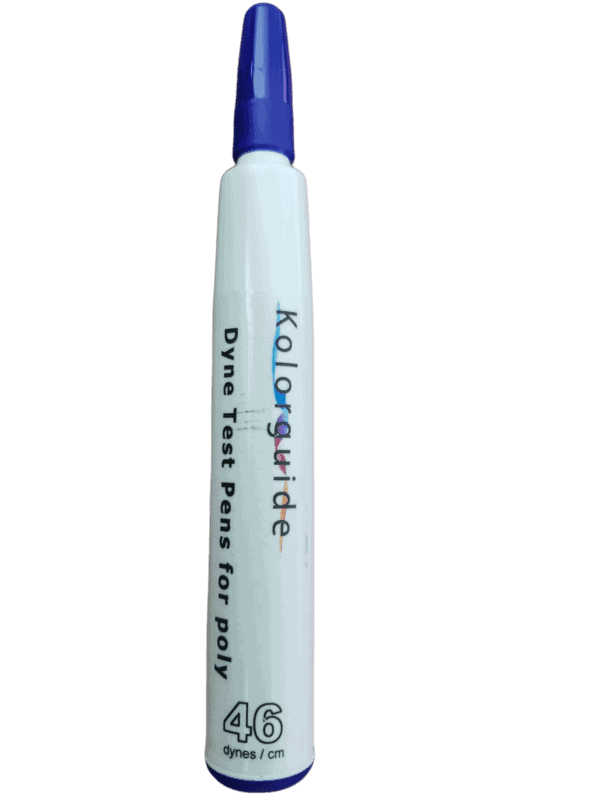
Dyne test pens contain precisely calibrated solutions at specific surface tension levels (typically 30-72 dynes/cm in 2-dyne increments). When applied to a surface:
- If surface energy ≥ pen level: Liquid forms continuous film for 2+ seconds
- If surface energy < pen level: Liquid beads up and retracts
Advantages:
- Quantitative measurement (exact dyne level)
- Fast (results in 2 seconds)
- Non-destructive
- Meets ASTM D2578 and ISO 8296 standards
- Industry-recognized and customer-approved
- Inexpensive and portable
- Creates documented quality records
Procedure:
- Clean test area with isopropyl alcohol
- Allow to dry completely (2-3 minutes)
- Select appropriate dyne pen (typically start with 38 or 40)
- Draw a continuous line 2-3 inches long
- Observe for exactly 2 seconds
- Pass = continuous film; Fail = breaks up or retracts
- Continue testing with higher/lower levels to determine exact value
Application Requirements by Ink Type:
| Application | Minimum Dyne Level | Optimal Dyne Level |
|---|---|---|
| Water-based flexo | 38 dyne/cm | 40-44 dyne/cm |
| Solvent-based flexo | 36 dyne/cm | 38-40 dyne/cm |
| UV flexo | 40 dyne/cm | 42-46 dyne/cm |
| Screen printing | 40 dyne/cm | 42-44 dyne/cm |
| Digital printing | 42 dyne/cm | 44-48 dyne/cm |
| Coating application | 42 dyne/cm | 44-48 dyne/cm |
| Lamination | 42 dyne/cm | 44-48 dyne/cm |
For a detailed explanation of dyne testing procedures, testing standards and troubleshooting methods, see our Complete Guide to Dyne Test Pens.
Contact Angle Measurement (Laboratory Method)
How It Works:
- Drop of liquid placed on surface
- Camera measures angle formed
- Lower angle = higher surface energy
- Typical range: 20-90 degrees
Advantages:
- Very precise
- Can test with different liquids
- Research-grade data
- Useful for material development
Limitations:
- Requires expensive equipment ($5,000-50,000+)
- Not practical for production floor
- Requires trained technician
- Slow (5-10 minutes per test)
- Not suitable for routine quality control
Solutions: Fixing Low Surface Energy
Surface Treatment Methods
Corona Treatment
How It Works: High-frequency electrical discharge creates ionized air molecules that bombard and oxidize the plastic surface, increasing surface energy from ~30 to 38-56 dynes/cm.
Best For:
- High-speed production (inline treatment)
- PE and PP films
- Cost-effective treatment
- Roll-to-roll processes
Considerations:
- Treatment decays over time (test before printing)
- Power settings must match line speed and material
- Requires regular electrode maintenance
- Effectiveness varies by material formulation
Plasma Treatment
How It Works: Ionized gas at low pressure modifies surface at molecular level without affecting bulk properties. More controlled than corona.
Best For:
- Medical devices and critical applications
- Three-dimensional parts
- Precision surface modification
- Low-damage requirements
Considerations:
- More expensive than corona
- Slower processing speeds
- Better for batch processing than continuous
- Superior treatment stability
Flame Treatment
How It Works: Direct oxidation of surface via controlled open flame. Common for blow-molded bottles and containers.
Best For:
- Three-dimensional objects
- Bottles, containers, automotive parts
- Existing production lines (easily retrofitted)
- PE and PP parts
Considerations:
- Safety protocols required
- Environmental controls necessary
- Immediate effect but variable penetration
- Best for parts that rotate through flame
Verifying Treatment Effectiveness
Critical: Always Test After Treatment
Even with proper treatment equipment, surface energy can vary due to:
- Equipment drift or malfunction
- Material formulation changes
- Line speed variations
- Environmental factors (humidity, temperature)
- Additive migration
Testing Protocol:
- Test at start of production run
- Re-test every hour during production
- Test after any equipment adjustment
- Test material if stored more than 24 hours after treatment
- Document all results for quality records
When Treatment Alone Isn’t Enough
signs your corona treatment isn’t working
Contamination Issues:
If dyne testing shows good surface energy but adhesion still fails:
- Check for oil or silicone contamination
- Verify cleanliness of handling equipment
- Examine storage conditions
- Review material supplier quality
Additive Migration:
Some materials are formulated with high levels of slip agents or anti-block additives that continuously migrate to the surface:
- Consider alternative material grades
- Reduce time between treatment and printing
- Use primers or tie coats
- Specify “print-grade” materials from supplier
Material Incompatibility:
Certain material combinations inherently have poor adhesion:
- PP-based inks on PE substrates (or vice versa)
- Incompatible chemistry between ink and substrate
- Consult with ink supplier for compatible systems
Prevention: Implementing Quality Control
Incoming Material Inspection
Test Every Roll/Lot:
- Even “pre-treated” materials decay during shipping and storage
- Supplier treatment may be inadequate for your application
- Establishes baseline for comparison
- Prevents production failures
Documentation:
- Record dyne level, date, lot number
- Track trends over time
- Share data with suppliers for continuous improvement
- Create specifications and acceptance criteria
In-Process Testing
During Production:
- Test at start of each roll
- Re-test every hour or after equipment adjustments
- Test after any interruption in production
- Test if visual appearance changes
Treatment Monitoring:
- Monitor corona power output
- Check for electrode wear or contamination
- Verify line speed matches treatment settings
- Maintain calibration records
Post-Print Verification
Before Release:
- Tape test or crosshatch adhesion test
- Rub resistance testing
- Visual inspection under proper lighting
- Accelerated aging tests for critical applications
Real-World Case Studies
Case Study 1: Flexible Packaging Manufacturer
Problem: Intermittent adhesion failures on pre-treated BOPP film, causing 15% rejection rate and customer complaints.
Root Cause: Dyne testing revealed surface energy varied from 34-42 dynes/cm across rolls from same supplier. Material was specified as “38 dyne minimum treated.”
Solution:
- Implemented incoming inspection with dyne testing
- Rejected material below 40 dynes/cm
- Worked with supplier to improve treatment consistency
- Added inline corona treatment as backup
Results:
- Rejection rate dropped to <2%
- Eliminated customer complaints
- Reduced waste by $50,000/year
- Improved supplier quality over time
Case Study 2: Label Converter
Problem: Water-based inks not adhering to PE labels despite supplier certificate showing “corona treated to 38 dynes.”
Root Cause: Material tested at 36-37 dynes/cm on delivery (decay during shipping/storage). Water-based inks required minimum 40 dynes/cm.
Solution:
- Specified minimum 42 dynes/cm from supplier
- Tested within 24 hours of delivery
- Reduced inventory time
- Implemented inline treatment for aged material
Results:
- Zero adhesion failures
- Eliminated production downtime
- Reduced ink consumption (better wet-out)
- Improved print quality
Common Mistakes to Avoid
Mistake #1: Trusting Supplier Certificates Without Verification
The Problem: Surface treatment decays during shipping and storage. A certificate showing “40 dynes” at time of manufacture may be 34 dynes when it reaches your facility.
The Solution: Always test incoming material regardless of certificates. Use supplier data as reference, not gospel.
Mistake #2: Using Expired or Improperly Stored Dyne Test Pens
The Problem: Dyne test solutions degrade over time. Expired pens give false readings, leading to incorrect decisions.
The Solution:
- Replace dyne pens every 6-12 months
- Store in cool, dark location
- Keep tightly capped when not in use
- Check expiration dates before critical testing
For more information on proper storage and shelf life, see Why Dyne Test Pens Have Only 6 Months Shelf Life.
Mistake #3: Testing Contaminated Surfaces
The Problem: Fingerprints, dust, oils, or processing residues give false low readings, leading to unnecessary re-treatment or material rejection.
The Solution:
- Clean test area with isopropyl alcohol
- Allow to dry completely (2-3 minutes)
- Avoid touching test area
- Use clean, lint-free cloth
Mistake #4: Not Testing After Equipment Changes
The Problem: Corona power settings, line speed changes, or electrode wear can dramatically affect treatment level without obvious visual cues.
The Solution:
- Test after any equipment adjustment
- Monitor treatment power output continuously
- Maintain regular electrode cleaning schedule
- Document settings and results
Mistake #5: Assuming Higher Treatment Is Always Better
The Problem: Over-treatment can damage material properties, cause brittleness, or create unintended surface chemistry issues.
The Solution:
- Treat to application requirement + 2-4 dynes/cm buffer
- Don’t exceed 52-56 dynes/cm for most plastics
- Monitor for physical damage (hazing, brittleness)
- Balance treatment level with material properties
Tools and Resources You Need
Essential Equipment
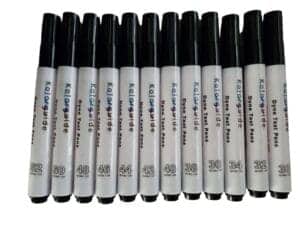
Dyne Test Pen Kit (30-52 dynes/cm)
- Cost: $75-100 for 12-pen set
- Essential for quality control
- ASTM D2578 and ISO 8296 compliant
- 6-12 month shelf life
Isopropyl Alcohol (70% or higher)
- For surface cleaning before testing
- Essential for accurate results
Clean Lint-Free Cloths
- For cleaning test areas
- Prevent contamination
Reference Standards
ASTM D2578: Standard Test Method for Wetting Tension of Polyethylene and Polypropylene Films
ISO 8296: Plastics – Film and Sheeting – Determination of Wetting Tension
ISO 2835: Graphic Technology – Laboratory Preparation of Test Prints – Minimum Surface Energy Requirements
For detailed information on ISO standards and surface energy testing compliance, see our article on ISO Standards, Surface Energy & Print Quality.
Frequently Asked Questions
Q: How long does corona treatment last? A: Surface energy decays gradually after treatment. Typical decay rates:
- 24 hours: 5-10% loss
- 1 week: 10-20% loss
- 1 month: 20-40% loss
- 3 months: 40-60% loss
Always test material before printing, regardless of age since treatment.
Q: Can I over-treat plastic? A: Yes. Excessive treatment can cause:
- Surface damage or hazing
- Brittleness and reduced mechanical properties
- Unintended chemical changes
- Blocking problems
Treat to requirement + small buffer, not maximum possible.
Q: Why does treatment vary across the roll width? A: Common causes:
- Electrode geometry (edges receive different power density)
- Air gap variations
- Material thickness inconsistencies
- Power distribution issues
Solution: Test multiple points across web width and adjust equipment accordingly.
Q: Do all inks need the same surface energy? A: No. Requirements vary by ink chemistry:
- Water-based inks: Need highest surface energy (40-46 dynes/cm)
- Solvent-based inks: Lower requirements (36-40 dynes/cm)
- UV inks: Moderate to high (40-46 dynes/cm)
Always verify requirements with your ink supplier.
Q: Can I test printed surfaces? A: Dyne testing measures substrate surface energy before printing. To test adhesion after printing, use:
- Tape test (ASTM D3359)
- Crosshatch adhesion test
- Rub resistance test
- Pull-off adhesion testing
Q: How do I test three-dimensional parts? A: Dyne test pens work on flat or slightly curved surfaces. For complex 3D parts:
- Test flattest areas available
- Use water break test for general indication
- Consider dyne test fluids (dropper bottle form) for vertical surfaces
Related Technical Resources
If you want to go deeper into surface energy testing and adhesion control, explore these technical resources:
• Surface Energy and Dyne Testing Guide – a complete technical reference with over 100 practical questions.
• How to Use Dyne Test Pens (Step-by-Step Guide) – practical instructions for production floor testing.
• Why Corona Treatment Decays Over Time – understanding treatment loss in plastic films.
• Complete Guide to Dyne Test Pens – standards, testing methods and troubleshooting.
Conclusion: Taking Control of Ink Adhesion
Ink adhesion problems on plastic substrates are frustrating, costly, and often seem unpredictable—but they don’t have to be.
The key insights:
- Surface energy is measurable and controllable – It’s not magic, it’s physics that can be quantified with simple tools.
- Prevention is cheaper than correction – Testing incoming material and monitoring treatment costs pennies compared to rejected production.
- Standards exist for a reason – ISO 8296, ISO 2835, and ASTM D2578 provide proven testing methods and specifications.
- Documentation creates accountability – Recording dyne levels creates data trail for continuous improvement and supplier communication.
Your action plan:
This Week:
- Acquire dyne test pen kit (30-52 dynes/cm range)
- Test current inventory of plastic materials
- Document baseline surface energy levels
This Month:
- Implement incoming material inspection protocol
- Train operators on proper testing procedure
- Establish acceptance criteria for materials
Ongoing:
- Test material before every production run
- Monitor treatment equipment performance
- Track trends and communicate with suppliers
- Review and update specifications regularly
By understanding surface energy, implementing systematic testing, and maintaining proper treatment, you can eliminate ink adhesion problems and achieve consistent, high-quality results.
About Kolorguide
Kolorguide specializes in quality control solutions for the graphic arts and packaging industries. We provide dyne test pens, surface energy testing equipment, and technical guidance to help printers and converters achieve reliable adhesion and consistent quality.
For comprehensive technical information, visit our Complete Guide to Dyne Test Pens.
© 2025 Kolorguide Corp. All rights reserved.
Dyne Test Pens Kit 30-52
Original price was: $99.00.$74.25Current price is: $74.25.