No products in the cart.
Return To ShopAccu Dyne Test Pens SDS
Diversified Enterprises
Diversified Enterprises
1. PRODUCT AND COMPANY IDENTIFICATION
Product identifiers
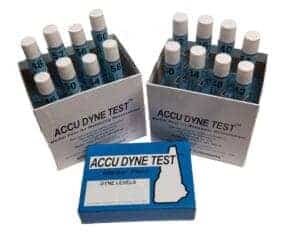
Product name: ACCU DYNE TEST™Marker Pens
SAFETY DATA SHEET
Revision Number: 1
Revision Date: August 26, 2022
Recommended use of product: Surface energy (wettability) measurement of non-absorptive solids
Supplier: DiversifiedEnterprises
101 Mulberry St., Ste 2N Claremont, NH 03743 USA 603-543-0038
Emergency telephone number: Chemtrec 1-800-424-9300
2. HAZARDS IDENTIFICATION
Classification:
2-ethoxyethanol and Methyl Violet 2B are considered hazardous by the 2012 OSHA Standard (29 CFR 1910.1200). Acute toxicity – oral: 2-ethoxyethanol, Category 4; Methyl Violet 2B, Category 4
Acute toxicity – ingestion: 2-ethoxyethanol, Category 4
Acute toxicity – inhalation: 2-ethoxyethanol, Category 4
Serious eye damage Irritation: 2-ethoxyethanol, Category 2B; Methyl Violet 2B, Category 2A Reproductive toxicity: 2-ethoxyethanol, Category 1B; formamide, Category 1B
Specific organ toxicity, repeated exposure: 2-ethoxyethanol, Category 2; formamide, Category 2 Flammable liquids: 2-ethoxyethanol, Category 3
Label elements:
Pictograms: Health Hazard, Exclamation Mark, Flammable
Signal word: Danger.
Hazard statements: •
H222: Flammable liquid and vapor H302: Harmful if swallowed.
H313: Causes eye irritation H332: Harmful if inhaled.
H351 Suspected of causing cancer.
H360 May damage fertility of the unborn child
H373 May cause damage to organs through prolonged or repeated exposure if swallowed
Precautionary statements – Prevention:
P201: Obtain special instructions before use.
P202: Do not handle until all safety precautions have been read and understood P210: Keep away from heat, sparks, or open flames.
P233: Keep container tightly closed.
P264: Wash hands and face thoroughly after handling P270: Do not eat, drink or smoke when using this product P271: Use only in a well-ventilated area.
P280: Wear long-sleeved clothing and gloves
Precautionary statements • Response:
If in eyes: Rise with water for several minutes. Remove contact lenses, if present and easy to do. Continue rinsing. If irritation persists get
medical attention.
If on skin: Remove all contaminated clothing immediately. Rinse skin with water. If skin irritation occurs, get medical attention. If swallowed: Call a poison center or physician if you feel unwell.
Precautionary statements• Disposal:
P501: Dispose of contents/container to an approved waste disposal plant
3. COMPOSITION/INFORMATION ON INGREDIENTS
Constituent
2-ethoxyethanol, Reagent Grade (C)* Formamide, ACS Reagent Grade (F)** Water. Reagent Grade (H)
Methyl Violet 28
CASNo.
110-80-5
75-12-7
7732-18-5
8004-87-3
Concentration
See below See below See below
3.0 grams iter (0.3% wlv)
* 2-ethoxyethanol is also known as ethylene glycol monomethyl ether, cellosolve solvent. ethyl cellosolve, and glycol ether EE
** Formamide is also known as methanamide.
Volumetric Mix Percentages by Dyne Level
| Level | C | F | Level | C | F | Level | F | H |
| 30 | 100.0% | 0.0% | 44 | 22.0% | 78.0% | 57 | 100.0% | 0.0% |
| 31 | 97.5% | 2.5% | 45 | 19.7% | 80.3% | 58 | 81.2% | 18.8% |
| 32 | 89.5% | 10.5% | 46 | 17.2% | 82.8% | 59 | 73.1% | 26.9% |
| 33 | 81.0% | 19.0% | 47 | 15.0% | 85.0% | 60 | 65.0% | 35.0% |
| 34 | 73.5% | 26.5% | 48 | 13.0% | 87.0% | 61 | 56.0% | 44.0% |
| 35 | 65.0% | 35.0% | 49 | 11.1% | 88.9% | 62 | 47.0% | 53.0% |
| 36 | 57.5% | 42.5% | 50 | 9.3% | 90.7% | 63 | 38.8% | 61.2% |
| 37 | 51.5% | 48.5% | 51 | 7.8% | 92.2% | 64 | 30.6% | 69.4% |
| 38 | 46.0% | 54.0% | 52 | 6.3% | 93.7% | 65 | 24.4% | 75.6% |
| 39 | 41.0% | 59.0% | 53 | 4.9% | 95.1% | 66 | 18.2% | 81.8% |
| 40 | 36.5% | 63.5% | 54 | 3.5% | 96.5% | 67 | 13.4% | 86.6% |
| 41 | 32.5% | 67.5% | 55 | 2.2% | 97.8% | 68 | 8.6% | 91.4% |
| 42 | 28.5% | 71.5% | 56 | 1.0% | 99.0% | 69 | 6.1% | 93.9% |
| 43 | 25.3% | 74.7% | 70 | 3.6% | 96.4% | |||
| 72 | 0.0% | 100.0% |
4. ARST AID MEASURES
General Advice: Poison information centers in each State capital city can provide additional assistance for scheduled poisons (13 1126).
Skin contact: Remove contaminated clothing. Wash exposed area with soap and water. Rinse thoroughly. If irritation persists or if contact has been prolonged, seek medical attention. Launder clothing before re-use.
Eye contact: Gently rinse eyes for 15 minutes. Consult a physician. Move individuals into fresh air.
Inhalation: Move individual into fresh air. If breathing is difficult. oxygen may be given by qualified personnel. Seek immediate medical attention.
Ingestion:: Do not induce vomiting without medical advice. Consult a physician.
Most important symptoms and effects, both acute and delayed: Irritating to eyes. May cause slight skin irritation. Central neNous system effects. Ingestion may cause gastrointestinal irritation, nausea, vomiting, and diarrhea. May affect the liver. May affect the kidneys. May affect the blood. May affect the bone marrow. May affect respiration. May affect fertility or cause teratogenic effects.
Indication of any immediate medical attention and special treatment needed: No data available.
5. FIRE FIGHTING MEASURES
Suitable extinguishing media: Carbon dioxide. alcohol-resistant foam, dry chemical, or water spray.
Unsuitable extinguishing media: No data available.
Special hazards arising from the substance: 2-ethoxyethanol is flammable. It may be ignited by heat. sparks, or flames. Most vapors are heavier than air. They will spread along the ground and collect in low or confined areas.
Advice for firefighters: Wear self-contained brathing apparatus for firefighting if necessary.
6. ACCIDENTAL RELEASE MEASURES
Personal precautions: Use personal protective equipment. Ensure adequate ventilation. Avoid breathing vapors.
Environmental precautions: Prevent futher leakage or spillage if safe to do so. Do not let product enter drains.
Methods and materials for cleaning up: Soak up with inert absorptive material and put into a suitable chemical waste disposal container.
7. HANDLING AND STORAGE
Precautions for safe handling: Avoid contact with skin and eyes. Avoid inhalation of vapor.
Conditions for safe storage: Keep bottles securely closed in a dry. well-ventilated place when not in use. Avoid strong oxidizing agents.
8. EXPOSURE CONTROLS/PERSONAL PROTECTION
Components with workplace control parameters:
2-ethoxyethanol:
OSHA Table Z-1 – 200 ppm TWA
ACGIH TLV- 5 ppm TWA
Formamide:
OSHATableZ-1-20ppmTWA ACGIH TLV-10 ppm TWA
Appropriate engineering controls: Ensure adequate ventilation. Handle in accordance with good industrial hygiene and safety practice.
Personal protective equipment:
Eye protection: Safety glasses.
Skin protection: Long-sleeved clothing. Gloves.
Hygiene measures: Avoid contact with skin, eyes, and clothing. Wash hands before breaks and immediately after handling product. Do not eat. drink, or smoke while using these test fluids.
9. PHYSICAL AND CHEMICAL PROPERTIES
Appearance and form: Blue-violet liquid Odor: Mild. slightly sweet to ammoniacal Odor threshold: No data available.
pH: No data available.
Evaporation rate: No data available.
Other properties:
| Freezing/melting point -90 C 2C oc 137C Boiling point 135C 210C 100C no data Flash point closed cup 43C 150C n/a n/a Autoignition temperature 235C no data n/a n!a Flammability/explosion limits 1.8-14.0% 2.7-19.0% n/a nia Vapor pressure@ 20C 5.05hPa 0.11 hPa 3.11 hPa n/a Vapor density (air = 1.0l 3.11 1.56 no data n1a Specific density @ 20C 0.929 1.134 0.998 nia Solubility in water miscible miscible n1a miscible |
Property
2-ethoxyethanol
Formamide
Water Methyl Violet 2B
Partition coefficient Decomposition temperature Molecular weight
-0.32
no data 90.12
no data
>180C 45.04
nia n!a
n/a no data
18.0i 393.96
10. STABILITY AND REACTIVITY
Reactivity Reacts with strong oxidizing agents.
Chemical stability: Stable under recommended storage conditions.
Possibility of hazardous reactions: No data available.
Conditions to avoid: Excessive heat, ignition sources, incompatible materials.
Incompatible materials: Strong oxidizing agents, strong bases, hydrogen peroxide, iodine, pyridine, sulfur oxides.
Hazardous decomposition products: No data available.
11. TOXICOLOGICAL INFORMATION
The most likely route of entry is by dermal absorption. Routes of entry include eye and skin contact, ingestion, and inhalation. Specific health effects are broken out by the two primary ingredients.
2-ethoxyethanol:
LOSO oral rat= 1746 mg/kg (EU Commission dataset) LOSO oral mouse= 2451 mg/kg (RTECS)
LOSO dermal rabbit= 3300 mg/kg (LOLI, EU Commission dataset and RTECS) LC50 inhalation rat = 4267 ppm 4 h: 15 mg/I 4 h
LCSO inhalation mouse= 1820 ppm 7 h
Carcinogenic effects: Not considered carcinogenic. Not listed by ACGIH, IARC, NTP, or OSHA HCS. Mutagen effects: May affect genetic material based on animal test data.
Reproductive effects: May cause adverse reproductive effects. May impair fertility. Teratogenic effects: May cause birth defects.
Specific target organ toxicity, single exposure: No information available.
Specific target organ toxicity, repeated exposure: May cause damage to central neNous system, blood, kidneys, liver, bone marrow. Aspiration hazard: No data available.
Formamide:
LOSO oral rat= 5,325 mg/kg (OECO Test Guideline 401) LCSO inhalation rat= 21 mg/I 4 h (OECO Test Guideline 403) LOSO dermal rat= >3,000 mg/kg
Carcinogenic effects: Not identified as probable, possible, or confirmed human carcinogen by IARC. ACGIH, NTP, or OSHA. Mutagenic effects: Mouse, male and female by micronucleus test – negative.
Reproductive effects: Presumed human reproductive toxicant. Teratogenic effects: May cause birth defects.
Specific target organ toxicity, single exposure: No information available.
Specific target organ toxicity, repeated exposure: Oral – may cause damage to blood or organs through prolonged or repeated exposure. Aspiration hazard: No data available.
12. ECOLOGICAL INFORMATION
2-ethoxyethanol:
Freshwater algae: 1,000 mg/I EC50 Desmodesmus subspicatus 72 h. Freshwater fish: 10,000 mg/I LCSO Lepomis macrochirus 96 h static 1. Water flea: 10,000 mg/I EC50 Daphnia magna 48 h.
Persistence and degradability: No data available.
Bio accumulative potential: Potential for bioconcentration in aquatic organisms is low. Mobility Expected to have high mobility in soil.
Formamide:
Freshwater algae: >500 mg/I ECSO Desmodesmus subspicatus 72 h. Freshwater fish: 6,569 mg/I LCSO Leuciscus idus 96 h.
Water flea: >500 mg/I ECSO Daphnia magna 72 h.
Persistence and degradability: Aerobic – exposure time 28 d: 99% readily biodegradable (OECO Test Guideline 301A). Bio accumulative potential: No data available.
Mobility: No data available.
13. DISPOSAL CONSIDERATIONS
Waste must be disposed of in accordance with federal, state, and local environmental control regulations.
Spent material samples must be handled with care. Disposal of these contaminated materials also presents exposure hazards, and should not be handled without gloves or in areas with poor ventilation.
14. TRANSPORT INFORMATION DOT
UN No.: UN 1171
Proper shipping name: Ethylene glycol monomethyl ether Hazard class: 3
Packing group: Ill ERG No.: 127
Symbol: R4
ADA, RID, ICAO, TOO (Canadá)
UN No.: UN 1171
Proper shipping name: Ethylene glycol monomethyl ether Hazard class: 3
Packing group: Ill
IMO/IMDG
UN No.: UN 1171
Proper shipping name: Ethylene glycol monomethyl ether Hazard class: 3
Packing group: Ill EMS: F-E
IATA
UN No.: UN 1171
Proper shipping name: Ethylene glycol monomethyl ether Hazard class: 3
Packing group: Ill ERG Code: 3L
15. REGULATORY INFORMATION
SARA Title 111, Section 302 Components: None SARA 313 Components: 2-ethoxyethanol
SARA 311/312 Hazards Acute health hazard, chronic health hazard, fire hazard
Inventories:
U.S. TSCA: 2-ethoxyethanol present, Section 5(a)2: 40 CFR 721.10001 Canada DSL:2-ethoxyethanol present
Korea KECL: 2-ethoxyethanol present KE-13667 Philippines (PICCS): 2-ethoxyethanol present
Japan ENCS: 2-ethoxyethanol present (7)-97 (2)-411 (2)-2424 China: 2-ethoxyethanol present
Australia (AICS): 2-ethoxyethanol present EINECS No.: 2-ethoxyethanol present 203-804-1
California Directors List of Hazardous Substances: 2-ethoxyethanol resent
California Proposition 65: 2-ethoxyethanol is known to the State of California to cause birth defects or other reproductive harm. Massachusetts RTK: 2-ethoxyethanol. formamide present
Minnesota: 2-ethoxyethanol present
New Jersey RTK and (EHS) List: 2-ethoxyethanol, formamide present Pennsylvania RTK: 2-ethoxyethanol, formamide present
Rhode Island RTK: 2-ethoxyethanol present
CERCLAISARA: Reportable quantity, 2-ethoxyethanol = 1.000 lb.
Canada WHMIS hazard class: 2-ethoxyethanol – B3, D1B. O2A, D2B. Classified according to the hazard criteria of the CPR
EU classification: 2-ethoxyethanol – R10, R60. R61. R20/22, S53, S45, Xn. Classified in accord with Annex VI to Directive 67/548/EEC
Indication of danger: Xn – Harmful
16. OTHER INFORMATION
Copyright 2015 Diversified Enterprises
License Is granted to make unlimited paper copies for internal use only.
The above information is believed to be correct but does not claim to be all-inclusive and is to be used only as a guide. This information should not be taken as a warranty for which Diversified Enterprises assumes legal responsibility. It is provided solely for consideration, investigation, and verification. The information contained in this document is based on our current understanding of available data and is applicable to the product with regard to appropriate safety precautions. It is the user’s responsibility to develop proper methods based on the actual conditions of use.