
No products in the cart.
Return To Shop
Cup Zahn: Viscosity Measurement Guide for Professionals
Professionals in industries from automotive to chemical processing rely on viscosity measurements to make sure products perform flawlessly. It sounds simple—just time how fast a liquid drains through a cup. But the timing difference between a paint that flows perfectly and one that ruins a car finish can be as little as one or two seconds. Here is what nobody expects: choosing the wrong cup or skipping a single calibration can throw off entire production lines and cost thousands. Get ready to see why precision with Cup Zahn is more crucial than anyone realizes.
Table of Contents
- Understanding Cup Zahn And Its Applications
- How To Use Cup Zahn For Accurate Measurements
- Choosing The Right Cup Zahn For Your Industry
- Maintenance And Troubleshooting For Long-Life Performance
Quick Summary
| Takeaway | Explanation |
|---|---|
| Select the correct Zahn cup size. | Choose from sizes #1 to #5 for accurate viscosity measurements based on the liquid’s characteristics. |
| Maintain temperature consistency during tests. | Conduct viscosity measurements at around 77 degrees Fahrenheit to ensure reliable, reproducible results. |
| Follow a systematic measurement procedure. | Adhere to established steps to minimize variations and achieve accurate viscosity readings. |
| Implement regular cleaning and calibration. | Ensure measurement accuracy by routinely cleaning the Zahn cup and verifying its calibration with standard reference liquids. |
| Troubleshoot performance issues effectively. | Identify and address common challenges in viscosity measurement to enhance accuracy and reliability. |
Understanding Cup Zahn and Its Applications
Cup Zahn viscosity measurement represents a critical technique for professionals across multiple industries who require precise fluid consistency evaluations. These specialized measuring instruments provide engineers, chemists, and manufacturing experts with a standardized method for determining the flow characteristics of liquids quickly and accurately.
The Science Behind Cup Zahn Measurements
Zahn cups function as elegant yet straightforward viscosity testing devices designed to measure the time required for a specific volume of liquid to flow through a precisely calibrated orifice. ASTM International has established comprehensive standards that define the exact specifications for these measurement tools, ensuring consistent and reliable results across different applications.
The fundamental principle involves filling the cup with a liquid and measuring the exact time it takes for the fluid to drain completely through a small hole at the bottom. This drainage time directly correlates with the liquid’s viscosity, providing professionals with a rapid assessment of fluid properties. Different cup sizes and designs accommodate various liquid types, from thin coatings to thick industrial fluids.
Industrial Applications and Precision
Professionals in numerous sectors rely on cup Zahn measurements for quality control and product development. Industrial Coating Magazine highlights that industries such as automotive, aerospace, paint manufacturing, and chemical processing depend on these precise viscosity evaluations.
Typical applications include:
- Coating Verification: Ensuring consistent paint and liquid coating viscosities
- Quality Control: Monitoring production liquid properties
- Research Development: Analyzing fluid behavior under different conditions
Engineers use Zahn cups to determine whether a liquid meets specific performance standards, checking if its flow characteristics align with design requirements. The measurement provides instant insights into potential variations that might affect product performance, allowing immediate adjustments in manufacturing processes.
Technical Considerations and Accuracy
Accurate cup Zahn measurements require careful technique and understanding of environmental factors. Temperature, for instance, significantly influences viscosity readings. Professionals must maintain consistent test conditions, typically around 77 degrees Fahrenheit, to ensure reproducible results.
The selection of the appropriate cup size becomes crucial. Standard Zahn cups range from #1 to #5, with each size optimized for different liquid viscosities. Selecting the wrong cup can lead to inaccurate measurements, underscoring the importance of technical expertise in viscosity testing.
While seemingly simple, cup Zahn viscosity measurement represents a sophisticated technique that bridges scientific precision with practical industrial applications. By providing a standardized, quick method for assessing liquid flow characteristics, these tools continue to play an essential role in quality control and product development across multiple professional domains.
How to Use Cup Zahn for Accurate Measurements
Precision in viscosity measurement requires a systematic approach and thorough understanding of cup Zahn techniques. Professionals must follow specific protocols to ensure reliable and reproducible results across various industrial applications.
Preparation and Equipment Setup
Before conducting a viscosity test, Paint Technology International recommends comprehensive preparation. Select the appropriate Zahn cup based on the expected liquid viscosity range. Cups are numbered from #1 to #5, with each size designed for specific fluid characteristics.
Essential equipment includes:
- Zahn cup: Precisely calibrated measurement tool
- Stopwatch: Accurate timing device
- Thermometer: For monitoring ambient temperature
- Clean surface: Flat and level testing area
Ensure all equipment is clean and free from previous liquid residues. Temperature plays a critical role in viscosity measurements, so maintain a consistent environment around 77 degrees Fahrenheit for standardized results.
Step by Step Measurement Procedure
Industrial Coating Research Center outlines a detailed protocol for accurate cup Zahn viscosity testing:
- Fill the cup completely with the test liquid, ensuring no air bubbles are trapped
- Position the cup vertically over a clean surface
- Simultaneously open the cup’s bottom orifice and start the stopwatch
- Observe and record the exact time required for the liquid to completely drain
- Repeat the measurement multiple times to validate consistency
Professionals typically conduct three to five trials, calculating the average drainage time. This approach minimizes potential measurement variations and provides a more reliable viscosity assessment.
For quick reference, here is a step-by-step process table outlining the recommended protocol for accurate cup Zahn viscosity measurement based on the provided procedure in the article.
| Step | Action | Key Details/Reminder |
|---|---|---|
| 1 | Fill the cup completely with test liquid | Avoid air bubbles |
| 2 | Position the cup vertically over a clean surface | Ensure stable and level placement |
| 3 | Open the bottom orifice and start stopwatch simultaneously | Timing accuracy is crucial |
| 4 | Observe and record time for complete drainage | Measure to the nearest tenth of a second |
| 5 | Repeat the measurement multiple times | Typically 3–5 trials for consistency |
Interpreting and Reporting Results
Viscosity measurements require careful interpretation. The drainage time directly correlates with the liquid’s flow characteristics. Longer drainage times indicate higher viscosity, while shorter times suggest thinner liquids.
Key considerations when reporting results include:
- Precise timing: Record measurements to the nearest tenth of a second
- Temperature notation: Always include ambient temperature
- Cup size: Specify the exact Zahn cup used
- Liquid composition: Note any relevant details about the tested substance
Standardized reporting ensures that other professionals can understand and potentially replicate the viscosity measurement under similar conditions. Industries like automotive coatings, paint manufacturing, and chemical processing rely on these precise and consistent measurement techniques to maintain quality control and product performance standards.
Mastering cup Zahn viscosity measurement requires practice, attention to detail, and a systematic approach. By following established protocols and understanding the nuanced factors affecting liquid flow, professionals can obtain accurate and reliable viscosity assessments across diverse industrial applications.
Choosing the Right Cup Zahn for Your Industry
Selecting the appropriate cup Zahn for viscosity measurement requires a nuanced understanding of industry-specific requirements and liquid characteristics. Professionals must carefully evaluate multiple factors to ensure accurate and reliable viscosity assessments across diverse applications.
Viscosity Range and Cup Specifications
Paints and Coatings Resource Center provides critical guidance for cup selection based on specific viscosity ranges. Each Zahn cup is designed to optimize measurements within a particular fluid consistency spectrum, ranging from thin liquids to more substantial industrial compounds.
Zahn cups are typically numbered from #1 to #5, with each size tailored for specific viscosity ranges:
To help professionals quickly identify the right Zahn cup for various liquid viscosities, the following table summarizes the different cup sizes and their typical applications as described in the article.
| Zahn Cup Size | Ideal Viscosity Range | Typical Applications |
|---|---|---|
| #1 | Extremely low viscosity liquids | Thin coatings, solvents |
| #2 | Low viscosity | Light coatings, thin industrial fluids |
| #3 | Medium viscosity | General coatings, medium-viscosity materials |
| #4 | High viscosity | Thick industrial liquids, heavy coatings |
| #5 | Very high viscosity | Very thick or paste-like substances |
- Zahn #1 Cup: Ideal for extremely low viscosity liquids
- Zahn #2 Cup: Recommended for light coatings and thin industrial fluids
- Zahn #3 Cup: Suitable for medium viscosity materials
- Zahn #4 and #5 Cups: Designed for thick industrial liquids and heavy coatings
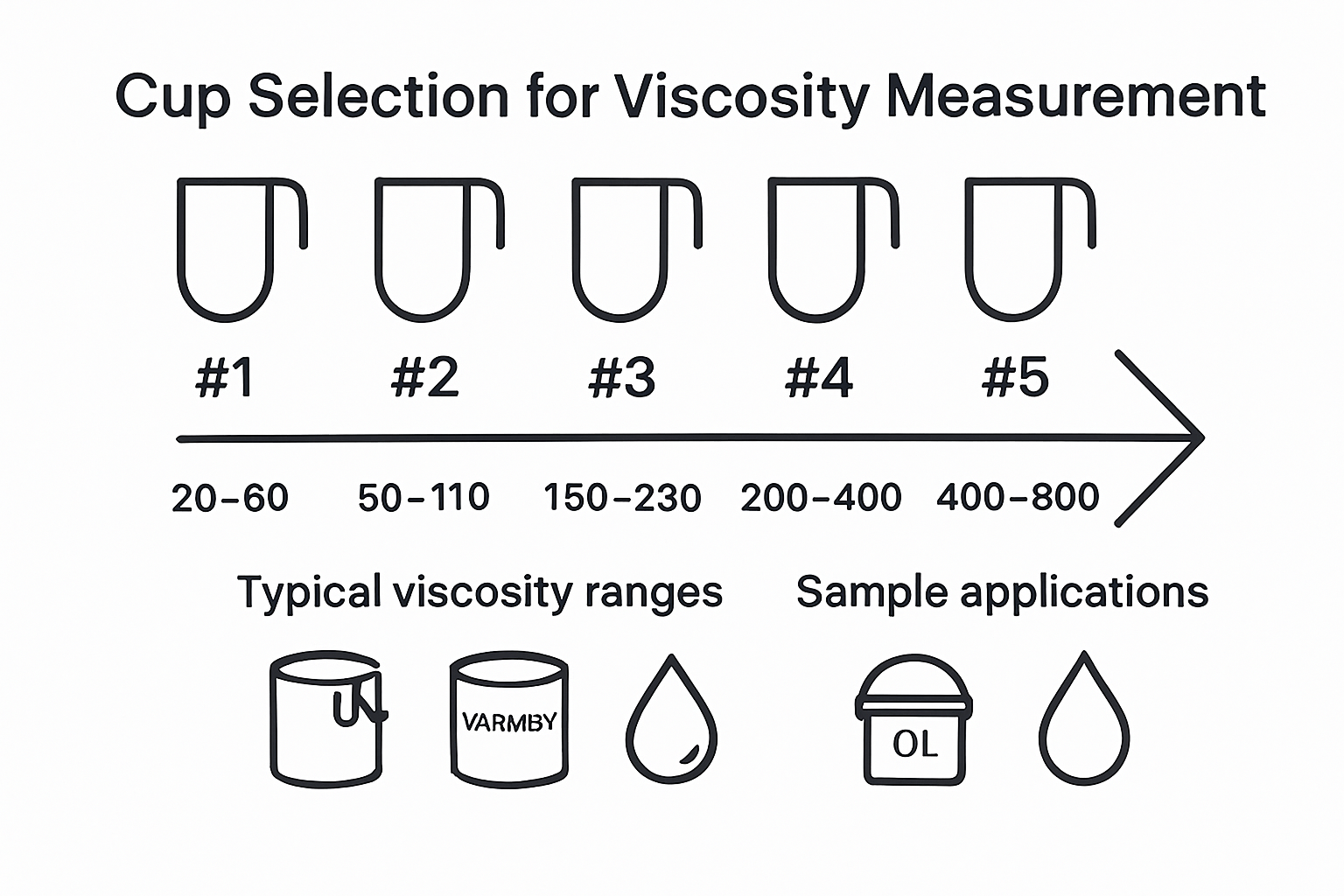
The critical consideration is selecting a cup that allows the liquid to flow smoothly while providing accurate measurement timing. Industrial Coating Research emphasizes that choosing the wrong cup can introduce significant measurement errors, potentially compromising quality control processes.
Industry-Specific Selection Criteria
Different industries require specialized viscosity measurement approaches. Automotive manufacturers, for instance, need precise coating viscosity measurements, while chemical processing demands exact fluid flow characterization.
Key selection considerations include:
- Liquid Composition: Chemical properties and molecular structure
- Operating Temperature: Impact of environmental conditions
- Intended Application: Specific performance requirements
- Measurement Precision: Required accuracy level
Professionals must consider the entire measurement context. A paint formulation requiring coating application might need a different cup than a lubricant used in mechanical systems. The goal is to match the cup’s characteristics with the liquid’s specific flow properties.
Practical Measurement Optimization
Optimal cup Zahn selection involves more than simply matching viscosity ranges. Professionals should conduct multiple trials, comparing results across different cup sizes to ensure the most accurate representation of liquid behavior.
Advanced techniques include:
- Multiple Measurement Trials: Conducting repeated tests
- Temperature Normalization: Accounting for environmental variations
- Comparative Analysis: Cross-referencing results with alternative measurement methods
The nuanced process of selecting the right cup Zahn requires technical expertise and a comprehensive understanding of fluid dynamics. By carefully evaluating liquid properties, industry requirements, and measurement objectives, professionals can achieve precise viscosity assessments that support critical quality control and product development processes.
Ultimately, cup Zahn selection is a sophisticated decision-making process that combines scientific knowledge, practical experience, and a deep understanding of industrial fluid characteristics. Professionals who master this skill can significantly enhance their ability to ensure product quality and performance across multiple industrial domains.
Maintenance and Troubleshooting for Long-Life Performance
Maintaining cup Zahn equipment requires meticulous attention to detail and a systematic approach to preserve measurement accuracy and instrument longevity. Professionals must implement comprehensive maintenance strategies to ensure consistent performance across industrial applications.
Cleaning and Preservation Techniques
Modern Physics Research emphasizes the critical importance of proper cleaning procedures for cup Zahn instruments. Residual liquid particles can significantly compromise measurement precision and potentially damage the cup’s calibrated orifice.
Essential cleaning protocols include:
- Immediate Rinse: Clean the cup immediately after each use
- Solvent Selection: Use appropriate solvents compatible with the tested liquid
- Careful Handling: Avoid scratching or damaging the cup’s interior surface
- Thorough Drying: Ensure complete moisture removal before storage
Professionals should develop a standardized cleaning routine that matches the specific liquid properties and cup material. Certain solvents might interact differently with various coating compositions, requiring tailored cleaning approaches.
Calibration and Performance Verification
American Coatings Association recommends periodic calibration to maintain measurement integrity. Regular performance checks help identify potential measurement drift or instrumental wear that could compromise viscosity assessments.
Key calibration procedures include:
- Periodic Inspection: Check cup orifice for wear or damage
- Standard Reference Liquids: Use certified viscosity standards for verification
- Comparative Measurements: Cross-reference results with alternative measurement methods
- Documentation: Maintain detailed records of calibration activities
Typical calibration intervals depend on usage frequency and industrial environment. High-stress industrial settings might require more frequent verification compared to controlled laboratory conditions.
Troubleshooting Common Performance Issues
Paints and Coatings Resource Center identifies several common challenges professionals encounter during cup Zahn viscosity measurements. Understanding these potential issues allows for rapid diagnosis and corrective action.
Common troubleshooting scenarios include:
- Inconsistent Drainage Times: Potential cup damage or liquid contamination
- Unexpected Viscosity Variations: Environmental temperature fluctuations
- Measurement Errors: Improper cup selection or cleaning procedures
- Orifice Blockage: Accumulated residue affecting flow characteristics
Successful troubleshooting requires a systematic approach. Professionals should first isolate the potential source of measurement variation, then implement targeted corrective strategies.
Maintaining cup Zahn equipment is not merely a technical requirement but a critical component of professional quality control. By implementing rigorous cleaning protocols, conducting regular calibrations, and developing robust troubleshooting skills, professionals can ensure their viscosity measurement tools deliver consistent, reliable performance across diverse industrial applications.
The investment in proper maintenance extends beyond equipment preservation. It directly impacts product quality, research accuracy, and overall operational efficiency across multiple professional domains.

Frequently Asked Questions
What is a Cup Zahn and how is it used?
A Cup Zahn is a viscosity measurement tool used to determine the flow characteristics of liquids by timing how long it takes for a specific volume of liquid to drain through a calibrated orifice. It helps professionals assess fluid consistency across various industries.
How do I ensure accurate viscosity measurements with a Cup Zahn?
To ensure accurate measurements, consistently maintain a temperature of around 77 degrees Fahrenheit during tests, select the correct Zahn cup size based on the liquid’s viscosity, and follow a systematic measurement procedure that includes multiple trials for verification.
What are the different sizes of Cup Zahn cups?
Cup Zahn cups range from #1 to #5, with each size optimized for specific viscosity ranges. For instance, size #1 is used for extremely low viscosity liquids, while size #5 is suited for very high viscosity or paste-like substances.
How should I maintain and clean my Cup Zahn for long-term performance?
To maintain your Cup Zahn, clean it immediately after each use with appropriate solvents, avoid scratching its interior surface, and ensure it is thoroughly dried before storage. Regular calibration checks with standard reference liquids are also essential to verify its performance.
Elevate Viscosity Accuracy with Professional Color Management Tools
Are you tired of inconsistent viscosity readings ruining the quality of your coatings and print jobs? The article on Cup Zahn viscosity measurements highlights how even a single misstep in precision can impact results, bringing costly errors and wasted materials. At Kolorguide.com, we understand that professionals like you need reliable, scientifically calibrated tools not just to measure but also to manage consistency and color fidelity in every project. When you use accurate viscosity measurements, pairing them with top-tier color guides and management solutions ensures final products always meet the highest industry standards.
Make your next production run your best ever. Shop trusted color management tools and Pantone guides built for exacting professionals. Discover why leading printers, designers, and manufacturers rely on Kolorguide.com for fast USA delivery, multiple payment options, and outstanding service. Visit Kolorguide.com now to experience hassle-free shopping and invest in quality solutions before your next deadline strikes.

