
No products in the cart.
Return To ShopCorona treatment is not eternal and Why Geography is Killing Your Surface Tension (and Your Profits)
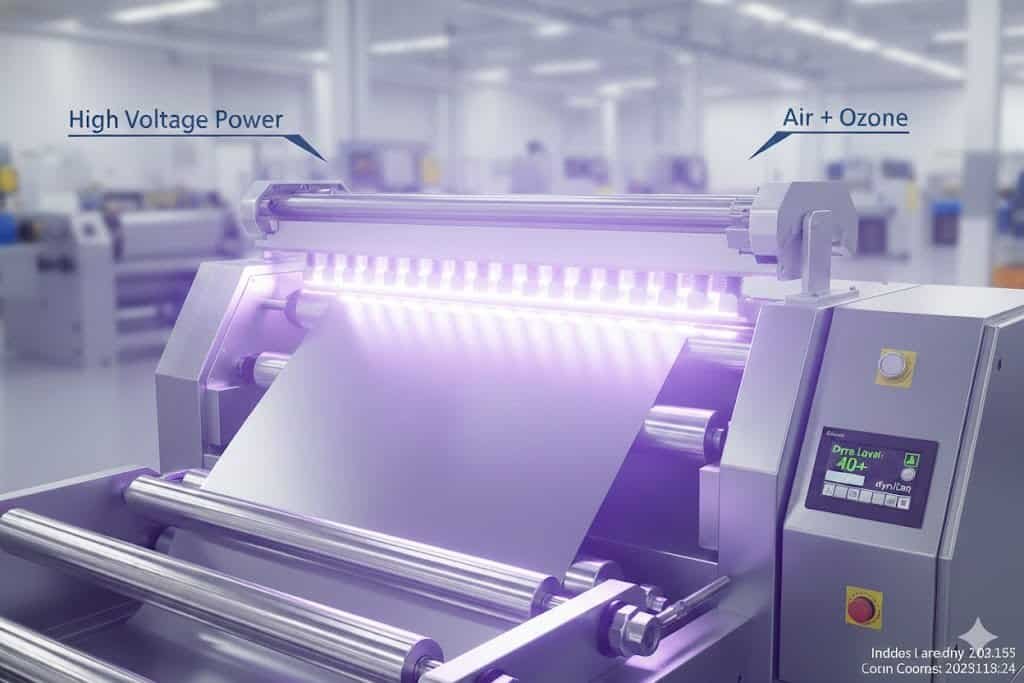
At Kolorguide, we live by one technical truth: “Corona treatment is not eternal; it is an unstable physical state that tends to decay.”
Have you ever wondered why a film that left extrusion at 42 dynes arrives at your press at 34 dynes, forcing you to stop production?
The answer isn’t just chemistry—it’s a mix of geography and physics. The Science: Molecular “Flipping”
Corona discharge oxidizes the film’s surface to ensure ink anchorage. But those molecules are unstable. Over time, they rotate toward the interior of the material seeking equilibrium—a process known as “molecular flipping.” Add slip agents to the mix, and you get an invisible waxy layer that migrates to the surface, effectively “killing” your treatment.
The Geographic Factor: Location Matters
The speed of this decay depends heavily on where your plant is located:
High Humidity (Amazon, Central America): Moisture accelerates the loss of surface receptivity. Treatment can vanish in weeks.
Extreme Heat (Deserts, Tropical Zones): Heat acts as a catalyst, pushing waxes and additives to the surface much faster than in temperate climates.
The Financial Reality: Data vs. Waste
In the packaging conversion world, relying on the supplier’s label is a high-risk gamble.
“EITHER YOU HAVE DATA, OR YOU HAVE WASTE.”
A discrepancy of just 3 dynes is the thin line between a perfect run and a massive client rejection. If you aren’t measuring right before the ink hits the substrate, you are risking your margins.
The Kolorguide Conclusion:
Treatment is perishable. Whether your plant is in a humid, dry, or hot zone, the only way to ensure quality is through constant measurement at the press side.
IF YOU DON’T MEASURE IT, IT’S USELESS.
