No products in the cart.
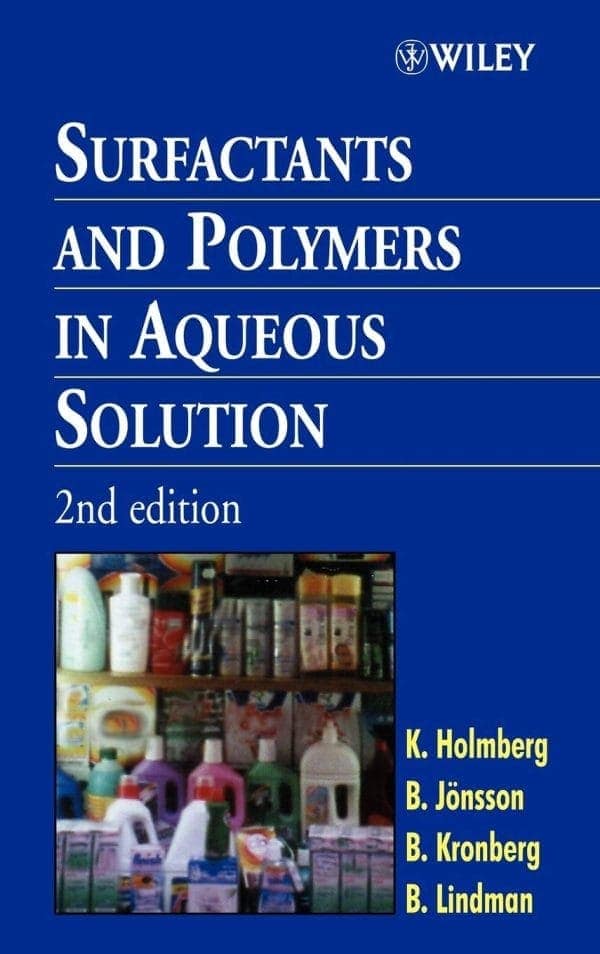
Return To ShopSurfactants and Polymers in Aqueous Solution 2nd Edition
Krister Holmberg (Author), Bo Jonsson (Author), Bengt Kronberg (Author), Björn Lindman (Author)
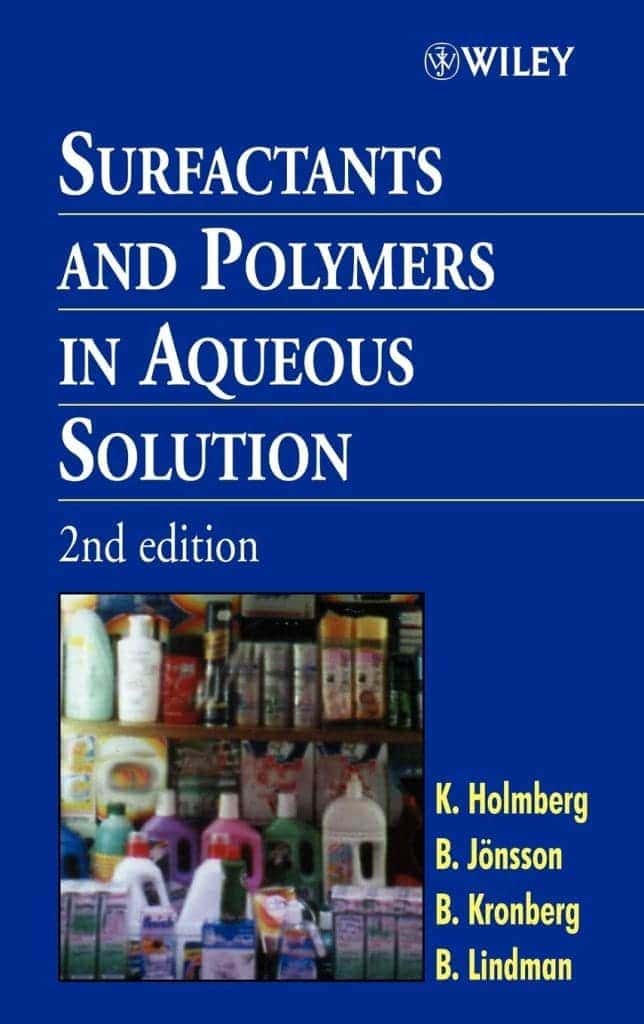
A Complete Guide to Modern Surface Chemistry
In industries such as detergents, paints, inks, coatings, cosmetics, food chemistry, and pharmaceuticals, the interaction between surfactants and polymers defines the performance and stability of countless formulations. The book Surfactants and Polymers in Aqueous Solution (2nd Edition) is one of the most respected references in the field, offering a broad and detailed view of how these materials behave in water-based systems.
A Complete Overview of Surfactants and Modern Preparation Methods
The authors introduce all major surfactant classes and their synthetic routes, including a newly added chapter dedicated to novel surfactants and recent advances in molecular design. From ionic and non-ionic surfactants to amphoteric and polymeric species, the book provides a strong theoretical foundation paired with practical industrial examples.
Self-Assembly, Adsorption, Gel Formation, and Foaming
One of the core strengths of this reference is its clear explanation of physicochemical phenomena such as micelle formation, adsorption mechanisms, gel structures, and foaming behavior—critical parameters in any formulation involving surface-active materials.
Deep Dive into Polymer–Surfactant Interactions
Polyoxyethylene-based systems receive special attention due to their widespread industrial use. The book also explores surface-active polymers and their interactions with surfactants, a topic essential for formulators working on detergents, personal care products, inks, and stabilizers.
Protein–Surfactant Interactions
The second edition introduces a complete chapter dedicated to protein–surfactant interactions, highlighting their role in food science, biotechnology, pharmaceuticals, and specialty formulations.
Microemulsions, Emulsions, and Applications
Microemulsions are analyzed in depth, covering formulation strategies, stability considerations, and their use as media for chemical reactions. Emulsion selection and emulsifier choice—fundamental topics for coatings, paints, cosmetics, and food products—are also detailed.
Rheology and Wetting
Newly expanded chapters explain how surfactants and polymers influence viscosity, flow behavior, and wetting properties, helping formulators predict and control product performance.
Who Should Read This Book?
This reference is ideal for:
- Surface chemistry researchers
- Industrial formulators in detergents, coatings, inks, cosmetics, and foods
- Polymer scientists
- Chemical engineers working with emulsions, microemulsions, and aqueous systems
With its combination of theoretical depth and real-world application, Surfactants and Polymers in Aqueous Solution remains an essential tool for anyone involved in modern formulation science.

About author
Related posts

by Geoffrey Holden Thermoplastic Elastomers (TPEs): A Complete Modern Guide to Structure, Processing, and Applications Thermoplastic elastomers (TPEs) represent one of the fastest-growing sectors in... Continue reading