
No products in the cart.
Return To Shop
The Complete Guide to Dyne Test Pens: Surface Energy Testing & Hi-Res Precision (Updated 2026).
A comprehensive technical resource combining scientific foundation with practical application
Introduction
In the competitive world of printing and packaging, quality control is non-negotiable. Yet one critical factor often goes overlooked until problems arise: surface energy. Whether you’re printing on polyethylene films, coating aluminum cans, or laminating flexible packaging, the success of your adhesion depends on a substrate property measured in dynes per centimeter (dyne/cm).
This comprehensive guide combines rigorous scientific principles with practical application, serving as your definitive resource for understanding and implementing surface energy testing with dyne test pens.
What Are Dyne Test Pens?
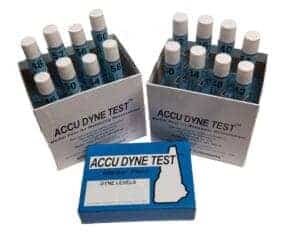
Dyne test pens (also called corona test pens or surface energy test pens) are precision measurement instruments used to evaluate whether a substrate has been adequately treated for printing, coating, or adhesive bonding.
Key characteristics:
• Measure surface energy in dynes per centimeter (dyne/cm)
• Contain calibrated test solutions based on ASTM D2578
• Provide quick, non-destructive testing in seconds
• Essential for quality control across graphic arts and packaging industries
The Science: Why Surface Energy Matters
The Fundamental Principle
At the molecular level, atoms at a surface have fewer neighboring interactions than those in the bulk material, resulting in excess energy at the interface. This surface energy determines how well liquids will wet and adhere to that surface.
The Critical Rule for Adhesion Success:
Surface Energy of Substrate > Surface Tension of Ink = Good Adhesion
When this condition isn’t met, you’ll see:
• Ink beading and poor coverage
• Color loss and print defects
• Delamination in subsequent processes
• Production waste and customer complaints
Young’s Equation
The relationship between surface energy and wetting is described mathematically by Young’s equation:
γS = γSL + γL cos θ
Where:
• γS = Surface energy of the solid
• γL = Surface tension of the liquid
• γSL = Interfacial tension
• θ = Contact angle
What this means practically:
• θ < 30° → Excellent wetting (high surface energy) • θ = 30-70° → Moderate wetting • θ > 70° → Poor wetting (low surface energy, treatment needed)
Material Classification by Surface Energy
Understanding your substrate’s inherent properties is the first step:
High Energy Materials (≥ 45 mN/m)
Examples: Metals (aluminum, steel), glass, ceramics Status: Excellent adhesion with cleaning only Common issues: Contamination from oils, dust, or oxides
Medium Energy Materials (36-44 mN/m)
Examples: PVC, ABS, PET, polycarbonate Status: Good adhesion with minimal preparation Requirements: Proper cleaning and degreasing
Low Energy Materials (< 36 mN/m)
Examples: Polyethylene (PE), polypropylene (PP), PTFE, silicone Status: Poor adhesion without treatment Solution: Corona, plasma, or flame treatment required
International Standards Compliance
ASTM D2578
Standard Test Method for Wetting Tension of Polyethylene and Polypropylene Films
• Defines procedures for measuring surface tension with test solutions
• Establishes calibration standards for dyne test fluids
• Global reference standard for surface energy testing
ISO 8296
Plastics – Film and sheeting – Determination of wetting tension
• International equivalent to ASTM D2578
• Defines test methods for flexographic ink adhesion evaluation
• Includes post-treatment testing procedures
ISO 2835
Graphic technology – Laboratory preparation of test prints – Flexographic process
• Establishes minimum surface energy requirements (typically 38-42 dyne/cm for flexo)
• Mandates surface tension measurement tool usage
• Applies to plastic films, coated papers, and printing materials
Important: ISO 8296 adhesion tests are only valid if substrates meet ISO 2835 surface energy specifications.
How to Use Dyne Test Pens: Step-by-Step
Required Equipment
• Dyne test pens (various levels: 30-70 dyne/cm)
• Clean, lint-free cloth
• Stopwatch or timer
• Nitrile gloves
• Well-ventilated area
Optimal Testing Conditions
• Temperature: 18-24°C (65-75°F)
• Humidity: 45-55% RH
• Location: Away from ignition sources
The Testing Procedure
Step 1: Surface Preparation
- Clean thoroughly with isopropyl alcohol
- Allow to dry completely (2-3 minutes minimum)
- Ensure room temperature
- Avoid touching test area with bare hands
Step 2: Pen Selection
– Start with 38-40 dyne/cm for most applications
https://kolorguide.com/38-dyne-marker-pen/– Use complete kit 30-52 for comprehensive testing
https://kolorguide.com/accu-dyne-test-pens/– Higher values (50-60) for critical adhesion – see extended range kit
https://kolorguide.com/accu-dyne-test-pens-set-30-60/– Lower values (30-36) for basic testing
https://kolorguide.com/accu-dyne-test-pens/
Step 3: Perform Test
- Shake pen vigorously for 10-15 seconds
- Remove cap and prime tip until ink flows
- Draw continuous line 2-3 inches long
- Start timing immediately
- Observe for exactly 2 seconds
Step 4: Interpret Results
✅ PASS: Line remains continuous and uniform for full 2 seconds → Surface energy ≥ pen’s dyne level
❌ FAIL: Line breaks up, beads, or retracts within 2 seconds
→ Surface energy < pen’s dyne level
Step 5: Determine Exact Value
• If pass → Try higher level pen
• If fail → Try lower level pen
• Continue until you find highest passing level
• That value = your surface energy
Regular dyne testing helps you catch corona treatment problems early. One of
the most critical applications is verifying corona treater performance.
Discover [how to identify the 5 signs your corona treatment isn’t working](https://kolorguide.com/5-signs-corona-treatment-not-working/)
and prevent adhesion failures before production.
Storage and Shelf Life: Critical for Accuracy
Standard Shelf Life
12-18 months from manufacturing date under optimal conditions 6 months for critical quality control applications
Storage Requirements
Parameter Requirement Impact if Not Met
Temperature 15-25°C (60-75°F) Solvent evaporation, degradation
Humidity < 60% RH Moisture contamination
Light Dark location UV degradation
Seal Tightly capped Solution drying, concentration changes
Warning Signs of Expiration
Replace immediately if you observe:
• Color variations in solution
• Changes in viscosity
• Crystallization or sediment
• Inconsistent ink flow
• Erratic test results
Critical fact: Expired dyne pens can produce up to 60% decrease in measurement accuracy, leading to production failures and quality control violations.
Industrial Applications and Requirements
Application-Specific Dyne Levels
Application Minimum Optimal Notes
Basic flexo printing 36 38-40 General packaging
High-quality flexo 40 42-44 Premium graphics
Water-based inks 40 42-46 Higher energy required
Solvent-based inks 36 38-40 Lower acceptable
UV inks 40 42-46 Critical adhesion
Lamination 42 44-48 Strong bond needed
Coating application 40 42-46 Uniform spreading
Hot stamping/foil 44 46-52 Excellent transfer
Common Substrate Values
Material Untreated After Treatment Min. for Printing
Polyethylene (PE) 30-32 38-46 38-40
Polypropylene (PP) 29-31 38-44 38-40
PET 43-45 48-56 44-46
BOPP 30-33 38-44 38-42
PVC 39-42 45-52 40-44
Recommended Products by Application
Basic Flexo (36-40 dyne/cm):
Kolorguide Kit 30-52 ($74.25) or AccuDyne Kit 30-52 ($99.00)
https://kolorguide.com/dyne-test-pens-kit-30-52/
https://kolorguide.com/accu-dyne-test-pens/
Extended Range (40-60 dyne/cm):
AccuDyne Full Set 30-60
https://kolorguide.com/accu-dyne-test-pens-set-30-60/
Laboratory (30-72 dyne/cm):
AccuDyne Set 30-72
https://kolorguide.com/accu-dyne-test-market-pens-kit-30-72-for-plastic-films-22-units/
Surface Treatment Methods
Why Treatment is Necessary
Untreated polyolefins (PE, PP) have surface energy around 28-32 dyne/cm. Most inks require 38-42 dyne/cm minimum. Treatment bridges this gap.
Corona Treatment
Process: High-frequency electrical discharge oxidizes surface molecules
Advantages:
• Cost-effective
• Fast processing (inline capable)
• Increases energy from ~30 to 38-56 dyne/cm
Limitation: Treatment decays over time (verify with dyne pens)
Plasma Treatment
Process: Ionized gas modifies surface at atomic level
Benefits:
• Precise molecular control
• No bulk material changes
• Superior for high-performance applications
Applications: Electronics, medical devices, aerospace
Flame Treatment
Process: Direct oxidation via controlled flame
Advantages:
• Simple equipment
• Effective on 3D shapes (bottles, containers)
• Immediate effect
Considerations: Safety protocols required, environmental controls
Treatment Decay
The Problem: Surface energy gradually decreases after treatment due to:
• Molecular rearrangement
• Additive migration to surface
• Environmental exposure
• Time elapsed
Prevention Strategy:
• Test immediately after treatment
• Re-test before printing if stored > 24 hours
• Establish maximum time windows
• Document decay rates for your materials
• Consider re-treatment if levels drop
Troubleshooting Guide
Problem: Inconsistent Test Results
Causes:
• Expired or degraded pen
• Surface contamination
• Incorrect environmental conditions
• Worn pen tip
Solutions:
• Replace with fresh inventory
• Re-clean with appropriate solvent
• Control temperature and humidity
• Verify storage conditions
Problem: Unexpected Low Readings
Causes:
• Surface contamination (oils, dust, moisture)
• Inadequate treatment power
• Treatment decay on aged material
• Material degradation
Solutions:
• Clean thoroughly before testing
• Verify treatment equipment function
• Test immediately after treatment
• Increase treatment power/duration
• Check material storage conditions
Problem: Pen Not Working
Causes:
• Insufficient shaking
• Clogged tip
• Expired pen
• Improper storage
Solutions:
• Shake vigorously 15-20 seconds
• Prime tip multiple times
• Check expiration date
• Ensure proper cap seal
Kolorguide Product Solutions
Complete Testing Kits
AccuDyne Kit 30-52 (12 Units) – $99.00
Range: 30-52 dyne/cm • Best for standard flexo and PE/PP films
https://kolorguide.com/accu-dyne-test-pens/
AccuDyne Full Set 30-60 (16 Units) – $108.80
Range: 30-60 dyne/cm • For PET films and lamination
https://kolorguide.com/accu-dyne-test-pens-set-30-60/
AccuDyne Set 30-72 (22 Units) – $149.60
Range: 30-72 dyne/cm • Complete laboratory range
https://kolorguide.com/accu-dyne-test-market-pens-kit-30-72-for-plastic-films-22-units/
Value Alternative
Kolorguide Kit 30-52 – $74.25
Same accuracy, economical pricing
https://kolorguide.com/dyne-test-pens-kit-30-52/
Individual Pens
Available via Individual Pens Selector
https://kolorguide.com/kolorguide-dyne-test-pens/
Most popular: 38 dyne/cm (standard flexo minimum)
https://kolorguide.com/38-dyne-marker-pen/
Best Practices for Quality Control
- Implement FIFO inventory rotation for pens
- Document all test results with date, time, operator
- Calibrate regularly with known reference samples
- Train multiple operators for consistency
- Test immediately after treatment and before printing
- Establish maximum time windows between treatment and use
- Monitor treatment decay rates for your materials
- Maintain environmental controls (temperature, humidity)
- Replace pens at first sign of degradation
- Combine with adhesion tests for complete diagnosis
Frequently Asked Questions
Q: How long do dyne test pens last? A: 12-18 months from manufacturing when stored properly at 15-25°C (60-75°F) in sealed, dark conditions. Critical applications may require 6-month replacement.
Q: What dyne level do I need for printing on polyethylene? A: Untreated PE is around 30-32 dyne/cm. For flexographic printing, treat to achieve 38-40 dyne/cm minimum. High-quality work may require 40-42.
Q: Can expired pens affect production quality? A: Yes. Expired pens can show up to 60% accuracy decrease, leading to false results, production failures, and quality violations.
Q: What’s the difference between ASTM D2578 and ISO 8296? A: Both measure surface tension similarly. ASTM D2578 is the US standard, ISO 8296 is international. Dyne pens comply with both.
Q: Why does treatment decay occur? A: Molecular rearrangement, additive migration, and environmental exposure cause gradual surface energy loss after corona/flame/plasma treatment. Regular testing monitors this.
Q: How do I know if my substrate needs treatment? A: Test with dyne pens. If your substrate fails at the dyne level required for your application (typically 38-40 for flexo), treatment is needed.
Q: Can I test any material? A: Dyne pens work on non-porous materials: plastics, films, metals, glass. For porous materials (paper, textiles), modified procedures or alternative methods may be needed.
Q: What causes inconsistent results? A: Common causes: expired pens, contaminated surfaces, improper storage, incorrect environmental conditions, or worn pen tips.
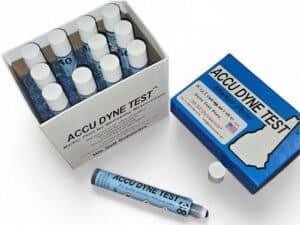
“It’s Not a Marker, It’s a Precision Instrument” A common mistake in the industry is treating Dyne pens as simple markers. However, Accu Dyne pens are precision metrology instruments. Unlike standard felt-tip pens where the fluid is constantly exposed, Accu Dyne utilizes a Valve-Tip (Pumping) Mechanism.
Why the Valve-Tip Matters:
Zero Contamination: In standard pens, the tip absorbs contaminants (dust, oils, additives) from the substrate and carries them back into the reservoir, spoiling the entire fluid. Accu Dyne’s valve system keeps the fluid reservoir hermetically sealed. Fresh fluid only flows when you press the tip.
Consistency: Each application uses “fresh” fluid, ensuring that the dyne level you are measuring today is as accurate as the first day you opened the pen.
Longer Shelf Life: By preventing evaporation and contamination, the valve-tip ensures the chemical integrity of the solution for much longer.
Introducing Hi-Res (High-Resolution) Dyne Testing
The Evolution of Detail: High-Resolution (Hi-Res) Dyne Testing” As packaging materials become more complex, the “Grey Area” between standard 2-point increments (38, 40, 42) has become a risk factor.
To solve this, Kolorguide is introducing Hi-Res Dyne Testing. This system moves beyond standard jumps to 1.0-point increments.
Standard Testing: Like a low-resolution image, it gives you the general idea but misses the details.
Hi-Res Testing: Provides a clear, sharp “image” of your surface energy. Knowing if your substrate is exactly 39 or 41 dynes—instead of “somewhere between 38 and 42″—can save thousands of dollars in rejected material
New Hi-Res Selection Tiers (Insertar antes de la conclusión)
Choose Your Resolution:
Hi-Res Stage 1 (30–41): For precision at the foundation of adhesion.
Hi-Res Stage 2 (42–53): The professional choice for high-speed printing.
Hi-Res Stage 3 (54–72): Scientific-grade for metals and advanced coatings.
Hi-Res Master Set (30–72): The ultimate 43-pen instrument collection for zero-compromise labs.
The Surface Tensiometer: The Key to 100% Quality Standard Compliance
To achieve a truly comprehensive measurement of surface energy, every element of the interface must be accounted for. Adhesion is a dual-sided interaction; therefore, a complete analytical profile must encompass both sides of the equation: the substrate and the liquid.
Achieving 360° Interfacial Characterization
A measurement is only as reliable as its variables. By integrating a Surface Tensiometer into your workflow, you move from estimation to absolute precision:
On the Solid Side: We utilize the goniometer to determine the Surface Free Energy (SFE) through contact angle analysis on the treated substrate.
On the Liquid Side: We use the Surface Tensiometer to measure the exact surface tension (static and dynamic) of the inks, coatings, or adhesives being applied.
100% Compliance with International Standards
Relying on theoretical values for liquids is a risk in high-precision industries. Integrating tensiometry is the only way to ensure 100% compliance with global quality standards such as ISO 8296, ASTM D7490, and DIN 55660.
| Feature | Standard Requirement | With Tensiometer Integration |
| Data Accuracy | Verification of test liquid purity. | Guaranteed via real-time measurement. |
| Component Analysis | Division of Polar vs. Dispersive forces. | Validated through precise liquid characterization. |
| Traceability | Documented proof of all interface variables. | Full Compliance for ISO 9001 audits. |
| Process Control | Elimination of “hidden” variables (surfactants/temp). | Total Control over the liquid-solid interaction. |
Technical Verdict: Partial measurement is an operational risk. Only by measuring the energy of the solid and the tension of the liquid simultaneously can we certify a process under 100% statistical and normative control.
This framing positions Kolorguide as a provider of “Total Solutions” rather than just hardware.
Would you like me to generate a technical diagram description or an image prompt to illustrate this “dual-sided” measurement for the English version?
Conclusion: Surface Energy Testing as Competitive Advantage
In industries where quality is non-negotiable, dyne test pen testing represents far more than a simple quality check—it’s a strategic tool for:
✅ Preventing production failures before they occur ✅ Reducing material waste through early detection ✅ Ensuring ISO/ASTM compliance with documented procedures ✅ Optimizing treatment processes through data-driven decisions ✅ Building customer confidence with consistent quality
The small investment in proper surface energy testing—including quality dyne test pens, proper storage, regular replacement, and trained operators—pays dividends in reduced waste, fewer customer complaints, and enhanced reputation.
Need a Dyne Test Pen?
For routine production verification, Kolorguide Dyne Test Pens are sold individually with no minimum order and free U.S. shipping.
About This Guide
This comprehensive resource combines decades of industry expertise with the latest scientific understanding of surface energy and adhesion. It represents the unified knowledge base of Kolorguide Corp, consolidated to serve as the definitive reference for surface energy testing in graphic arts and packaging industries.
Created under the direction of: Kolorguide Corp / Esmarco Corporation, Florida, USA Technical Direction: Juan M. Rincón
Development support: Claude (Anthropic) – AI-powered content consolidation and optimization
Source materials:
• Guía Técnica Kolorguide sobre Energía Superficial (v1.0)
• International Standards: ISO 8296, ISO 2835, ASTM D2578, ASTM D3369
• Kolorguide Technical Blog (2015-2025)
• Scientific research and industry publications
• Internal quality control protocols
Connect With Kolorguide
Website: www.kolorguide.com Email: info@kolorguide.com
For technical consultations, product information, or training resources, visit our website or contact our technical team.
Keywords: #SurfaceTesting #DynePens #SurfaceEnergy #GraphicArts #QualityControl #Printing #Packaging #Flexography #ISO8296 #ASTMD2578 #CoronaTreatment #InkAdhesion #PrintQuality #PackagingIndustry #IndustrialPrinting
© 2025 Kolorguide Corp. All rights reserved.
1997577748

1000 in stock

Buy Accu Dyne Test Pens – Selectable Range 30 to 72 Dynes
$19.00 Select options This product has multiple variants. The options may be chosen on the product page99 in stock


About author
Related posts
Anilox Roll Maintenance: The Complete Guide to Cleaning, Control, and Performance In flexography, the anilox roll is often defined by its specifications. Line screen.Cell volume.Engraving.... Continue reading
Surface Energy Chart by Material (Dyne Levels for Plastics, Films, Metals and Packaging) This reference chart is used by engineers and technicians to evaluate adhesion,... Continue reading
Surface Energy and Dyne Testing Guide: 105 Technical Questions for Printing and Converting January 26, 2026Kolorguide Technical Division Introduction Surface energy is one of the... Continue reading
Surface energy testing is a critical control point in printing, coating, laminating, and converting operations. Dyne test pens are routinely used to verify surface treatment... Continue reading
Corona treatment is not eternal and Why Geography is Killing Your Surface Tension (and Your Profits)
At Kolorguide, we live by one technical truth: “Corona treatment is not eternal; it is an unstable physical state that tends to decay.”Have you ever... Continue reading