
No products in the cart.
Return To Shop
The Importance of Surface Tension Testing in ISO Standards for the Graphic Arts Industry
In today’s highly competitive printing and packaging industry, ensuring consistent quality and optimal adhesion is a daily challenge. Whether you’re working in flexographic printing, gravure, digital, or offset, the effectiveness of inks, coatings, and adhesives begins with one often-overlooked factor: surface energy.
Surface energy determines how well a substrate can bond with ink or coatings. A substrate with low surface energy will repel the ink or coating, leading to poor anchorage, delamination, or premature wear. This results in waste, rework, and, ultimately, customer dissatisfaction.
What is Surface Tension Testing?
Surface tension testing is the process of evaluating the wettability of a surface—how easily a liquid can spread across it. In industrial settings, this is typically done using dyne test pens or test fluids, which are applied to the substrate. If the fluid spreads evenly and doesn’t bead up, the surface has sufficient energy to allow adhesion.
Testing surface tension allows manufacturers and printers to:
- Ensure that substrates have been properly treated (e.g., by corona or flame treatment)
- Detect degradation in surface treatment over time
- Confirm that the material is ready for printing or coating
- Avoid costly production errors and waste
Relevance to ISO Standards
Several ISO standards guide quality control practices in the graphic arts industry, including:
- ISO 8296 – Inks for flexographic printing: covers adhesion properties
- ISO 2835 – Printing substrates: defines surface requirements for ink adhesion
- ISO 12647 – Process control for the production of half-tone colour separations, proof and production prints
These standards emphasize the importance of verifying the printability and adhesion readiness of substrates prior to applying ink or coatings. Surface tension testing is an essential part of meeting these requirements.
In fact, many converters, printers, and quality managers have integrated surface tension testing into their ISO-certified workflows as part of regular incoming material inspection and process control.
How Kolorguide Helps
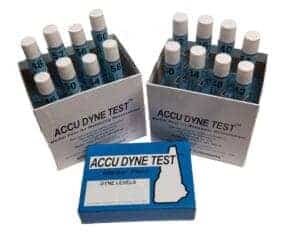
At Kolorguide, we provide industry-leading Accu Dyne Test Pens and Fluids to support graphic arts professionals in achieving consistent, ISO-compliant results. Our products offer:
- Accurate measurements in dynes/cm (from 30 to 70)
- Fast, non-destructive testing on most films, foils, and glass
- Easy application with minimal training required
These tools help reduce:
- Ink adhesion failures
- Waste due to poor surface treatment
- Production downtime and customer rejections
Whether you’re printing on polyethylene, BOPP, PET, or coated paper, testing surface tension gives you data-driven assurance that your process is under control.
Benefits of Incorporating Surface Tension Testing
- Improve adhesion and reduce defects
- Support ISO 9001 and ISO 12647 quality systems
- Reduce material waste and save costs
- Shorten troubleshooting time
- Improve customer satisfaction
Final Thoughts
In an industry where quality is non-negotiable, testing surface tension is a small step that makes a big difference. It empowers you to catch problems before they happen, deliver better products, and maintain the trust of your clients.
At Kolorguide, we’re here to help you bring surface quality under control.
Want to learn more? Contact us today for technical datasheet or SDS
#Kolorguide #SurfaceTension #DyneTest #ISOStandards #GraphicArts #InkAdhesion #PrintQuality #ISO2835 #FlexoPrinting #IndustrialPrinting #PrintingTechnology #SurfaceTesting #AccuDyne #QualityControl #PrintInspection #AdhesionFailure #PackagingPrinting

Tags: #dynetest, #dynetestpens, #FLEXO, #packaging printing, flexo printing, industrial printing, ISO 12647, iso 2834, ISO 8296 Dyne Testing, iso 9001, printing, Surface Energy Measurement, surface energy test pens, surface tension pens, Surface Wettability

About author
Related posts
Surface Energy and Dyne Testing Guide: 105 Technical Questions for Printing and Converting January 26, 2026Kolorguide Technical Division Introduction Surface energy is one of the... Continue reading
Surface energy testing is a critical control point in printing, coating, laminating, and converting operations. Dyne test pens are routinely used to verify surface treatment... Continue reading
Corona treatment is not eternal and Why Geography is Killing Your Surface Tension (and Your Profits)
At Kolorguide, we live by one technical truth: “Corona treatment is not eternal; it is an unstable physical state that tends to decay.”Have you ever... Continue reading
En Kolorguide tenemos una máxima: “El tratamiento de corona no es eterno; es un estado físico inestable que tiende a desaparecer”. Muchos impresores se preguntan... Continue reading
No es solo Kolorguide: Las máximas autoridades de las Artes Gráficas lo exigen A veces nos preguntan si somos demasiado estrictos al insistir en que... Continue reading