No products in the cart.
Return To ShopWhich Pantone Guide Do I Need?
Find the Perfect One for Your Work
Have you ever asked for “a red” and received something completely different from what you expected?
Choosing the right Pantone guide can be confusing, but first let’s understand why you need one.
🔴 THE PROBLEM: “NOT ALL REDS ARE THE SAME”
Look at these famous reds. They might look “the same” to you, but each has a unique identity:
Can you tell the difference?
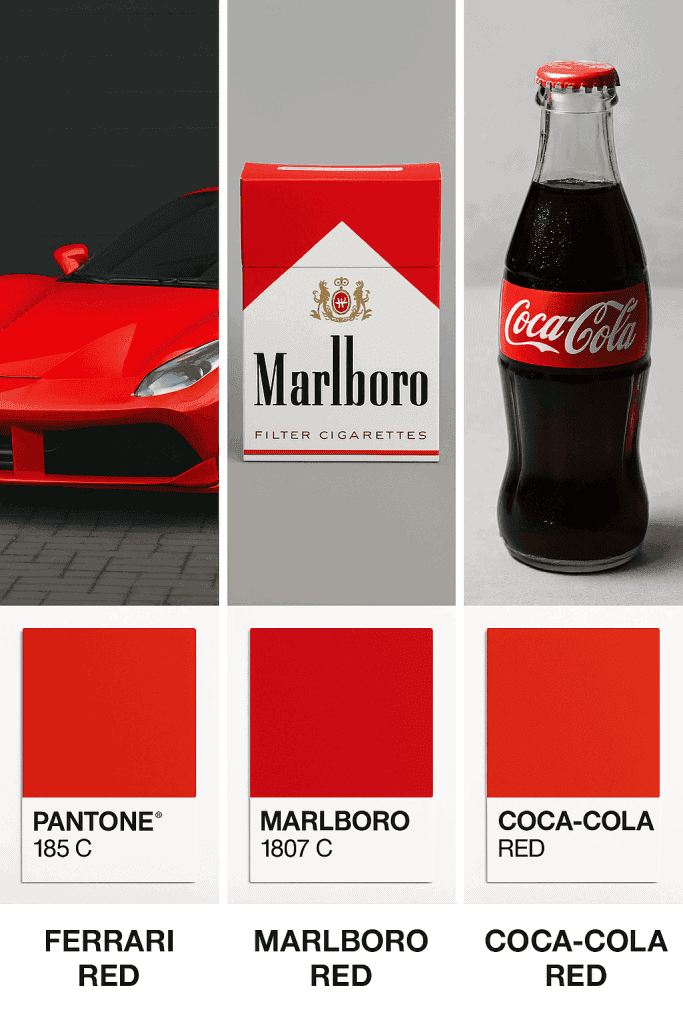
Ferrari Red → Pantone 18-1763 TPX (Rosso Corsa)
Coca-Cola Red → Pantone 484 C
Marlboro Red → Pantone 18-1664 TPX
Canadian Flag Red → Pantone 032 C
USA Flag Red → Pantone 193 C
Mexican Flag Red → Pantone 18-1664 TPX
Why does this matter?
Imagine these real scenarios:
Scenario 1: You design luxury brand packaging. You say “I want Ferrari red.” Without Pantone, each printer interprets differently. Result: 1,000 boxes with 5 different red tones.
Scenario 2: Your client in Mexico sends production to China. They tell the factory “the red from our flag.” Without an exact Pantone code, 10,000 products arrive with a red that “looks similar” but isn’t the same.
Scenario 3: You design a t-shirt. You approve it on your screen (looks perfect), the printer says “looks great” (on their monitor too), but when it comes out printed, it’s completely different.
🌍 THE SOLUTION: THE UNIVERSAL LANGUAGE OF COLOR
Pantone is like GPS for colors. Instead of saying “turn where the big tree is,” you say “turn at exact coordinates 25.7617° N, 80.1918° W.”
The power of precise communication:
Without Pantone:
You: “I want an elegant corporate blue”
Printer: “Sky blue, navy blue, royal blue?”
Result: Confusion and reprints
With Pantone:
You: “I want Pantone 279 C”
Printer in Miami: “Perfect, Pantone 279 C”
Factory in China: “确认,潘通279 C” (Confirmed, Pantone 279 C)
Supplier in India: “हां, पैंटोन 279 सी” (Yes, Pantone 279 C)
Result: The exact same color worldwide
Real cases where Pantone saves projects:
🏢 Multinational with global offices: Their logo must look identical in New York, Hong Kong, and São Paulo. With Pantone 032 C, it doesn’t matter which local printer they use.
👕 Clothing brand: Produces in Guatemala, Vietnam, and Bangladesh. Pantone 18-3838 TPX guarantees all their jean blues are identical.
📱 Product launch: Apple, Samsung, Nike… all use Pantone because an “almost equal” color isn’t an option when your reputation is at stake.
⚽ Adidas Case – The Most Complex Challenge:

Imagine you’re Adidas producing Germany’s National Team uniform. You need to coordinate:
Jersey factory (Vietnam) → polyester fabric
Shorts factory (Indonesia) → mesh fabric
Socks factory (Guatemala) → elastic knit
Shoe factory (China) → synthetic leather and plastic
Logo supplier (Mexico) → transfer vinyl
The problem: Each substrate (fabric, plastic, leather, vinyl) absorbs and reflects color differently. Without Pantone, you’d have 5 different tones of “Germany white.”
The Pantone solution:
Main White: Pantone 11-0601 TPX (for textiles)
Black: Pantone 19-0303 TPX (for textiles)
Red: Pantone 18-1763 TPX (for textiles)
Yellow: Pantone 13-0859 TPX (for textiles)
Result: German fans see exactly the same colors of their national team since 1990, whether they buy the jersey in Berlin, shorts in Munich, or shoes in Hamburg. The passion remains intact because the colors never change.
Without Pantone, each World Cup would have a different “Germany white.” With Pantone, visual identity transcends decades and continents.
🎯 NOW: IDENTIFY YOUR PROFILE
You understand why you need Pantone. Now let’s see which guide you need according to your work:
What do you mainly do?
Screen/web design → Digital, social media, websites
Print design → Brochures, magazines, packaging, stationery
Commercial printing → Operate offset, digital, screen printing machines
Textile/fashion design → Clothing, fabrics, accessories
Mixed work → Combine various activities
Coordinate international production → Send files to factories in other countries
📚 THE 4 MAIN GUIDES EXPLAINED
- PANTONE COLOR BRIDGE
What is it? Shows Pantone colors alongside their best CMYK equivalent
It’s perfect for you if:
You design digitally but your work gets printed
You need to communicate with print shops
You work with clients who ask for “specific Pantone colors”
You want to avoid surprises between what you design and what gets printed
Real example: You design a logo in Pantone Red 032 C, the guide shows exactly how it will look when the printer converts it to CMYK. Bonus: You can send this code to any printer worldwide and get the same result.
- PANTONE COLOR SOLID (Formula Guide)
What is it? “Pure” Pantone colors with formulas for mixing inks
It’s perfect for you if:
You’re a printer and mix Pantone inks
You work in packaging where you need exact colors
You handle brands requiring precise corporate colors
You do screen printing or printing with special inks
Real example: The client wants the exact blue from their corporate logo. With this guide, you mix the perfect ink, no approximations. Global communication: That same code works if they send production to a printer in China or Colombia.
- CMYK PROCESS GUIDE
What is it? All possible colors using only the 4 CMYK inks (Cyan, Magenta, Yellow, Black)
It’s perfect for you if:
You work mainly in mass commercial printing
Your budget doesn’t allow special inks
You design magazines, catalogs, books, newspapers
You need to maximize color range in four-color process
Real example: You design a 100-page magazine. This guide shows all the colors you can achieve without extra special ink costs.
- FASHION, HOME + INTERIORS (FHI)
What is it? Colors developed specifically for textiles and interiors
It’s perfect for you if:
You design clothing, textiles, upholstery
You work in interior decoration
You handle lifestyle and consumer products
Colors must look good on fabrics, not just paper
Real example: You design a t-shirt line. The colors in this guide are designed to look perfect on cotton, polyester, and other fabrics. International production: That Pantone 18-1664 TPX will look the same whether you produce in Guatemala, Vietnam, or Bangladesh.
🤔 WHICH ONE DO I CHOOSE? SPECIFIC CASES
I’M A FREELANCE DESIGNER
If you do more digital but it gets printed: Color Bridge (perfect communication with printers)
If you do more budget printing: CMYK Process Guide
If you handle premium or international brands: Color Bridge + Color Solid
If you include fashion/textile: Fashion + Color Bridge
I’M A PRINTER
General commercial printing: Color Solid + CMYK Process
Offset/digital only: CMYK Process Guide
With special inks: Color Solid is essential
Textile work: Fashion mandatory
International clients: Color Solid lets you speak the same language globally
I WORK AT AN AGENCY
Digital agency: Color Bridge (perfect for printer coordination)
Full-service agency: Color Bridge + Fashion
Luxury/international agency: Color Bridge + Color Solid
Multinational clients: Color Solid is indispensable
I’M A TEXTILE/FASHION DESIGNER
Fashion only: Fashion is indispensable
Fashion + graphics: Fashion + Color Bridge
Sports/technical fashion: Fashion + Color Solid
Production in Asia/Latin America: Fashion is your lifeline for exact communication
I COORDINATE INTERNATIONAL PRODUCTION
Essential: Color Solid (your “universal dictionary”)
Complement: Your industry-specific guide (Fashion for textile, Bridge for graphics)
Why: A Pantone 186 C means exactly the same in Miami as in Shenzhen
⚖️ QUICK COMPARISON
NeedColor BridgeColor SolidCMYK ProcessFashionGlobal printer communication✅✅❌✅Consistent international production❌✅❌✅Mix exact inks❌✅❌❌Budget mass printing❌❌✅❌Textile design❌❌❌✅Digital → print conversion✅❌❌❌Exact corporate colors❌✅❌❌
💡 DECISION TIPS
If you’re torn between two guides:
Think of your most common project: What do you do 80% of the time?
Consider your budget: Can you afford special inks?
Evaluate your clients: What level of precision do they demand?
Signs you need to update:
Your guide is more than 2 years old
Colors look different than expected
Your clients mention inconsistencies
You’ve changed types of work
Need more than one guide?
Many professionals use 2-3 guides depending on the project:
Most common combination: Color Bridge + Fashion
For versatile printers: Color Solid + CMYK Process
For full-service agencies: Color Bridge + Color Solid + Fashion
🎯 FINAL DECISION
If you can only buy ONE guide:
General designer: Color Bridge (perfect communication)
Printer: Color Solid (the professional standard)
Editorial/advertising: CMYK Process (your daily work)
Fashion/textile: Fashion (created for your industry)
International work: Color Solid (universal color language)
The best investment for most:
Color Bridge – Gives you the best of both worlds: precise Pantone colors AND their mass printing equivalent. Plus: perfect communication with any printer on the planet.
Still have doubts? Think about your biggest color headache: is it communication with suppliers, production precision, or both? That’s your answer.
🎯 REMEMBER: PANTONE = ERROR-FREE COMMUNICATION
Without Pantone: “I want a red like Ferrari”
With Pantone: “I want Pantone 18-1763 TPX”
The result: The same perfect color on your screen, at your local printer, at the factory in China, and in stores in any country worldwide.
⚠️ IMPORTANT NOTE: YOUR SCREEN VS REALITY
Have you noticed that sometimes what you see on your monitor isn’t the same as what comes out printed?
This is completely normal and has a technical explanation:
Your monitor emits light (RGB – Red, Green, Blue)
Your printer absorbs light (CMYK – Cyan, Magenta, Yellow, Black)
Your phone has different calibration
Paper reflects light differently
What does this mean?
A bright blue on screen may look duller when printed
A vibrant red on your iPhone may look different on your laptop
The same file may look different on different devices
Should you worry?
Not at all! This is basic physics of light and pigments. That’s why Pantone exists: so you have a real physical reference, not digital.
📚 UPCOMING TOPICS
In future articles we’ll cover:
Monitor calibration: How to sync your screen with reality
Color profiles: RGB vs CMYK explained simply
Color management: The complete professional workflow
For now remember: If you see differences between screen and print, it’s normal. Your physical Pantone guide is always the correct reference.


About author
Related posts

Explore the differences between CMYK vs RGB colors for accurate design and printing. Gain a comprehensive understanding of their applications. Continue reading

Discover the 7 best fonts for packaging that can elevate your brand image and attract customers effectively. Learn tips for each choice. Continue reading

Discover 7 key tips for enhancing sustainability in printing industry practices that professionals can implement for a greener future. Continue reading

Discover the key difference between CMYK and RGB for plastic, printing, and packaging industries. Learn how to choose the right color model for your needs. Continue reading