
No products in the cart.
Return To Shop
Understanding the History of Offset Printing
Offset printing changed the way the world shares information, letting publishers and businesses print millions of newspapers, books, and magazines at lightning speed. Most people assume printing tech is just about putting ink on paper. That ignores the real breakthrough. What made offset printing so powerful is its ability to deliver high-quality images on everything from newspapers to packaging, with per-unit costs dropping as print runs grow—sometimes to just pennies a piece.
Table of Contents
- What Is Offset Printing And Its Historical Background
- Why Offset Printing Became A Preferred Method
- The Evolution Of Offset Printing Technology
- Key Concepts Driving Offset Printing Practices
- Real-World Applications And Impact On Industries
Quick Summary
| Takeaway | Explanation |
|---|---|
| Offset printing enhances image quality and precision. | The method provides sharper, clearer images due to its unique transfer mechanism using intermediate rubber blankets. |
| Lower production costs for mass printing. | Offset printing significantly reduces per-unit costs, making it economically attractive for large volume runs. |
| Versatile application across various materials. | This printing method can effectively print on paper, cardboard, and plastics without compromising quality. |
| Continuous technological advancement included digital integration. | Modern offset printing systems now utilize digital workflows, improving efficiency and color management immensely. |
| Transformative impact on media and communication. | Offset printing has reshaped how information is produced and disseminated, influencing advertising, packaging, and publishing industries. |
What is Offset Printing and Its Historical Background
Offset printing represents a revolutionary printing technique that transformed industrial communication and mass media production throughout the 20th century. At its core, this method transfers an inked image from a plate to a rubber blanket, and then onto the printing surface, creating high-quality reproductions with remarkable precision and efficiency.
The Fundamental Mechanics of Offset Printing
The offset printing process distinguishes itself through a unique image transfer mechanism. Unlike traditional direct printing methods, offset printing uses an intermediary rubber blanket that receives the inked image from a metal plate before transferring it onto the final printing surface.
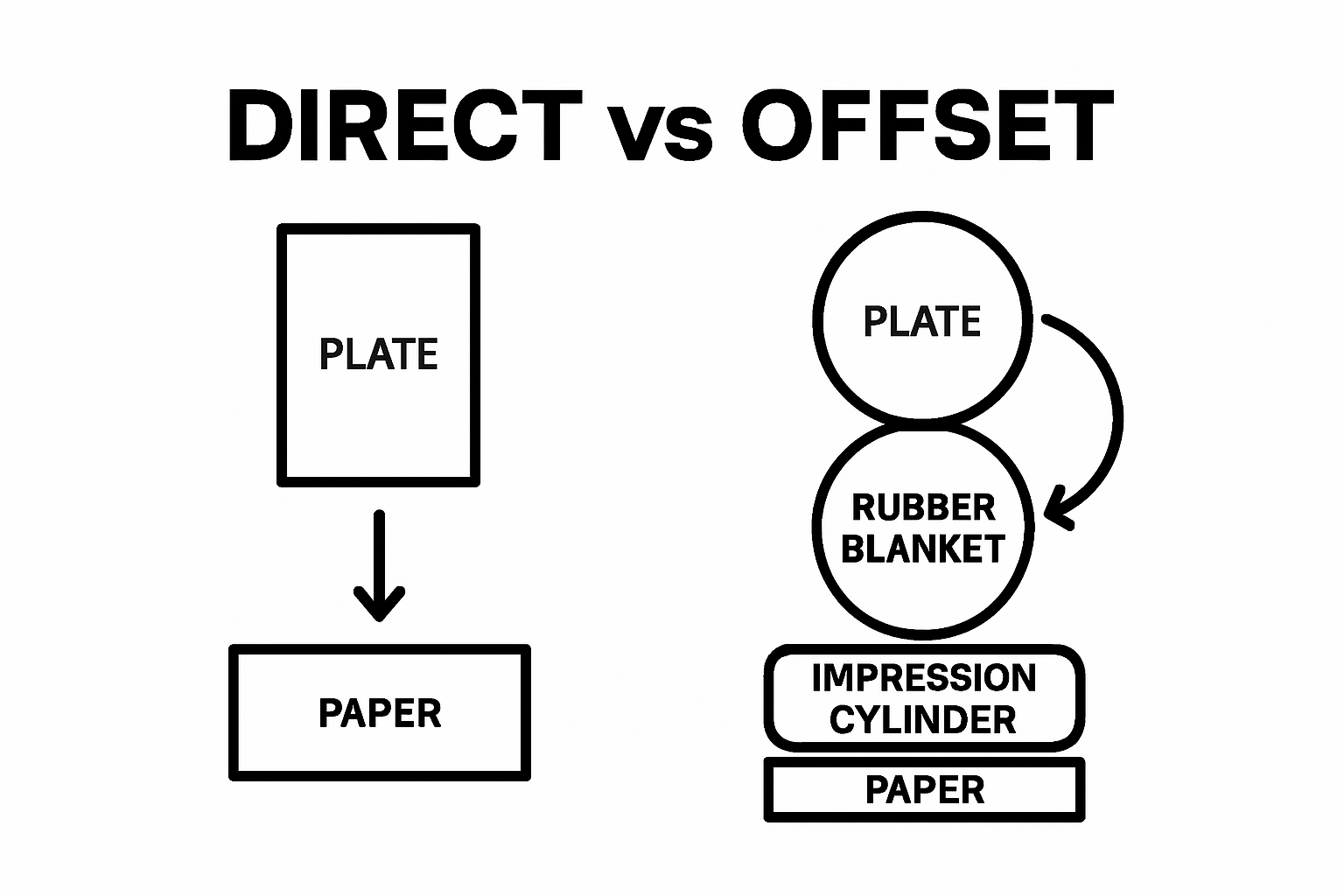 This indirect approach offers several significant advantages:
- Produces consistently sharp and clean images
- Allows printing on a wide variety of surfaces including paper, cardboard, and plastics
- Enables large volume print runs with minimal quality degradation
According to Encyclopædia Britannica, offset printing emerged as an innovative adaptation of lithographic techniques in the early 20th century, quickly becoming the dominant printing method for newspapers, books, and commercial publications.
Historical Evolution and Technological Significance
The origins of offset printing can be traced back to the late 19th century, with significant technological developments occurring between 1875 and 1904. Pioneering printers and engineers recognized the limitations of direct lithographic printing and sought more efficient reproduction methods. The breakthrough came when inventors discovered that transferring an image via a rubber intermediary could produce clearer, more consistent prints.
By the mid-20th century, offset printing had become the standard for commercial and industrial printing. Its ability to produce high-quality images at rapid speeds revolutionized communication, enabling mass media, advertising, and information dissemination on an unprecedented scale. Modern offset printing continues to be a critical technology in publishing, packaging, and graphic design industries worldwide.
Why Offset Printing Became a Preferred Method
Offset printing rapidly transformed the printing industry by addressing critical limitations of previous printing technologies and offering unprecedented advantages in image reproduction and economic efficiency. Its emergence represented a significant technological breakthrough that fundamentally reshaped communication and media production strategies.
Economic and Production Advantages
The economic benefits of offset printing were revolutionary for industrial printing processes. By dramatically reducing production costs and increasing output speed, this method became exceptionally attractive for businesses and publishers. Key economic advantages included:
- Significantly lower per-unit printing costs for large volume runs
- Faster production cycles compared to traditional printing methods
- Minimal plate wear, reducing long-term equipment maintenance expenses
- Ability to print on multiple surface types without compromising image quality
According to the American Printing History Association, offset printing’s versatility and cost-effectiveness made it the preferred method for mass media and commercial printing throughout the 20th century.
Technological Superior Image Reproduction
Unlike earlier printing techniques, offset printing delivered exceptional image clarity and consistency. The unique transfer mechanism using a rubber blanket allowed for unprecedented precision in reproducing complex graphics, photographs, and text. This technological advancement meant publishers and advertisers could achieve higher quality visual communications with remarkable reliability.
Professional designers and print specialists quickly recognized that offset printing could reproduce intricate details with sharper resolution and more vibrant colors than previous methods. The ability to maintain image integrity across thousands of printed copies made offset printing particularly valuable for magazines, newspapers, marketing materials, and commercial publications.
By the mid-20th century, offset printing had not just become a preferred method but had effectively established itself as the standard technology for large-scale printing worldwide.
To help clarify how offset printing compares to earlier printing methods, the following table summarizes key differences in economic and technological benefits.
| Printing Method | Image Quality | Production Speed | Per-Unit Cost (Large Runs) | Material Versatility |
|---|---|---|---|---|
| Traditional Lithography | Moderate | Slow | High | Mostly paper |
| Letterpress | Moderate | Moderate | Moderate | Mostly paper and thin board |
| Offset Printing | High (sharp, clean) | Fast | Low | Paper, cardboard, plastics |
Its combination of economic efficiency, technological sophistication, and superior image reproduction transformed how information and visual media were created and distributed.
The Evolution of Offset Printing Technology
Offset printing technology has undergone remarkable transformations since its inception, continuously adapting to meet the changing demands of communication, design, and industrial production. From its early mechanical foundations to sophisticated digital integrations, the technology represents a fascinating journey of innovation and technological refinement.
Early Mechanical Foundations
The initial development of offset printing emerged from critical limitations in existing printing methods. Inventors and engineers sought more efficient ways to reproduce images with greater precision and consistency. Key breakthrough moments included:
- The invention of lithographic techniques in the late 19th century
- Development of rubber blanket transfer mechanisms
- Introduction of aluminum plate technology
- Refinement of ink and chemical processing techniques
According to the National Postal Museum, Ira Washington Rubel’s 1903 invention of the lithographic offset printing press marked a pivotal moment in printing technology, replacing traditional stone plates with more efficient rubber impression rollers.
Technological Advancements and Digital Integration
As industrial demands grew, offset printing technology rapidly evolved. Mechanical systems became increasingly sophisticated, incorporating precision engineering and advanced materials. The introduction of computer-to-plate technologies in the late 20th century represented a significant leap forward, allowing direct digital image transfer and dramatically reducing production preparation times.

Modern offset printing systems now integrate complex digital workflows, enabling unprecedented levels of color management, image resolution, and production efficiency. These technological advancements have transformed offset printing from a purely mechanical process to a highly integrated digital production method, capable of delivering exceptional quality across diverse printing applications.
Key Concepts Driving Offset Printing Practices
Offset printing represents a sophisticated technological process that relies on intricate mechanical and chemical interactions to produce high-quality printed materials. Understanding the fundamental principles driving this printing method reveals the complexity behind what appears to be a straightforward reproduction technique.
Mechanical Precision and Image Transfer
The core mechanism of offset printing hinges on a precise three-cylinder system that enables exceptional image reproduction. Critical mechanical components include:
- Plate cylinder containing the original image
- Rubber blanket cylinder acting as an intermediary transfer surface
- Impression cylinder applying pressure for accurate image transfer
According to California State University, San Bernardino, this interconnected system allows for exceptional print quality by pressing inks directly into paper fibers with remarkable consistency.
The table below breaks down the core mechanical elements of offset printing and their primary functions, making it easier to understand how these components work together for precise image transfer.
| Component | Function |
|---|---|
| Plate Cylinder | Holds the image to be printed and applies ink to image areas |
| Blanket Cylinder (Rubber) | Receives inked image from plate and transfers it to printing surface |
| Impression Cylinder | Applies pressure to ensure accurate ink transfer onto substrate |
| Ink Rollers | Distribute ink evenly onto the plate cylinder |
| Dampening Rollers | Apply water to non-image areas to repel ink |
Chemical and Material Science Principles
Beyond mechanical engineering, offset printing integrates advanced chemical principles. The process depends on the fundamental property of oil and water repulsion, where the printing plate is chemically treated to attract ink only to image areas while repelling ink from non-image surfaces. This hydrophobic-hydrophilic interaction enables precise ink transfer and ensures crisp, clean reproductions.
Modern offset printing practices continue to evolve, incorporating sophisticated color management techniques and digital workflow integrations. Learn more about color control technologies that complement these intricate printing methodologies, demonstrating how material science and technological innovation continuously reshape printing practices.
Real-World Applications and Impact on Industries
Offset printing has fundamentally transformed communication, manufacturing, and information dissemination across numerous industries. Its versatility and efficiency have made it an indispensable technology that extends far beyond traditional print media, influencing everything from packaging to global communication strategies.
Industrial and Commercial Print Applications
The widespread adoption of offset printing has revolutionized multiple sectors by enabling high-quality, cost-effective mass production. Key industrial applications encompass:
- Packaging design for food, pharmaceutical, and consumer goods industries
- Marketing materials including brochures, catalogs, and promotional literature
- Newspaper and magazine production
- Product labeling and commercial documentation
- Specialized technical manuals and instructional materials
According to the National Postal Museum, offset printing has been instrumental in transforming how information is produced and distributed across various commercial and communication platforms.
Economic and Technological Implications
Beyond immediate print applications, offset printing has generated significant economic impacts by democratizing information production. The technology dramatically reduced printing costs, enabling smaller businesses and organizations to produce professional-quality materials that were previously accessible only to large corporations.
The technological sophistication of offset printing has also driven innovation in related fields such as graphic design, marketing communication, and digital workflow management. By providing a reliable, high-quality reproduction method, offset printing has become a critical infrastructure technology that supports global information exchange and commercial communication.
For professionals seeking to understand advanced color management techniques, offset printing represents a cornerstone of modern visual communication strategies, bridging traditional print methodologies with cutting-edge technological approaches.
Bridge the Gap Between Printing History and Modern Color Accuracy
Unlock the true potential of your offset printing projects by solving one of the most challenging aspects identified throughout history: achieving consistent and reliable color results. As outlined in the article, even with advancements in offset printing techniques and mechanical precision, maintaining accurate color reproduction remains a persistent concern for professionals in printing, design, and manufacturing.

If you are searching for tools to ensure your prints match industry standards every time, now is the moment to upgrade your workflow. Browse our professional color management tools and trusted Pantone color guides today. You can also discover more about advanced color control for flexible film within our expert resources. Take the next step for quality and innovation. Visit Kolorguide.com to find the precise color solutions every step of your offset printing journey demands.
Frequently Asked Questions
What is offset printing?
Offset printing is a printing technique that transfers an inked image from a plate to a rubber blanket and then onto the printing surface. This method produces high-quality reproductions with remarkable precision and efficiency.
How did offset printing evolve historically?
Offset printing emerged from lithographic techniques in the early 20th century, with its origins tracing back to the late 19th century. Key innovations included the use of rubber blankets and aluminum plates, significantly improving image quality and production efficiency.
What are the advantages of offset printing compared to other printing methods?
Offset printing offers several advantages, including lower per-unit costs for large volume runs, faster production cycles, and the ability to produce high-quality images with consistency and clarity on a variety of surfaces.
What industries benefit from offset printing technology?
Offset printing technology is widely used across industries such as packaging, marketing, publishing, and commercial documentation. It plays a crucial role in producing brochures, magazines, newspapers, and product labels.
Recommended


About author
Related posts

Discover why registration is important for businesses in the printing, packaging, plastics, and technology industries. Learn how it protects and boosts your company’s growth. Continue reading

Explore essential printing press terminology to enhance your knowledge as a graphic designer or industry professional. Comprehensive insights included. Continue reading