
No products in the cart.
Return To Shop
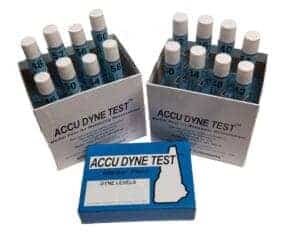
Why Do Dyne Test Pens Only Last 6 Months?
Precision doesn’t last forever — but it can be renewed.
In industries like packaging, coating, extrusion, or printing, surface preparation is everything. A well-treated surface ensures proper adhesion, ink transfer, or lamination. And when it comes to checking that surface energy, Dyne Test Pens are one of the simplest and fastest tools available.
But here’s the catch: these pens have a shelf life of just 6 months from the date of manufacture.
No, it’s not because they’re low quality. Quite the opposite — it’s because they’re formulated for accuracy.
So why only 6 months?
The reason lies in chemistry. Dyne pens are filled with test fluids made of highly volatile solvents and sensitive dye indicators. Even when sealed, chemical changes begin over time:
The solvent slowly evaporates or alters in concentration
Reactive dyes can break down or change behavior
The wetting action becomes less reliable on treated surfaces
These changes are usually invisible to the naked eye, but they can result in false readings — meaning you might think a surface is ready for printing or bonding when it’s not. And that can lead to big problems: failed adhesion, print defects, sealing issues, or rejected product.
What does ASTM D2578 say?
The most widely accepted standard for this type of testing, ASTM D2578, is very clear:
Test fluids must be within their valid shelf life and free from contamination.
That means if you’re using a pen that’s expired — even if it “looks fine” — your test results are no longer compliant. And in a process driven by quality and traceability, that’s a risk you don’t want to take.
It’s not a defect. It’s a feature of precision.
We get it — 6 months might sound short. But that limited shelf life is there on purpose.
It’s not a sign of weakness. It’s a sign of a chemically precise product that’s only trusted to give accurate results for a specific time window.
Just like a calibrated sensor or lab scale, a Dyne pen needs to be rotated regularly to maintain trust in your process.
What should I do?
If you’re working with Dyne pens in production or lab settings, here are a few simple best practices:
- Check the manufacturing date on every new pen you receive
- Clearly label the expiration date (6 months after manufacture)
- Don’t use pens that are expired or missing a date
- Set a routine to replace pens every 6 months
- Log pen usage and rotation for audits or ISO compliance
What if I have old pens?
If you’re unsure about how old your pens are, it’s best to check now. If the manufacture date is over 6 months ago, it’s time to replace them.
At Kolorguide, we only ship freshly dated pens with high stock turnover — so you can count on accuracy and compliance every time.
Final Thoughts
Dyne Test Pens don’t last forever — and that’s okay.
Because in quality control, consistency and repeatability are everything.
Replacing your pens on time isn’t wasteful — it’s an investment in accuracy, reliability, and peace of mind.
So remember:
Precision has an expiration date — but it also has a solution.
And Kolorguide is here to help you stay ahead of it.

Tags: Accurate Dyne Level Results, Dyne Level Measurement, dyne level testing, Dyne pens for plastic, Dyne pens surface energy, dyne test pens

About author
Related posts
Surface Energy and Dyne Testing Guide: 105 Technical Questions for Printing and Converting January 26, 2026Kolorguide Technical Division Introduction Surface energy is one of the... Continue reading
Surface energy testing is a critical control point in printing, coating, laminating, and converting operations. Dyne test pens are routinely used to verify surface treatment... Continue reading
Corona treatment is not eternal and Why Geography is Killing Your Surface Tension (and Your Profits)
At Kolorguide, we live by one technical truth: “Corona treatment is not eternal; it is an unstable physical state that tends to decay.”Have you ever... Continue reading
En Kolorguide tenemos una máxima: “El tratamiento de corona no es eterno; es un estado físico inestable que tiende a desaparecer”. Muchos impresores se preguntan... Continue reading
No es solo Kolorguide: Las máximas autoridades de las Artes Gráficas lo exigen A veces nos preguntan si somos demasiado estrictos al insistir en que... Continue reading