No products in the cart.
Return To Shop
Essential Printing Industry Terminology for Professionals
printing industry terminology, Printing is all around us, from flashy billboards to the label on your morning coffee cup. Most people might assume it’s all ink, paper, and a press, but the real story is packed with technical terms and surprising technology. For example, 3D printing now lets us create complex objects layer by layer, reducing material waste by up to 90 percent compared to traditional methods. Think you know the basics? These must-know printing terms could surprise even an industry veteran.
Table of Contents
- Key Terms Every Printing Professional Should Know
- Printing Methods And Technologies Explained
- Common Finishing And Coating Terminology
- Industry-Specific Terms For Packaging And Materials
Quick Summary
| Takeaway | Explanation |
|---|---|
| Master core printing terms | Understanding terms like ‘artwork’ and ‘bindery’ ensures clear communication in the printing industry. |
| Familiarize yourself with equipment terminology | Knowing terms such as ‘anti-offset powder’ and ‘color separation’ enhances technical knowledge and improves workflow efficiency. |
| Stay updated on advanced printing methods | Being aware of technologies like 3D printing and electrohydrodynamic printing keeps you competitive and innovative in your work. |
| Know finishing and coating techniques | Familiarity with methods like lamination and UV coating can greatly enhance the final quality of printed materials. |
| Understand packaging terminology | Grasping terms like ‘modified atmosphere packaging’ and ‘sustainable packaging’ can improve product presentation and environmental impact. |
Key Terms Every Printing Professional Should Know
Navigating the complex world of printing requires a solid understanding of industry-specific terminology. Professionals must master a comprehensive vocabulary that spans technical processes, equipment, and workflow components. Learn more about professional printing techniques to enhance your industry knowledge and communication skills.
Core Printing Process Terminology
Understanding fundamental printing terminology is crucial for effective communication and technical precision. According to the Printing Industry Midwest, several key terms define the printing workflow:
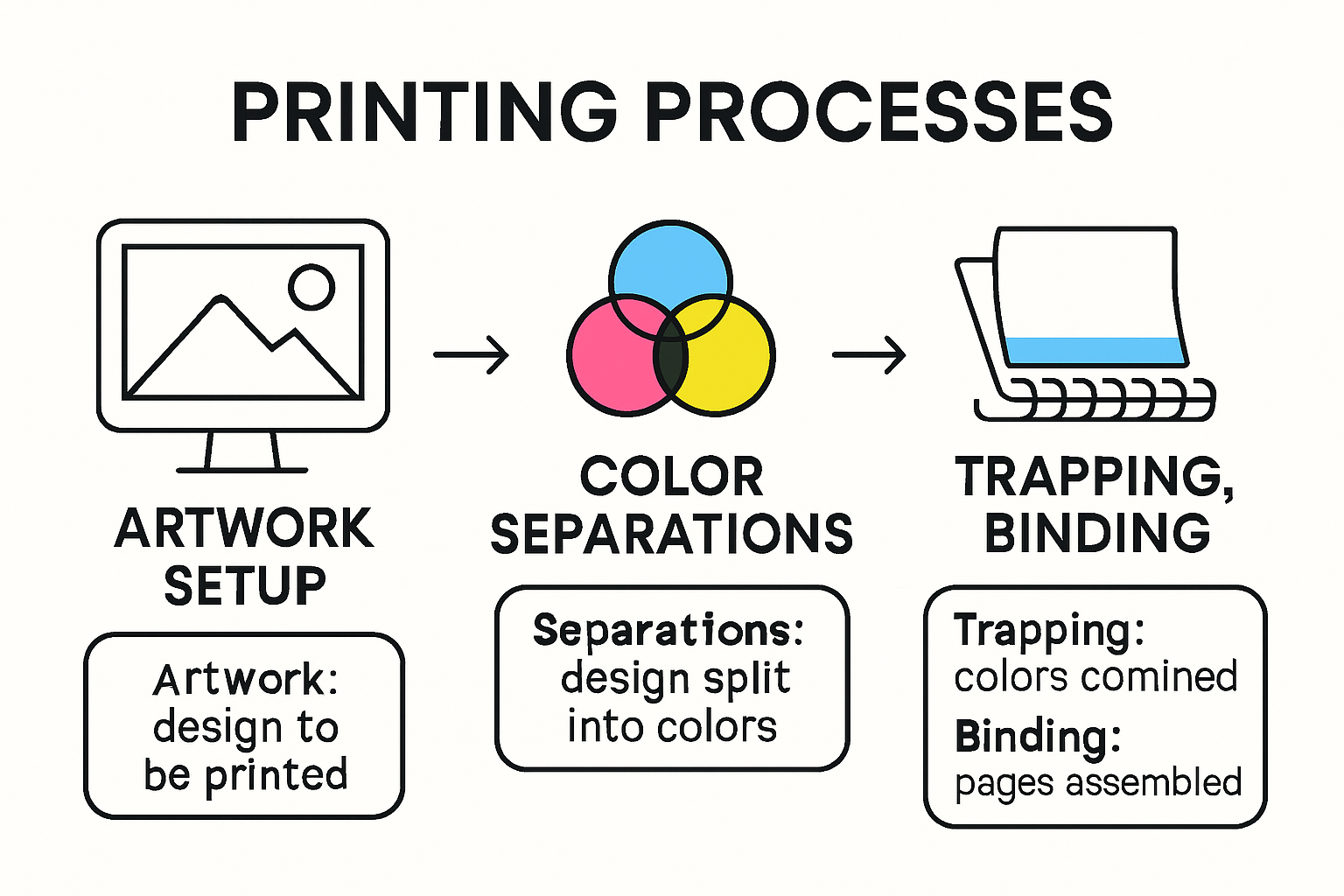
- Artwork: The complete graphic design or visual composition prepared for printing, including all graphical elements, text, and layout specifications.
- Bindery: The final stage of print production where printed materials are assembled, folded, cut, and finished into their final form.
- Web Press: A high-speed printing machine that uses large rolls of paper instead of individual sheets, enabling rapid production of newspapers, magazines, and other high-volume print materials.
Technical Equipment and Print Production Terms
The Occupational Safety and Health Administration (OSHA) highlights critical technical terms that printing professionals must understand. These terms encompass various aspects of print production equipment and processes:
- Anti-offset Powder: A fine, dry substance applied to printed sheets to prevent wet ink from sticking together during the printing and drying process.
- Color Separation: The process of dividing a color image into individual color channels (typically Cyan, Magenta, Yellow, and Black) for precise printing reproduction.
- Plate: A flat surface, traditionally made of metal or photopolymer, used in printing processes to transfer ink onto paper or other substrates.
Advanced Printing Workflow Terminology
Professionals must also be familiar with advanced terminology that describes complex printing workflows and specialized techniques. The University of Arkansas Division of Agriculture provides insights into these sophisticated print industry terms:
- Trapping: A technique used to compensate for slight misalignments during multi-color printing by creating tiny overlaps between different color layers.
- Creep: The slight shift in page position that occurs when multiple pages are folded and bound, requiring careful adjustment during document layout.
- Ghosting: An unintended print defect where faint secondary images appear on a printed page, often caused by residual ink or printing plate issues.
Mastering these printing industry terms is not just about memorization but understanding their practical applications. By developing a comprehensive vocabulary, printing professionals can communicate more effectively, troubleshoot technical challenges, and optimize their production processes.
Printing Methods and Technologies Explained
The printing industry continues to evolve with innovative technologies that transform how visual communication is produced. Explore the latest digital textile printing techniques to understand the breadth of modern printing capabilities.
Traditional Printing Technologies
Traditional printing methods have long been the backbone of print production. According to Clemson University’s open textbook, several key technologies define the industry:
- Flexography: A versatile printing method using flexible relief plates that can print on various substrates including plastics, foils, and packaging materials. This technique is particularly popular in the packaging industry due to its adaptability and efficiency.
- Offset Printing: A widely used technique where ink is transferred from a plate to a rubber blanket and then to the printing surface, producing high-quality and consistent results for large print runs.
- Screen Printing: A method that uses a mesh screen to transfer ink onto a surface, allowing for printing on diverse materials including textiles, ceramics, and metal.
Advanced Digital Printing Technologies
Digital printing technologies have revolutionized the industry with precision and flexibility. The U.S. Department of Energy highlights emerging technologies that are transforming print production:
- 3D Printing: An additive manufacturing process that constructs objects layer by layer from digital models. This technology enables the creation of complex three-dimensional objects with reduced material waste.
- Electrohydrodynamic (EHD) Printing: A cutting-edge technique that uses electric fields to eject ink, allowing for extremely precise droplet production. As documented in the National Center for Biotechnology Information, this method shows significant potential in flexible hybrid electronics.
- Digital Direct-to-Garment Printing: A technology that allows for full-color, high-resolution designs to be printed directly onto textiles, enabling on-demand and customized clothing production.
Emerging Printing Technologies
The future of printing is marked by continuous innovation and technological advancement. Emerging technologies are pushing the boundaries of what is possible in print production:
- Nanotechnology Printing: Techniques that utilize nanoscale materials to create ultra-precise and high-resolution prints with unprecedented detail.
- Bioprinting: A groundbreaking technology that uses specialized 3D printing techniques to create living tissues and biological structures, with potential applications in medical research and regenerative medicine.
- Conductive Ink Printing: Advanced printing methods that create circuits and electronic components directly on flexible surfaces, opening new possibilities in wearable technology and flexible electronics.
Understanding these printing methods and technologies is crucial for professionals seeking to remain competitive in a rapidly evolving industry. Each technique offers unique advantages, and the ability to select the right technology can significantly impact print quality, efficiency, and cost-effectiveness.
To help professionals understand the differences between traditional, digital, and emerging printing technologies, the table below provides a side-by-side comparison of the key features, substrates, and main applications of each method discussed in the article.
| Printing Technology | Key Features | Suitable Substrates | Main Applications |
|---|---|---|---|
| Flexography | Uses flexible relief plates, adaptable, efficient | Plastics, foils, packaging | Packaging, labels, flexible materials |
| Offset Printing | High-quality, consistent, ideal for large runs | Paper, cardboard | Books, magazines, newspapers |
| Screen Printing | Mesh screen transfers ink, versatile for materials | Textiles, ceramics, metal | Apparel, promotional items, signs |
| 3D Printing | Layer-by-layer construction, reduces material waste | Plastics, resins, composites | Prototypes, manufacturing, custom parts |
| EHD Printing | Electric field-driven ejection, precise droplets | Flexible substrates, electronics | Flexible hybrid electronics, circuits |
| Digital Direct-to-Garment Printing | Direct-to-textile, high-resolution, full-color | Fabrics, garments | Customized apparel, short runs |
| Nanotechnology Printing | Nanoscale precision, high resolution | Various (depends on application) | Electronics, security, fine art prints |
| Bioprinting | Specialized 3D printing with living tissues | Biological materials | Medical research, tissue engineering |
| Conductive Ink Printing | Prints circuits directly onto flexible surfaces | Plastics, films, wearable tech | Wearable electronics, smart packaging |
Common Finishing and Coating Terminology
Finishing and coating processes are critical components of print production that transform printed materials from basic sheets to polished, professional products. Discover advanced coating techniques for premium print finishes to elevate your print quality and durability.
Paper and Surface Finishing Terminology
According to the University of Cincinnati’s Printing Services Glossary, finishing encompasses a wide range of post-printing processes that enhance the appearance and functionality of printed materials:
- Finish: The surface quality or texture of paper, which can range from smooth and glossy to rough and matte. Different finishes can dramatically alter the visual and tactile experience of a printed piece.
- Embossing: A technique that creates raised or three-dimensional designs by pressing a die into the paper surface, adding texture and visual interest.
- Lamination: A protective process where a thin plastic film is applied to printed materials, providing enhanced durability, water resistance, and a glossy or matte appearance.
Coating Types and Applications
PrintWiki explains that coatings are sophisticated finishing operations that protect and enhance printed substrates. The Printing Industry Midwest provides additional insights into various coating techniques:
- Aqueous Coating: A water-based protective layer applied directly on the printing press, offering a uniform, glossy finish that protects the printed surface from minor abrasions and fingerprints.
- UV Coating: A high-gloss finish applied and instantly cured using ultraviolet light, creating a durable and vibrant protective layer that enhances color depth and provides excellent scratch resistance.
- Spot Coating: A selective coating technique where only specific areas of a printed piece are coated, allowing for creative contrast and highlighting of particular design elements.
Advanced Finishing Techniques
Modern print finishing goes beyond basic protection, offering innovative techniques that add value and functionality to printed materials:
- Soft Touch Coating: A specialized finish that creates a smooth, silk-like texture, providing a luxurious feel and reducing glare.
- Anti-Scuff Coating: A protective layer designed to prevent scratching and marring, particularly useful for packaging and materials subject to frequent handling.
- Metallic Foil Stamping: A technique that applies metallic or holographic foils to specific areas, creating eye-catching highlights and adding a premium feel to printed products.
Understanding these finishing and coating terminologies is essential for print professionals seeking to deliver high-quality, visually appealing, and durable printed materials. Each technique offers unique advantages, allowing designers and printers to select the most appropriate method for their specific project requirements.
The following table summarizes essential finishing and coating techniques, outlining each method’s purpose and the main benefits, which can help professionals choose the right option for their print projects.
| Technique | Purpose/Description | Key Benefits |
|---|---|---|
| Embossing | Creates raised designs using dies | Adds texture, tactile and visual interest |
| Lamination | Applies a thin plastic film over prints | Increases durability, water resistance |
| Aqueous Coating | Water-based coating applied on press | Glossy finish, protects against minor damage |
| UV Coating | High-gloss finish cured by ultraviolet light | Enhances color, strong scratch resistance |
| Spot Coating | Applies coating to selected areas only | Highlights design elements, creative effects |
| Soft Touch Coating | Produces a smooth, silk-like finish | Luxurious feel, reduces glare |
| Anti-Scuff Coating | Protective layer for high-contact items | Prevents scratching and marring |
| Metallic Foil Stamping | Applies metallic/holographic foil to selected areas | Premium effect, eye-catching highlights |

Industry-Specific Terms for Packaging and Materials
Packaging and materials terminology represents a complex and evolving field that intersects design, manufacturing, and environmental considerations. Explore innovative packaging material solutions to understand the breadth of modern packaging technologies.
Packaging Material Composition Terminology
According to Wikipedia’s comprehensive overview, packaging materials encompass a diverse range of substrates and manufacturing techniques:
- Molded Pulp: A sustainable packaging material created from recycled paperboard and newsprint, used for protective packaging and food service trays. This environmentally friendly option provides an alternative to traditional plastic-based packaging materials.
- Corrugated Fiberboard: A structured material consisting of a fluted corrugated sheet sandwiched between flat linerboards, renowned for its strength and lightweight properties. Manufacturers use specialized ‘corrugators’ to produce these versatile packaging solutions.
- Flexible Packaging: Materials like plastic films, metallic foils, and laminated structures that can be easily shaped and sealed, offering versatility in product protection and presentation.
Printing and Coating Techniques for Packaging
Flexography represents a critical printing technology for packaging materials, offering unique capabilities for various substrate printing:
- Substrate Printing: The process of applying graphics and information directly onto packaging materials, utilizing specialized printing techniques that accommodate different surface properties.
- Food-Grade Coating: Protective layers applied to packaging materials to ensure food safety, prevent contamination, and maintain product integrity.
- Barrier Coating: Advanced protective treatments that prevent moisture, oxygen, and other environmental factors from compromising packaged products.
Advanced Packaging Terminology
Modern packaging technologies incorporate sophisticated terms that reflect innovative design and functional requirements:
- Modified Atmosphere Packaging (MAP): A technique that alters the internal atmosphere of a package to extend product shelf life by controlling oxygen and carbon dioxide levels.
- Tamper-Evident Packaging: Specialized design features that provide visual indication if a package has been opened or compromised before purchase.
- Sustainable Packaging: Design approach focusing on minimizing environmental impact through material selection, reduced waste, and recyclability.
Understanding these packaging and materials terms is crucial for professionals navigating the complex landscape of modern product protection and presentation. Each term represents a sophisticated approach to solving practical challenges in manufacturing, preservation, and environmental responsibility.
Frequently Asked Questions
What are some essential printing industry terms that professionals should know?
Key terms include ‘artwork’, ‘bindery’, and ‘web press’. Understanding these terms is crucial for effective communication in the printing industry.
What is the significance of color separation in printing?
Color separation is the process of dividing an image into separate color channels for precise reproduction during the printing process, ensuring that each color is printed accurately.
How does 3D printing differ from traditional printing methods?
3D printing is an additive manufacturing process that builds objects layer by layer from digital models, significantly reducing material waste compared to traditional subtractive methods.
What are the benefits of using aqueous and UV coatings in printing?
Aqueous coatings provide a glossy finish and protect against minor abrasions, while UV coatings create a strong, high-gloss finish that enhances color depth and provides exceptional scratch resistance.
Bridge the Gap Between Knowledge and Professional Printing Success
Mastering essential industry terminology is just the beginning. Bringing clarity to terms like color separation, substrate printing, or accurate coatings is powerful, but it can feel overwhelming when you need to deliver flawless results for clients right now. Many printing professionals face the daily challenge of matching colors precisely, choosing the right substrate, and explaining technical concepts to clients without the right resources in hand. These pain points can delay projects or compromise quality.
Stop second-guessing your color choices and finishing options. At Kolorguide.com, you will find the industry-leading color guides, Pantone swatches, and premium graphic arts supplies that help you apply your new terminology expertise in real-world print jobs. Trust our curated color management tools and fast service to keep you ahead of deadlines and ensure your work stands out for all the right reasons. Take the next step in your professional journey by exploring our full range of color reference solutions. Make your next print project perfect—shop now to experience accuracy and confidence with every job.

