
No products in the cart.
Return To ShopSurface Energy Tension in Industry: 2025 Guide for Printers & Manufacturers
Every year, countless manufacturing lines grind to a halt because of bad adhesion and failed coatings. That sounds like a small technical glitch, but it actually costs the industry billions annually. Here is what surprises most people. Just a tiny change in surface energy tension can make the difference between perfect adhesion and costly rework, and the right adjustment slashes waste by up to 30 percent. This science might seem hidden in a lab, but it is the secret power move for any printer or manufacturer in 2025.
Table of Contents
- Understanding Surface Energy Tension Basics
- Why Surface Energy Tension Matters In Manufacturing
- Best Practices For Measuring And Controlling Surface Energy Tension
- Surface Energy Tension Solutions For Industry Challenges
Quick Summary
| Takeaway | Explanation |
|---|---|
| Surface energy affects adhesion and coating. | Managing surface energy tension is crucial for ensuring effective bonding and optimal coating performance in manufacturing processes. |
| Advanced measurement techniques enhance accuracy. | Techniques like Atomic Force Microscopy provide precise surface tension measurements, essential for quality control in production. |
| Modify surface energy for better material interactions. | Techniques such as plasma treatments and thin-film coatings can enhance material compatibility and wetting properties significantly. |
| Control environmental conditions during production. | Factors like humidity and temperature should be managed consistently to ensure optimal surface energy tension in materials. |
| Continuous optimization is essential for success. | Regular monitoring and adjustment of surface energy tension are necessary for maintaining product quality and performance. |
Understanding Surface Energy Tension Basics
Surface energy tension represents a critical physical phenomenon that plays a fundamental role across multiple industrial applications, particularly in printing and manufacturing processes. At its core, surface energy tension describes the molecular interactions at the boundary between a liquid and another medium, which significantly impacts adhesion, wetting, and material performance.
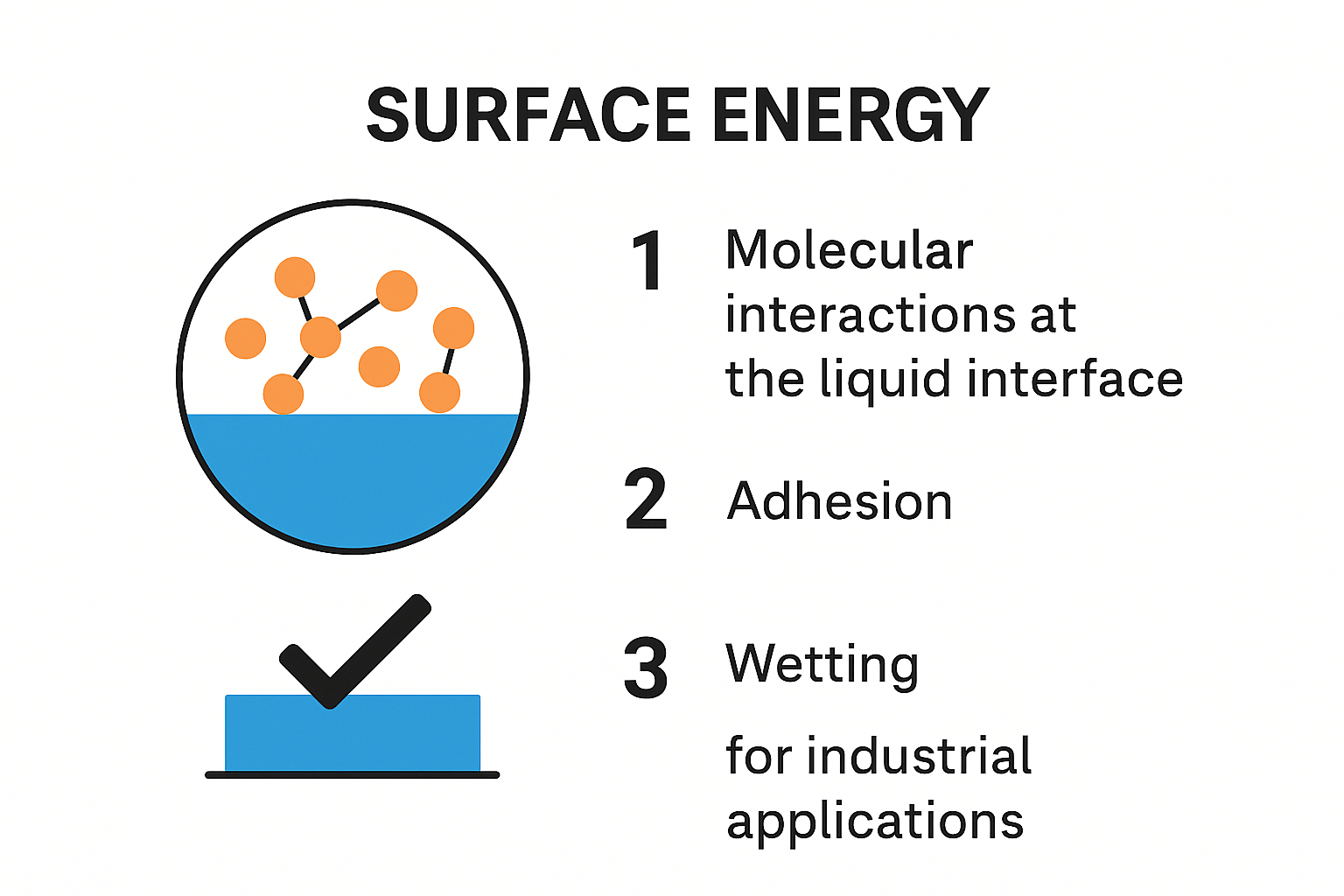
The Molecular Science Behind Surface Energy
At the microscopic level, surface energy tension emerges from the complex interactions between molecules. Learn more about molecular dynamics in material science reveals that molecules within a liquid experience unique intermolecular forces. According to Britannica, these forces create a phenomenon where the liquid surface behaves like an elastic membrane.
When liquid molecules are surrounded by other molecules, they experience balanced attractive forces. However, molecules at the surface encounter an imbalance, with fewer neighboring molecules pulling them inward. This molecular asymmetry generates surface tension, causing liquids to minimize their surface area and create phenomena like water droplets forming nearly perfect spheres.
Practical Implications in Industrial Processes
Understanding surface energy tension becomes crucial for industries requiring precise material interactions. In printing and manufacturing, this property directly influences critical processes such as coating adhesion, ink spreading, and material compatibility. The United States Geological Survey highlights that surface tension determines how liquids interact with solid surfaces, which is paramount in creating high-quality printed materials.
For manufacturers and printers, managing surface energy tension means controlling molecular interactions to achieve optimal performance. This involves understanding how different materials interact, predicting coating behaviors, and ensuring consistent print quality. Technical professionals must consider surface energy when selecting inks, designing printing processes, and evaluating material compatibility.
The measurement of surface energy tension typically involves calculating the energy required to increase a liquid’s surface area by a unit measurement. As Purdue University’s Chemistry Department explains, this quantitative approach allows industries to systematically analyze and predict material behaviors.
Practical applications range from ensuring proper ink adhesion on various substrates to developing advanced coatings that perform consistently across different environmental conditions. Manufacturers who master surface energy tension principles can significantly improve product quality, reduce waste, and optimize production processes.
Whether working with polymers, metals, or specialized printing substrates, understanding the fundamental principles of surface energy tension provides a competitive edge in precision manufacturing and graphic arts industries.
Why Surface Energy Tension Matters in Manufacturing
Surface energy tension represents a critical parameter that significantly influences manufacturing processes across multiple industries. Its impact extends far beyond simple molecular interactions, directly affecting product quality, performance, and manufacturing efficiency.
Critical Role in Material Adhesion and Coating
In manufacturing, surface energy tension determines how effectively materials bond, spread, and interact. According to research from Wikipedia, surface energy quantifies the disruption of intermolecular bonds when a surface is created, which is fundamental to processes like coating, painting, and adhesion. Learn more about material interactions reveals that precise control of surface energy can dramatically improve product outcomes.
Manufacturers leverage techniques such as plasma activation, wet chemical treatment, and thin-film coating to modify surface energy. These methods enhance wetting properties, ensuring consistent and high-quality manufacturing results. For instance, in electronics and printed circuit board production, managing surface energy is crucial for ensuring proper solder mask adhesion and preventing defects.
Precision in Advanced Manufacturing Techniques
Advanced manufacturing processes demonstrate the profound importance of surface energy tension. A 2018 research study examining cohesion in fine metal powders used in additive manufacturing highlighted how surface energy influences powder behavior. The research revealed that neglecting cohesive forces can lead to significant underestimations of material properties, emphasizing the need for precise surface energy management.
In inkjet printing and similar high-precision manufacturing methods, surface energy tension becomes even more critical. A 2017 study investigating droplet formation in piezoelectric inkjet printing found that surface tension directly controls print quality and speed. The research demonstrated that manipulating the contact angle and surface tension can dramatically improve droplet formation, velocity, and overall print consistency.
Manufacturers must understand that surface energy tension affects multiple critical parameters. These include:
- Adhesive bonding strength
- Coating uniformity
- Material wettability
- Printing and deposition precision
- Resistance to environmental factors
By carefully controlling surface energy, manufacturers can optimize product performance, reduce material waste, and enhance overall production quality. The ability to predict and manipulate molecular interactions provides a significant competitive advantage in industries ranging from electronics and automotive to packaging and medical devices.
Understanding and mastering surface energy tension is no longer optional but a fundamental requirement for modern manufacturing excellence. As technological demands increase and manufacturing tolerances become ever more precise, the role of surface energy tension will only grow in importance.
Best Practices for Measuring and Controlling Surface Energy Tension
Measuring and controlling surface energy tension requires a systematic approach that combines advanced technological methods with precise analytical techniques. Manufacturers and printers must implement robust strategies to ensure consistent material performance and product quality.
Advanced Measurement Techniques
Explore precision measurement methods reveals the complexity of surface energy assessment. According to the National Institute of Standards and Technology, advanced measurement techniques like the Maximum Force Technique using Atomic Force Microscopy (AFM) provide unprecedented accuracy in surface tension measurements. This method involves measuring the maximum force exerted on a quartz rod as it is pulled from an air/fluid interface, offering manufacturers a powerful tool for precise quality control.
Researchers from the University of Hawaii emphasize the importance of measuring surface free energies for both liquid and solid surfaces. Drop shape analysis emerges as a critical methodology, allowing professionals to understand material interactions through detailed contact angle measurements. This approach enables manufacturers to predict and control how different materials will interact, ensuring consistent performance across various production environments.

Practical Control Strategies
Controlling surface energy tension requires a multifaceted approach. A comprehensive study demonstrates the effectiveness of developing low-cost goniometers for measuring contact angles and calculating surface free energy. These instruments provide manufacturers with actionable insights into material properties, allowing for precise modifications and quality assurance.
Key control strategies include:
- Surface Preparation: Implementing rigorous cleaning and treatment protocols
- Chemical Modification: Using plasma treatment or chemical coatings
- Environmental Control: Managing humidity and temperature during production
- Regular Calibration: Maintaining measurement equipment for consistent accuracy
Manufacturers must recognize that surface energy control is not a one-time process but a continuous optimization strategy. Each production run requires careful monitoring and potential adjustments to maintain optimal material performance.
The most successful approaches integrate multiple measurement techniques, combining quantitative data from advanced scientific instruments with practical production insights. This holistic method allows for real-time adjustments and predictive quality management.
Industry professionals should invest in comprehensive training programs that help teams understand the nuanced relationship between surface energy tension and material performance. By developing a deep technical understanding and implementing sophisticated measurement protocols, manufacturers can significantly improve product consistency, reduce waste, and enhance overall production efficiency.
As technology continues to advance, the ability to precisely measure and control surface energy tension will become an increasingly critical competitive advantage across manufacturing and printing industries.
To clarify the available options for measuring and controlling surface energy tension, the following table summarizes the main techniques and strategies discussed in this section:
| Technique or Strategy | Description | Typical Use |
|---|---|---|
| Atomic Force Microscopy (AFM) | Measures maximum force at air/fluid interface to quantify surface tension | High-precision measurement & QC |
| Drop Shape Analysis | Determines contact angles to analyze surface free energy | Predicting material interactions |
| Low-Cost Goniometers | Measures contact angles to calculate surface free energy | Practical, routine analysis |
| Surface Preparation | Cleaning and treatment to optimize surface properties | Enhancing adhesion and coating |
| Chemical Modification | Plasma or chemical treatments to adjust surface energy | Modifying wettability |
| Environmental Control | Managing humidity/temperature during production | Maintaining consistent surface energy |
| Regular Calibration | Ongoing equipment upkeep for accuracy | Quality assurance |
Surface Energy Tension Solutions for Industry Challenges
Industrial challenges related to surface energy tension demand innovative and strategic solutions that address complex material interaction problems. Manufacturers and printers face increasingly sophisticated requirements that necessitate advanced approaches to managing surface properties.
Advanced Surface Modification Techniques
Explore cutting-edge surface treatment methods reveals the complexity of modern surface modification strategies. Research from 2016 highlights the critical importance of surface treatments like UV-ozone cleaning and silanization for tuning substrate surface energy. These techniques enable precise control of wetting behavior, particularly in high-resolution applications such as semiconductor film production.
Specialized surface modification approaches offer targeted solutions across multiple industries. For instance, in electronics manufacturing, depositing thin polymeric layers can mediate substrate wetting challenges. A 2018 study demonstrated that the chemical nature of these polymers determines surface energy and polarity, allowing manufacturers to achieve exceptional pattern quality and substrate compatibility.
Strategic Solutions for Printing and Manufacturing
Inkjet printing presents unique surface energy tension challenges that require sophisticated intervention. Research from 2017 revealed that controlling nozzle wall wettability and ink surface tension dramatically improves print quality and speed. Manufacturers can implement strategic solutions such as:
- Hydrophilic Nozzle Modification: Enhancing inner nozzle surface properties
- Precise Ink Formulation: Developing inks with optimized surface tension characteristics
- Substrate Pre-treatment: Preparing surfaces for improved material interactions
- Environmental Control: Managing humidity and temperature during production
These approaches transform surface energy tension from a potential manufacturing obstacle into a controllable parameter. By understanding and manipulating molecular interactions, industry professionals can achieve unprecedented levels of precision and consistency.
Comprehensive solutions require an integrated approach that combines advanced measurement techniques, targeted surface modifications, and continuous process optimization. Manufacturers must view surface energy tension not as a static property but as a dynamic characteristic that can be systematically managed and improved.
Emergent technologies continue to expand our understanding of surface interactions. Nanotechnology, advanced polymer science, and sophisticated measurement techniques are rapidly transforming how industries approach surface energy challenges. Professionals who invest in understanding these complex molecular interactions will gain significant competitive advantages in precision manufacturing and high-performance printing applications.
As industrial demands become increasingly sophisticated, the ability to precisely control and manipulate surface energy tension will become a critical differentiator across multiple manufacturing sectors. Embracing these advanced solutions represents not just a technological upgrade but a fundamental shift in how we understand and engineer material interactions.
Below is a summary table of common surface energy tension modification techniques and their application focus as mentioned in this section:
| Modification Technique | Application Focus | Example Industry |
|---|---|---|
| UV-Ozone Cleaning | Tuning substrate surface energy | Semiconductor |
| Silanization | Wetting control and surface property tuning | Electronics, Printing |
| Thin Polymeric Film Deposition | Mediating substrate wetting challenges | Electronics |
| Plasma Activation | Improving wetting and adhesion | Manufacturing |
| Hydrophilic Nozzle Treatment | Enhancing inkjet print quality and speed | Printing |
| Substrate Pre-treatment | Improving material compatibility | Printing, Packaging |
| Environmental Control | Managing humidity/temperature for consistency | All |
Frequently Asked Questions
What is surface energy tension and why is it important in manufacturing?
Surface energy tension refers to the molecular interactions at the boundary between a liquid and another medium, affecting adhesion, wetting, and material performance. It is crucial in manufacturing because it determines how effectively materials bond and interact, directly impacting product quality and efficiency.
How can surface energy tension be measured in industrial processes?
Surface energy tension can be measured using advanced techniques such as Atomic Force Microscopy (AFM) and drop shape analysis to determine contact angles. These methods provide precise data on surface properties, enhancing quality control during production.
What are some common strategies to control surface energy tension?
Common strategies include rigorous surface preparation, chemical modifications like plasma treatment, and environmental control to manage humidity and temperature during production. Regular calibration of measurement equipment is also vital to maintain accuracy.
How does surface energy tension impact printing quality?
In printing, surface energy tension affects droplet formation, adhesion, and ink spreading. Precise control of surface energy can significantly improve print quality, speed, and consistency, making it essential for high-precision manufacturing methods like inkjet printing.
Ready to Master Surface Energy for Printing Excellence?
Struggling with wasted materials and inconsistent adhesion is frustrating, especially when every misstep impacts your bottom line. The article highlighted how just a small shift in surface energy tension can cause costly rework and disrupt your entire production process. Imagine taking full control over adhesion, coating, and print quality using solutions built for the modern graphic arts and printing industry.

Kolor Guide empowers you to solve these challenges fast. We provide proven products and tools that help printers and manufacturers optimize material compatibility and surface energy in real time. Avoid production headaches and keep your presses running with ease. Start making real improvements in print performance today. Visit Kolor Guide to explore our trusted solutions. Discover how you can achieve flawless adhesion and cut your waste—do not let another faulty batch slow you down. Take action now and advance your surface energy control with support from the experts in your industry.

