No products in the cart.
Return To Shop
The Most Common Types of Printing Methods Explained
Everyone sees printed packaging and flyers every day and most people think printing is just ink on paper. Yet the options run much deeper than that. Did you know that flexographic printing handles more than 60 percent of all packaging worldwide and digital methods are shaking up everything from textiles to electronics? New printing techniques are transforming how products look, feel, and even function—so the way we print is almost as important as what gets printed.
Table of Contents
- Overview Of Major Printing Methods
- Printing Techniques By Industry Applications
- Key Factors For Choosing The Right Printing Method
- Emerging Technologies In Modern Printing
Quick Summary
| Takeaway | Explanation |
|---|---|
| Choose printing based on application. | Different printing methods serve specific industrial needs, so alignment with application requirements is crucial for optimal outcomes. |
| Consider material compatibility. | The printing substrate’s texture, thickness, and chemical properties can significantly affect method selection and final results. |
| Assess production volume and costs. | Digital printing is cost-effective for short runs, while traditional methods like offset lithography are better for larger batches. |
| Prioritize print quality and performance. | Desired attributes, such as resolution and color consistency, vary by method and must be matched to specific quality requirements. |
| Stay updated on emerging technologies. | New advancements like 3D printing and sustainable approaches are reshaping the printing industry, thus requiring ongoing knowledge to maintain competitiveness. |
Overview of Major Printing Methods
Printing technologies have evolved dramatically over centuries, transforming how we communicate, market, and produce visual information across multiple industries. Understanding the various types of printing methods provides critical insights into selecting the most appropriate technique for specific applications.
Core Printing Process Classifications
Printing methods can be broadly categorized into several fundamental classifications based on their technical approach and image transfer mechanisms. According to the University of Illinois at Urbana-Champaign, these classifications determine the printing technique’s efficiency, cost-effectiveness, and suitable production environments.
To help compare the main printing methods discussed in the article, the following table summarizes key features, applications, and typical use cases for each:
| Printing Method | Transfer Approach | Common Applications | Typical Substrates |
|---|---|---|---|
| Letterpress | Direct | Traditional books, stationery | Paper, cardboard |
| Screen Printing | Direct | Textiles, electronics, industrial labels | Textiles, glass, metal, ceramics |
| Flexography | Direct | Packaging, labels, shopping bags | Plastic films, corrugated, metallic |
| Offset Lithography | Indirect | Newspapers, magazines, marketing print | Paper, cardboard |
| Gravure | Indirect | High-volume packaging, publication | Paper, flexible packaging |
| Digital Printing | (Usually) Direct | Short runs, custom print jobs, textiles | Paper, textiles, specialty surfaces |
Direct Printing Methods involve transferring an image directly from the printing plate or surface onto the target material. These techniques typically include:
- Letterpress: A traditional method where raised surfaces are inked and pressed against the printing substrate
- Screen Printing: Uses a mesh screen to transfer ink onto surfaces, excellent for textiles and promotional materials
- Flexography: Utilizes flexible relief plates, commonly used in packaging and label production
Indirect Printing Methods transfer images through an intermediary surface, offering greater precision and versatility. The Plate Number Coil Collectors Club highlights these methods as particularly sophisticated for complex graphic reproduction.
Industrial and Commercial Applications
Each printing method serves unique industrial requirements, making the selection process critical for achieving optimal results. Lithographic offset printing dominates commercial printing, while gravure printing excels in high-volume packaging and publication production. Digital printing has emerged as a flexible solution for short-run, customized print jobs across various sectors.
The diversity of printing technologies reflects the complex demands of modern visual communication. From packaging design to marketing collateral, understanding these methods empowers professionals to make informed decisions about their print production strategies. Learn more about advanced color management techniques to complement your printing workflow and enhance overall output quality.
As industrial requirements continue to evolve, printing technologies adapt, integrating advanced materials, sustainable practices, and precision engineering to meet increasingly sophisticated market demands. Professionals must remain knowledgeable about these technological nuances to leverage the most appropriate printing methods for their specific applications.
Printing Techniques by Industry Applications
Printing technologies have become integral to diverse industrial sectors, with each printing method offering unique capabilities tailored to specific applications and material requirements. The versatility of modern printing techniques enables sophisticated visual communication across multiple professional domains.
Packaging and Manufacturing Printing
In the packaging industry, printing techniques play a critical role in product presentation, branding, and information dissemination. According to the U.S. Environmental Protection Agency, flexographic printing dominates packaging production. This method excels in printing on non-porous substrates like plastic films, metallic surfaces, and corrugated materials.
Key Packaging Applications include:
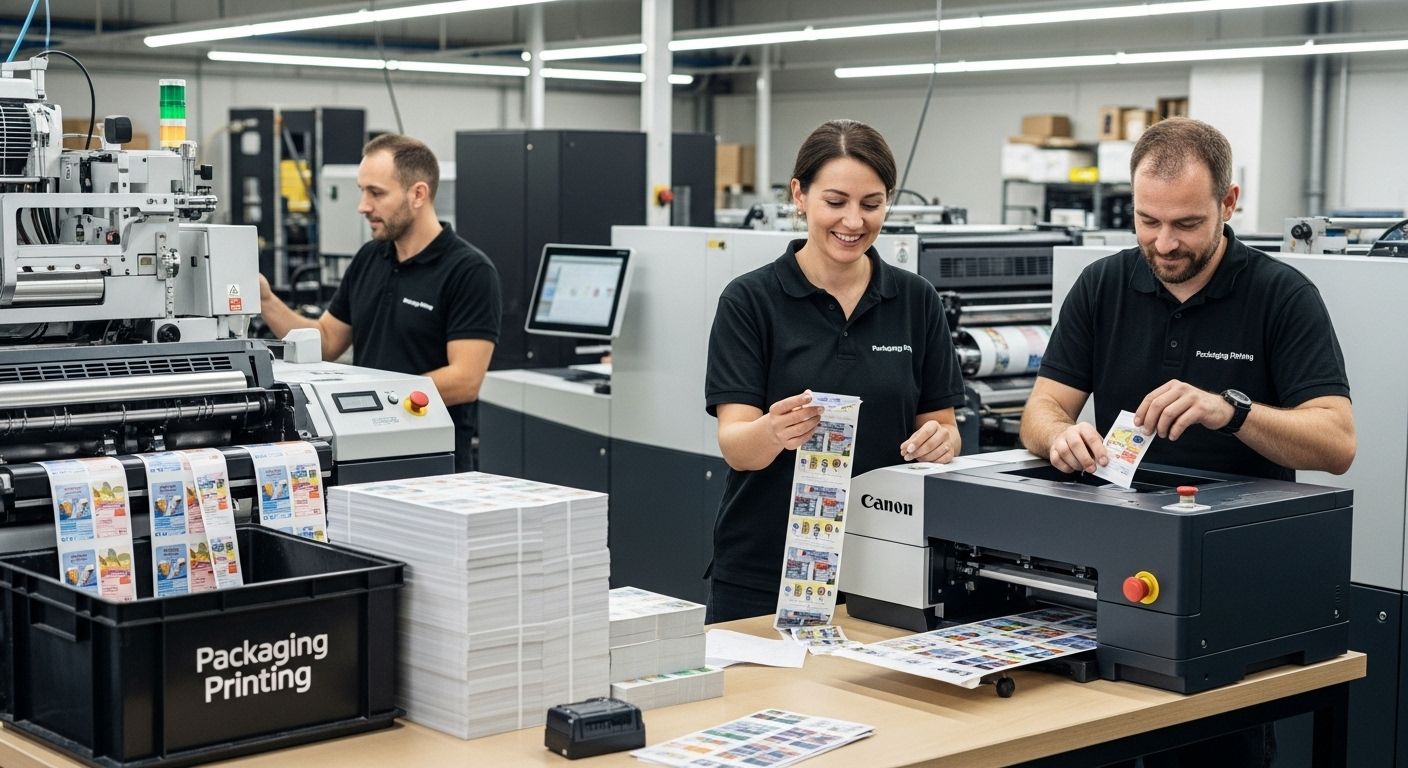
- Food packaging materials
- Beverage cartons
- Self-adhesive labels
- Retail and shopping bags
- Disposable containers
Digital textile printing technologies have revolutionized industrial printing, offering unprecedented precision and customization capabilities across multiple sectors.
Specialized Industrial Printing Techniques
Screen printing demonstrates remarkable versatility across multiple industries. Wikipedia highlights its extensive applications, ranging from medical device manufacturing to electronics production. This technique enables printing on diverse surfaces including ceramics, glass, metal, and specialized substrates.
Unique Industrial Applications of Screen Printing:
- Medical device component marking
- Electronic circuit board production
- Printed electronics manufacturing
- Specialized technical textile production
- Decorative industrial components
The electronics industry particularly benefits from screen printing’s ability to create precise, multilayered conductive circuits on various materials. Manufacturers leverage this technique for producing complex electronic components with exceptional accuracy and repeatability.
Technology and Communication Printing
Offset lithography remains the cornerstone of commercial communication printing. This technique produces high-quality printed materials for newspapers, magazines, marketing collateral, and corporate documentation. Its ability to reproduce intricate details with consistent color reproduction makes it invaluable in communication and media industries.
Modern printing technologies continue evolving, integrating advanced materials science, precision engineering, and digital innovations. Professionals across industries must stay informed about emerging printing techniques to optimize their visual communication strategies and maintain competitive advantage in rapidly changing markets.
As manufacturing and communication requirements become increasingly sophisticated, printing methods will continue adapting, offering more sustainable, precise, and versatile solutions for complex industrial challenges.
Key Factors for Choosing the Right Printing Method
Selecting the appropriate printing method requires careful consideration of multiple technical, economic, and strategic factors. Professionals must evaluate a complex interplay of variables to ensure optimal results that balance quality, cost-effectiveness, and production requirements.
For quick reference, the following table organizes the main factors to consider when choosing a printing method, along with what each factor typically impacts:
| Factor | What to Consider | Why It Matters |
|---|---|---|
| Material / Substrate | Texture, thickness, chemical composition | Determines compatible printing techniques |
| Production Volume | Number of copies required | Affects cost-effectiveness and method choice |
| Economic Efficiency | Setup costs, unit price for run size | Impacts budget planning |
| Print Quality Requirements | Resolution, color accuracy, detail | Ensures final output meets expectations |
| Durability/Performance Needs | Environmental resistance, adhesion | Affects longevity and usability |
Material and Substrate Considerations
The physical characteristics of the printing substrate represent a critical determinant in method selection. According to Castle Press, different printing techniques excel with specific materials, making substrate compatibility a primary decision factor.
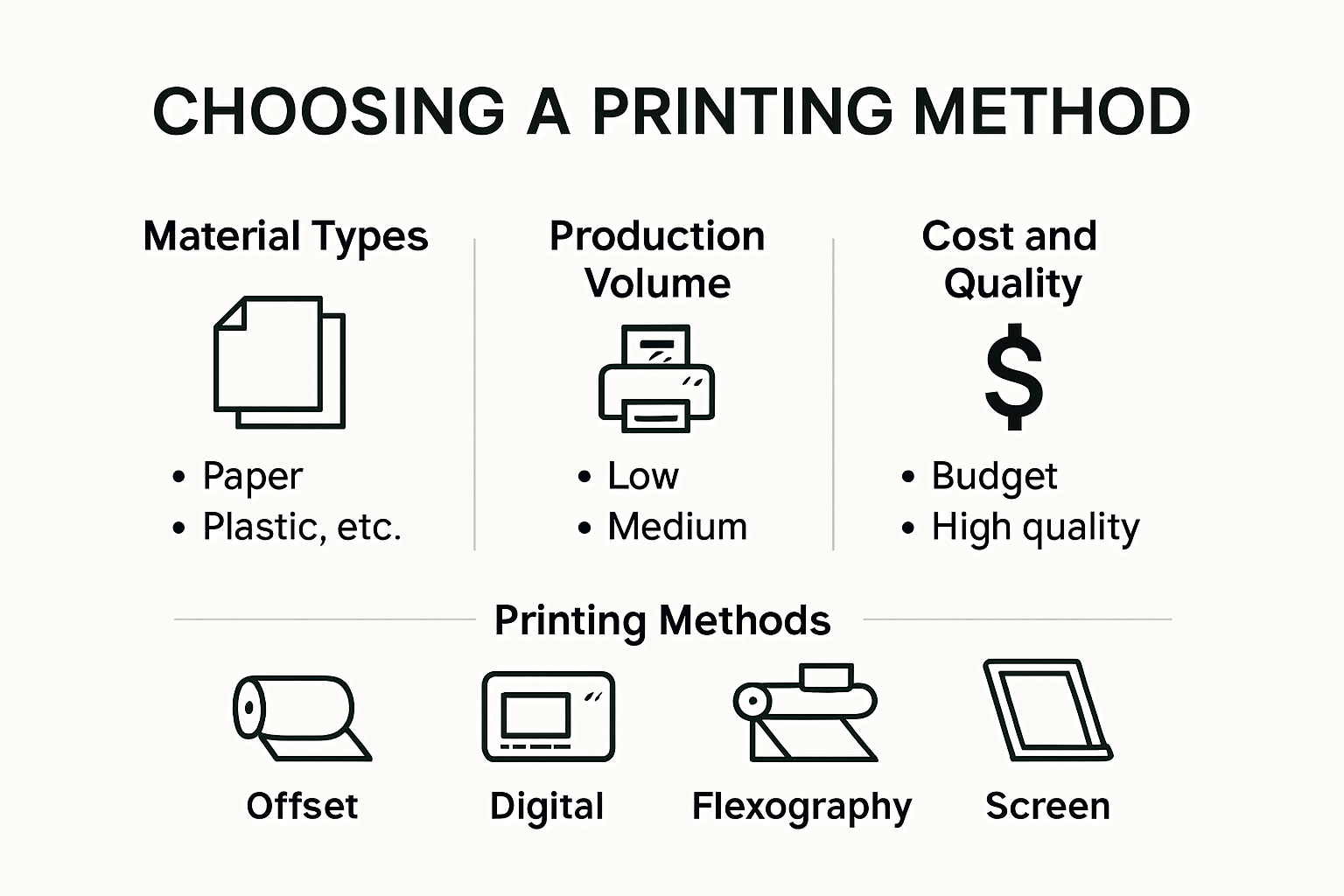
Key Material Evaluation Criteria:
- Surface texture and porosity
- Material thickness
- Chemical composition
- Intended end-use environment
- Durability requirements
For instance, flexible packaging demands different printing approaches compared to rigid surfaces like ceramics or metal. Screen printing offers exceptional versatility for complex surface printing, while flexography provides superior performance for non-porous substrates.
Production Volume and Economic Efficiency
Production scale significantly influences printing method selection. The Education Bureau recommends evaluating economic implications across different print volumes. Digital printing emerges as cost-effective for smaller batches, whereas offset lithography becomes more economical for larger production runs.
Volume-Based Printing Strategy:
- Short runs (1-500 copies): Digital printing
- Medium runs (500-5000 copies): Offset lithography
- Large industrial runs: Specialized techniques like gravure or flexography
Advanced digital textile printing technologies have revolutionized production economics by enabling rapid customization and reduced setup costs.
Quality and Technical Performance Requirements
The desired print quality and technical specifications are paramount in method selection. Resolution, color accuracy, and reproduction fidelity vary significantly across different printing technologies. Complex graphic designs might require high-precision techniques like offset printing, while industrial marking may prioritize durability over intricate detail.
Professionals must consider additional performance parameters such as:
- Color consistency
- Image resolution
- Ink adhesion properties
- Long-term material stability
- Environmental resistance
Understanding these nuanced selection criteria empowers businesses to optimize their printing strategies, balancing technical requirements with economic constraints. As printing technologies continue evolving, staying informed about emerging techniques becomes crucial for maintaining competitive advantage in rapidly changing visual communication landscapes.
Emerging Technologies in Modern Printing
The printing industry stands at the forefront of technological innovation, rapidly transforming traditional production methods through groundbreaking digital and additive manufacturing technologies. These emerging approaches are redefining the boundaries of visual communication and industrial production.
Digital Manufacturing and Functional Printing
According to the National Institute of Standards and Technology, digital printing technologies are revolutionizing manufacturing processes by enabling unprecedented levels of customization and precision. Functional printing goes beyond traditional visual reproduction, integrating advanced materials and smart technologies into the printing process.
Key Innovations in Functional Printing:
- Conductive ink printing for electronic circuits
- Biomedical printing of tissue scaffolds
- Smart packaging with embedded sensors
- Printed electronics for flexible displays
- Adaptive material printing with responsive properties
Digital textile printing technologies have particularly transformed manufacturing by allowing rapid prototyping and on-demand production with minimal waste.
Additive Manufacturing and 3D Printing Technologies
The National Academies Press highlights 3D printing as a transformative technology rapidly expanding across multiple industrial sectors. This technique enables complex geometries and multi-material production that traditional printing methods cannot achieve.
Advanced 3D Printing Applications:
- Aerospace component manufacturing
- Medical prosthetics and implants
- Architectural model production
- Rapid prototyping in automotive design
- Customized consumer product development
Sustainable and Intelligent Printing Solutions
Emerging printing technologies are increasingly focused on sustainability and intelligent design. Advanced printing methods now incorporate eco-friendly materials, energy-efficient processes, and intelligent data integration. These technologies enable more responsive, adaptable, and environmentally conscious production strategies.
Intelligent printing solutions now leverage artificial intelligence and machine learning to optimize color reproduction, predict material behavior, and enhance production efficiency. These technologies represent a significant leap beyond traditional printing methods, transforming how industries approach visual communication and manufacturing.
As technological capabilities continue to expand, printing technologies will increasingly blur the lines between digital design, material science, and manufacturing. Professionals across industries must remain adaptable and informed about these rapid technological transformations to maintain competitive advantage in an increasingly complex and dynamic production landscape.
Frequently Asked Questions
What are the main printing methods used in packaging?
Flexographic printing is the most common method in packaging, accounting for more than 60 percent of global packaging. It is known for its efficiency with non-porous substrates like plastic films and metallic surfaces.
How does digital printing compare to traditional printing methods?
Digital printing is cost-effective for short runs and allows for high customization, while traditional methods like offset lithography are more economical for large volume production due to lower unit costs with higher quantities.
What factors should I consider when choosing a printing method?
Key factors include the material compatibility, production volume, economic efficiency, print quality requirements, and durability or performance needs of the printed product.
What are the emerging trends in printing technologies?
Emerging trends include digital manufacturing, functional printing with smart materials, and sustainable printing solutions that incorporate eco-friendly practices and intelligent design technologies.
Master Your Print Quality with Professional Color Tools
If you are struggling with print inconsistencies, color mismatches, or choosing the right method for different materials and volumes, you are not alone. This article explored the challenges of material compatibility, color accuracy, and efficient workflow in printing. Many professionals face these same issues when producing packaging, marketing materials, or industrial prototypes. Color fidelity is critical for every method, from flexography to digital printing. Without the right color management solutions, even the most advanced printing technology cannot deliver consistent results.
Take control of your color workflow today with Kolorguide.com. Browse our selection of genuine Pantone color guides and swatches designed for printing, design, and manufacturing industries. Fast delivery in the USA means you can stay on schedule. Stop guessing with color and start working with confidence. Visit Kolorguide.com now to discover the industry’s trusted tools for perfect print results.

