No products in the cart.
Return To Shop
Understanding CMYK vs RGB Colors in Design and Printing
Everyone’s seen a photo look perfect on a phone screen but completely off when it lands on paper. Did you know RGB color can produce about 16.7 million shades, while CMYK covers only around 7,000? The surprising part is that the difference has almost nothing to do with quality and everything to do with how our eyes and printers read color. This clash between color models quietly shapes every brand logo, web ad, and product package you see.
Table of Contents
- The Basics Of Color Models: Cmyk And Rgb
- Why Cmyk And Rgb Colors Matter In Design
- How Cmyk And Rgb Work: Technical Insights
- Key Differences Between Cmyk And Rgb Applications
- Real-World Impact Of Cmyk And Rgb In Various Industries
Quick Summary
| Takeaway | Explanation |
|---|---|
| Understand RGB for digital design | RGB is used for screens, creating colors through light. It’s essential for web graphics and digital content. |
| Utilize CMYK for print materials | CMYK is the standard for physical printing, using ink to achieve color accuracy on paper products like brochures and packaging. |
| Manage color consistency across media | Consistent color use across digital and print formats is crucial for brand integrity and recognition. Maintain exact color codes during conversions. |
| Leverage color management tools | Use professional software to accurately convert colors between RGB and CMYK, ensuring visual integrity in projects. |
| Be aware of color limitations | RGB has a broader color range than CMYK. Designers must understand each model’s strengths and limitations for optimal results. |
The Basics of Color Models: CMYK and RGB
Color models are fundamental systems that help designers and printers understand and reproduce color accurately across different mediums. Two of the most critical color models are RGB (Red, Green, Blue) and CMYK (Cyan, Magenta, Yellow, Key/Black), each serving distinct purposes in visual communication and reproduction.
Understanding RGB Color Model
The RGB color model is an additive color system primarily used in digital displays like computer monitors, smartphone screens, and television sets. In this model, colors are created by combining varying intensities of red, green, and blue light. When these primary colors are mixed at full intensity, they produce white, while the absence of all colors results in black. Research from Harvard University confirms that RGB offers a broader color spectrum, making it ideal for electronic displays where light is generated directly.
Key characteristics of the RGB color model include:
- Designed for electronic screens and digital devices
- Uses light to create colors
- Maximum color range of 16.7 million possible color combinations
- Best suited for web graphics, digital photography, and screen-based design
Understanding CMYK Color Model
In contrast, the CMYK color model is a subtractive color system used in printing. Unlike RGB, CMYK works by absorbing and reflecting light through ink layers applied to white paper. The four ink colors – cyan, magenta, yellow, and black (key) – are combined in various proportions to create a wide range of colors. Design Lab research indicates that CMYK is essential for commercial printing, ensuring accurate color reproduction on physical surfaces.
Key characteristics of the CMYK color model include:
- Specifically designed for physical printing processes
- Uses ink to create colors
- Typically limited to around 7,000 reproducible color combinations
- Standard for magazines, brochures, packaging, and professional printing
While both color models are crucial in visual design, understanding their unique properties helps professionals choose the right approach for their specific project requirements. When transitioning between digital and print mediums, designers must carefully convert color modes to maintain visual integrity and color accuracy.
Read more about color management techniques in our comprehensive guide.
Why CMYK and RGB Colors Matter in Design
In the world of visual communication, color is more than just an aesthetic choice. It’s a powerful tool that communicates emotion, brand identity, and critical information across various mediums. Understanding how CMYK and RGB color models function is essential for designers, marketers, and professionals who require precise color reproduction.
Color Accuracy and Brand Consistency
Color consistency is paramount for maintaining brand integrity.
 When a logo or marketing material appears different across digital and print platforms, it can confuse consumers and dilute brand recognition. Interaction Design Foundation highlights that designers must strategically manage color transitions between digital and print formats to ensure visual coherence.
Key considerations for color consistency include:
- Preserving exact color codes across different media
- Understanding color gamut limitations
- Using professional color management tools
- Calibrating monitors and printers regularly
Design and Communication Impact
Color models directly influence how audiences perceive and interact with visual content. RGB’s vibrant digital palette allows for stunning web graphics and social media visuals, while CMYK ensures precise color reproduction in printed materials like brochures, packaging, and professional documents. Designers must carefully select and convert color modes to maintain the intended visual message.
Professional designers leverage color models by:
- Selecting appropriate color modes based on project requirements
- Using color management software for accurate conversions
- Creating color profiles that maintain visual integrity
- Understanding each color model’s unique strengths and limitations
Ultimately, mastering CMYK and RGB color models empowers designers to create visually compelling and professionally consistent communication materials. Explore our comprehensive guide on professional color management techniques.
How CMYK and RGB Work: Technical Insights
Understanding the intricate technical mechanisms behind RGB and CMYK color models reveals the fascinating science of color reproduction. These color systems operate on fundamentally different principles, each uniquely suited to specific visual communication needs.
RGB Color Generation Mechanism
RGB is an additive color model that generates colors by combining different intensities of red, green, and blue light. Digital screens like monitors, smartphones, and televisions use tiny light-emitting pixels that activate these primary colors in precise combinations. When all three colors are at maximum intensity, they create white, while their complete absence produces black. The American Meteorological Society explains that this light-based system allows for exceptional color vibrancy and range.
Key technical characteristics of RGB color generation include:
- Uses light emission rather than pigment absorption
- Operates on a 0-255 scale for each primary color
- Capable of producing approximately 16.7 million color variations
- Primarily used in electronic display technologies
CMYK Color Reproduction Process
In contrast, CMYK is a subtractive color model that creates colors by layering cyan, magenta, yellow, and black inks on white surfaces. Each ink layer absorbs specific wavelengths of light, progressively reducing the reflected color spectrum. Professional printers carefully manage ink percentages to achieve precise color reproduction. This process is fundamentally different from RGB, as it depends on physical ink interactions rather than light emission.
Key technical aspects of CMYK color reproduction include:
- Uses ink layering to absorb specific light wavelengths
- Operates on a 0-100% percentage scale for each ink color
- Produces approximately 7,000 distinct color combinations
- Primarily used in physical printing processes
Understanding these technical nuances helps designers and professionals select the appropriate color model for their specific project requirements.
The following table provides a clear comparison between the RGB and CMYK color models, highlighting their distinct features, technical mechanics, and best-use scenarios.
| Aspect | RGB Color Model | CMYK Color Model |
|---|---|---|
| Color Creation Mechanism | Additive (combines light) | Subtractive (uses ink on paper) |
| Primary Uses | Digital screens, web graphics, photography | Print materials, brochures, packaging |
| Color Range (Gamut) | Up to 16.7 million colors | Approximately 7,000 colors |
| Color Components | Red, Green, Blue | Cyan, Magenta, Yellow, Black (Key) |
| How White is Created | All three colors at full intensity | Absence of ink (paper background shows) |
| How Black is Created | Absence of all colors (no light emitted) | Full coverage of all inks, especially Key/Black |
| Numerical Scale | 0–255 for each component | 0–100% for each ink color |
| Common Industries | Web, digital media, electronic displays | Commercial printing, publishing, manufacturing |
Key Differences Between CMYK and RGB Applications
While both CMYK and RGB are color models used in visual communication, their applications diverge significantly based on technological requirements and output mediums. Understanding these critical differences enables designers and professionals to make informed decisions about color representation and reproduction.
Digital vs Physical Color Representation
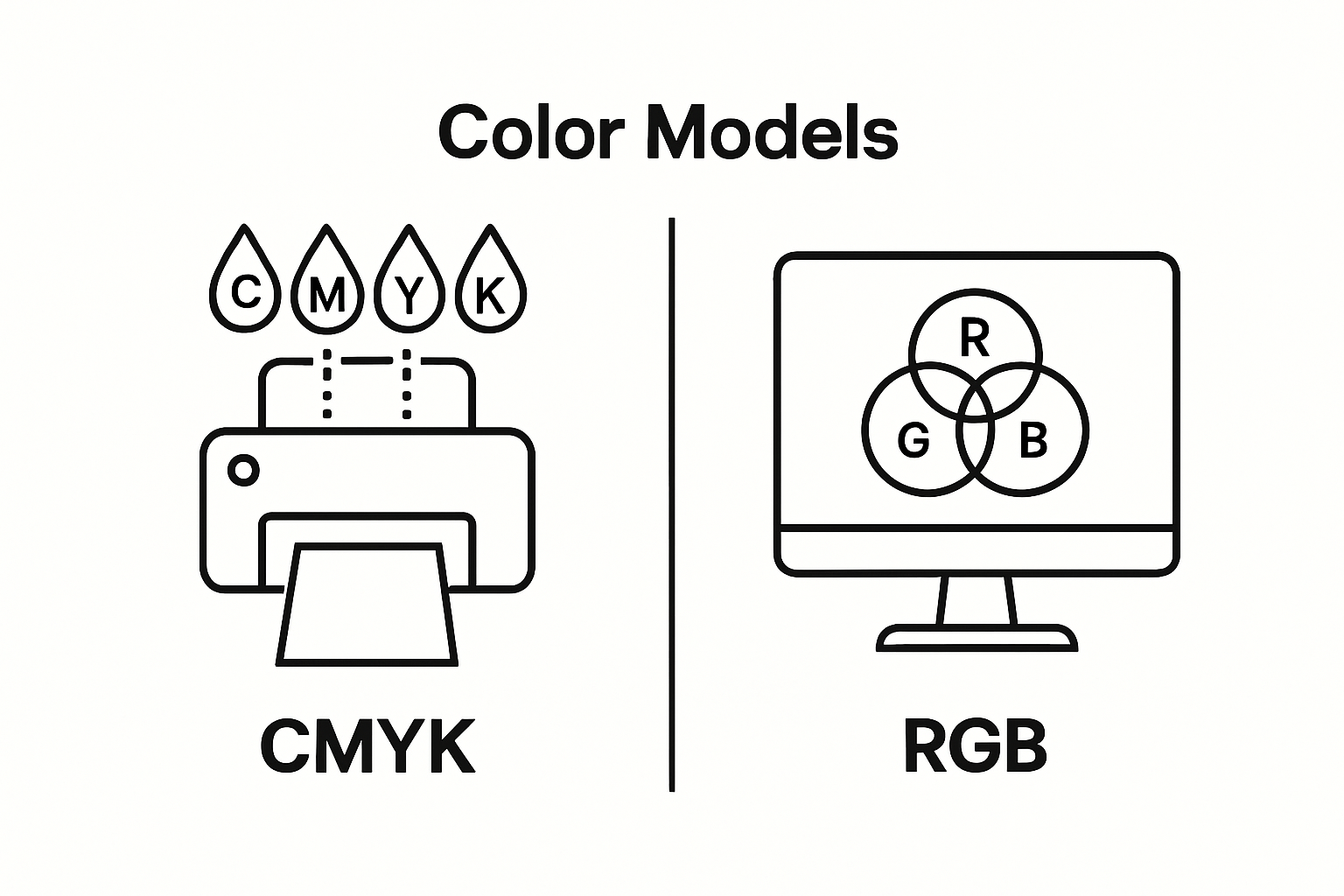
RGB is fundamentally designed for digital environments, where colors are generated through light emission. Electronic devices like computers, smartphones, and televisions utilize RGB to create vibrant, luminous visuals. Professional digital designers rely on RGB’s expansive color palette to craft engaging web graphics, user interfaces, and digital marketing materials. Color Science Research confirms that RGB’s light-based system allows for more dynamic and saturated color expressions compared to print-based models.
Key digital application areas for RGB include:
- Website and mobile app design
- Social media graphics
- Digital advertising assets
- Electronic display interfaces
- Digital photography and image editing
Print and Physical Media Color Reproduction
CMYK emerges as the standard color model for physical printing processes. Unlike RGB’s light-based generation, CMYK creates colors through ink layering on white surfaces. Professional print designers must carefully manage ink percentages to achieve precise color reproduction across various materials like magazines, packaging, brochures, and commercial print products. The subtractive nature of CMYK means colors are created by absorbing specific light wavelengths, resulting in a more limited but physically reproducible color range.
Key print application areas for CMYK include:
- Commercial printing
- Product packaging design
- Magazine and newspaper layouts
- Business collateral materials
- Textile and fabric printing
Professionals must understand that converting between these color models can lead to significant color shifts. Careful color management becomes crucial when transitioning designs between digital and print platforms. Explore our comprehensive guide on color conversion techniques to ensure consistent visual representation across different media.
Real-World Impact of CMYK and RGB in Various Industries
Color models are far more than theoretical concepts. CMYK and RGB play critical roles in shaping visual communication across diverse industries, influencing everything from product design to consumer perception. Understanding their practical applications reveals the profound significance of color reproduction technologies.
This table outlines the impact of CMYK and RGB color models across key industries, organizing their main applications and roles within each sector.
| Industry | RGB Color Model Applications | CMYK Color Model Applications |
|---|---|---|
| Manufacturing & Product | Digital prototypes, visualization | Color translation for product output |
| Marketing & Advertising | Digital ads, web banners | Print ads, brochures, packaging |
| Fashion & Textile Design | Digital fabric simulation, rendering | Textile/fabric printing |
| Publishing | E-books, digital magazines | Magazines, books, newspapers |
| Corporate Identity | Screen-based logos, presentations | Business cards, print collateral |
Manufacturing and Product Design
In manufacturing, color accuracy is paramount. Automotive, electronics, and consumer goods industries rely extensively on precise color representation to maintain brand consistency and aesthetic appeal. RGB color models enable designers to create vibrant digital prototypes, while CMYK ensures accurate color translation during physical production. Manufacturers must navigate complex color conversion processes to guarantee that digital designs match final product appearances.
Key manufacturing color applications include:
- Product prototype visualization
- Brand color standardization
- Quality control in color-sensitive industries
- Material and coating color matching
- Digital rendering of physical products
Marketing and Visual Communication
Marketing professionals leverage color models to create compelling visual narratives. Digital advertising predominantly uses RGB for screen-based campaigns, while print marketing materials depend on CMYK for accurate color reproduction. Color Science Research demonstrates that precise color management significantly impacts consumer perception and brand recognition. Strategic color selection can evoke specific emotional responses and influence purchasing decisions across various media platforms.
Industries utilizing advanced color management include:
- Advertising and branding
- Fashion and textile design
- Packaging and product visualization
- Digital and print media production
- Corporate identity design
The intersection of digital and physical color representation requires sophisticated color management techniques. Professionals must understand the nuanced differences between RGB and CMYK to maintain visual integrity across multiple platforms. Explore our comprehensive guide on professional color strategies to optimize your color reproduction workflow.
Ready to Solve Your Color Accuracy Challenges?
You have just explored the critical differences between CMYK and RGB color models and seen how essential accurate color management is for achieving true-to-life results in design and printing. If you have ever faced the frustration of mismatched brand colors between print and digital media or worried about maintaining color fidelity for your clients, you are not alone. The search for reliable tools and guides to ensure visual integrity in every project is a common challenge for professionals in your field.
Elevate your color workflow today by choosing industry-trusted solutions from Kolorguide.com. Discover our catalog of Pantone color guides, chips, and advanced management tools, ideal for designers, printers, and brand agencies who demand excellence. Stop risking color inconsistencies that could harm your brand reputation. Shop our premium color reference materials now and experience fast USA delivery, secure payment options, and expert support. Take control of your color management process before your next important project. Visit Kolorguide.com and make color accuracy your competitive advantage.
Frequently Asked Questions
What is the difference between CMYK and RGB color models?
CMYK is a subtractive color model used in printing, where colors are created by mixing cyan, magenta, yellow, and black inks. RGB, on the other hand, is an additive color model used for digital displays, where colors are formed by combining red, green, and blue light.
When should I use RGB or CMYK for my designs?
Use RGB for digital designs such as website graphics, social media images, and any content meant for screens. Use CMYK for printed materials like brochures, business cards, and other physical products to ensure accurate color reproduction.
How does color accuracy impact brand identity?
Color accuracy is crucial for brand identity, as inconsistent colors across digital and print mediums can confuse consumers and harm brand recognition. Ensuring color consistency helps maintain a strong and unified brand presence.
Can I convert between RGB and CMYK without losing color quality?
While you can convert between RGB and CMYK, it often results in color shifts due to the different ways each model reproduces colors. Using professional color management tools can help minimize those shifts and maintain visual integrity.
Recommended
- La importancia de la economía circular y omnicanal – kolorguide
- … so my correct Pantone color guide is … – kolorguide
- UPDATING YOUR PANTONE GUIDES CAN SAVE YOU VALUABLE PRODUCTION TIME AND MONEY! – kolorguide
- Cómo lograr el color PANTONE® del año 2020 en bienes duraderos y electrónica de consumo – kolorguide
- CMYK Vs. RGB: Essential Color Conversion Tips For Perfect Prints
- Choosing the Right Colour Palette: Web Agency Sussex|BM


About author
Related posts

Discover the 7 best fonts for packaging that can elevate your brand image and attract customers effectively. Learn tips for each choice. Continue reading

Discover 7 key tips for enhancing sustainability in printing industry practices that professionals can implement for a greener future. Continue reading

Discover the key difference between CMYK and RGB for plastic, printing, and packaging industries. Learn how to choose the right color model for your needs. Continue reading

Master essential graphic design terminology for the printing, packaging, and manufacturing industries. Clear explanations tailored for rapid learning. Continue reading