
No products in the cart.
Return To Shop
Understanding Color Management for Industrial Printing 2025
Color management shapes everything from glossy packaging to high-end automotive finishes. Imagine a single color shift leading to entire print batches being rejected and costing thousands in wasted materials. Most people assume color accuracy is just a tech calibration issue, but the real challenge lies in managing human perception, environmental changes, and evolving standards all at once.
Table of Contents
- What Is Color Management And Why It Matters
- Key Color Standards In Industrial Printing
- Best Practices For Consistent Color In Manufacturing
- Common Color Management Challenges And Solutions
Quick Summary
| Takeaway | Explanation |
|---|---|
| Color management is essential for consistency | It ensures accurate color reproduction across various industrial printing devices, impacting product quality and brand perception. |
| Understand and implement key color standards | Familiarize yourself with ISO standards like ISO 15339-1 and ISO 12647 to optimize workflows and reduce production waste in color management. |
| Adopt the Four Cs of Color Management | Focus on Consistency, Calibration, Characterization, and Conversion to achieve uniform color reproduction and effective communication across devices. |
| Prioritize environmental control | Manage temperature and humidity as they significantly affect color reproduction, and maintain stable conditions in production areas. |
| Embrace an ongoing learning approach | Continuous improvement in color management strategies and staff training are critical for adapting to technological advancements and maintaining quality. |
What Is Color Management and Why It Matters
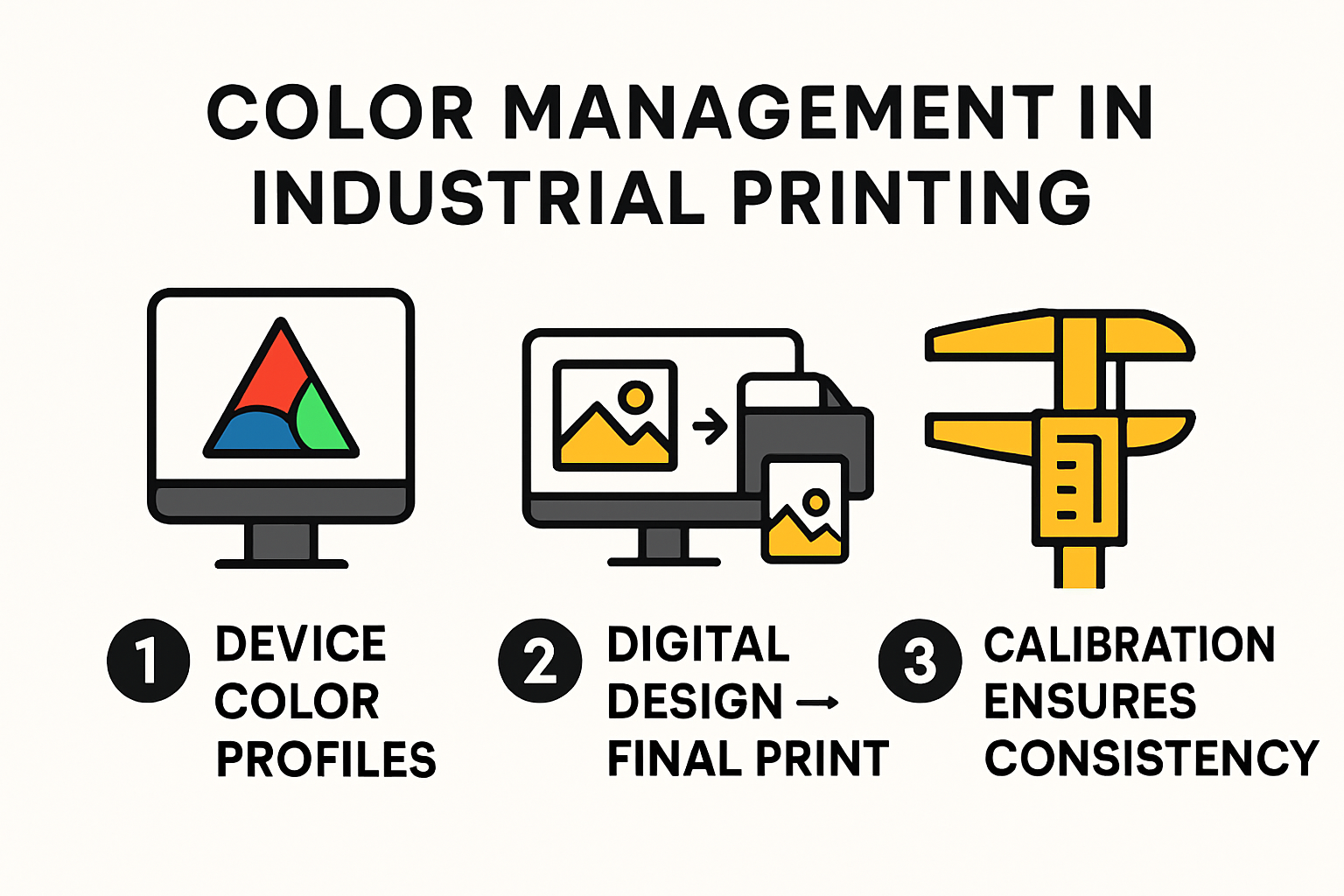
Color management represents a critical technical process that ensures accurate and consistent color reproduction across various industrial printing devices and platforms. At its core, understanding color management involves recognizing how different devices interpret and display colors, and implementing strategies to maintain color fidelity throughout the production workflow.
The Fundamental Principles of Color Consistency
Color management is more than a simple technical procedure. It is a complex system that translates color information between different devices with unique color capabilities. Learn how color communication impacts print quality, professionals must understand that each device generates colors differently. According to research from the Printing Organization, color management involves ‘fingerprinting’ output devices by mapping their unique color ranges when printed on specific media.
The process fundamentally relies on color profiles—standardized descriptions that define how colors should be displayed or reproduced. These profiles account for the inherent variations between devices like monitors, cameras, and printers. Without effective color management, the same image can appear dramatically different across various platforms, leading to significant inconsistencies in industrial printing applications.
Why Color Management Matters in Industrial Printing
In industrial printing, color accuracy is not just about aesthetics—it directly impacts product quality, brand perception, and production efficiency. Konica Minolta’s color sensing experts emphasize that color perception is inherently subjective, varying between individuals and influenced by factors like lighting environments, viewing angles, and background colors.
For industries ranging from packaging to automotive manufacturing, precise color reproduction is paramount. A slight color variation can mean the difference between a premium product and a rejected batch. Color management enables manufacturers to:
- Ensure consistent brand representation across different print runs and materials
- Minimize waste by reducing color-related reprints and adjustments
- Maintain high-quality standards that meet stringent industry specifications
Professionals must recognize that color management is not a one-time setup but an ongoing process requiring continuous calibration and profile updates. As printing technologies evolve, so too must the strategies for maintaining color accuracy and consistency.
Understanding color management means embracing a technical discipline that bridges the gap between digital design and physical reproduction. It requires specialized knowledge, precise tools, and a commitment to maintaining the highest standards of color fidelity in industrial printing environments.
Key Color Standards in Industrial Printing
Industrial printing relies on comprehensive color standards to ensure consistent, high-quality output across diverse production environments. These standards provide critical guidelines that help manufacturers, designers, and print professionals communicate and reproduce colors with exceptional precision and reliability.
International Standards for Color Reproduction
The International Organization for Standardization (ISO) has developed several key standards that form the backbone of color management in industrial printing. Learn about precise color reproduction techniques, professionals must understand these critical frameworks.
ISO 15339-1 establishes fundamental principles for printing from digital data across multiple technologies. This standard provides comprehensive guidelines for preparing files, organizing print jobs, creating proofs, and producing printed materials that maintain consistent color characteristics across different output devices.
Another critical standard, ISO 12647, addresses color consistency, calibration, and process control in the graphic arts industry. It enables printers to achieve high-quality prints that precisely match designers’ expectations, optimizing workflows and reducing production waste.
Specialized Color Standards for Different Printing Techniques
Different printing methods require specialized color standards to account for unique technical characteristics. ISO 2846-4:2000, for instance, specifies color and transparency requirements for screen printing inks. This standard defines precise color production parameters for both conventional drying and radiation (UV) curing processes.
These standards go beyond simple color matching. They provide comprehensive frameworks that address:
- Color characterization across various input and output devices
- Process control methodologies for consistent color reproduction
- Transparency and ink quality specifications
- Calibration techniques for different printing technologies
Professionals in industrial printing must recognize that color standards are not static documents but evolving guidelines that adapt to technological advancements. Staying current with these standards requires continuous learning and technological investment.
Understanding and implementing these color standards represents a commitment to quality. They transform color management from a technical challenge into a precise, predictable science that bridges design imagination with manufacturing reality. For industries where color accuracy is paramount—such as packaging, automotive, and electronics—these standards are not optional recommendations but essential operational requirements.
To clarify the main industrial printing color standards and their focus areas, the following table provides a concise comparison.
| Standard | Area of Application | Key Focus |
|---|---|---|
| ISO 15339-1 | Printing from digital data | Consistent color across output devices; workflow guidelines |
| ISO 12647 | Graphic arts industry, process control | Color consistency, calibration, waste reduction |
| ISO 2846-4:2000 | Screen printing inks | Color/transparency requirements, ink quality, curing types |
Best Practices for Consistent Color in Manufacturing
Consistent color reproduction is a critical challenge in modern manufacturing, requiring a strategic approach that goes beyond simple visual matching. Professionals must implement comprehensive color management protocols that address technological, environmental, and procedural aspects of color consistency.
The Four Cs of Color Management
Explore advanced color matching techniques, manufacturers must understand the fundamental framework of color management. According to industry research, effective color management revolves around four key principles: Consistency, Calibration, Characterization, and Conversion.
Consistency ensures devices reproduce colors uniformly over time. Calibration brings equipment back to standard settings, while characterization involves measuring the actual colors produced to create accurate ICC profiles. Conversion processes enable precise communication of color information between different devices and platforms.
To help readers better understand the Four Cs of Color Management, the following table summarizes their functions and importance.
| Principle | Function | Importance |
|---|---|---|
| Consistency | Ensures uniform color reproduction over time | Maintains brand/quality standards |
| Calibration | Returns equipment to standard settings | Reduces drift, enables accurate profiling |
| Characterization | Measures device color output to create ICC/color profiles | Enables precise color mapping between devices |
| Conversion | Translates color info between devices/platforms | Achieves reliable cross-device communication |
Instrumental Precision and Environmental Control

Quality Magazine experts emphasize the critical role of spectrophotometers in modern color management. These advanced instruments measure light reflected or transmitted across the visible spectrum, providing spectral data for unprecedented color matching accuracy.
Environmental control plays a crucial role in maintaining color consistency. Manufacturers must carefully manage ambient conditions such as temperature and humidity, which can significantly impact color perception and reproduction. Key practices include:
- Maintaining stable environmental conditions in production areas
- Regular calibration of color measurement instruments
- Annual factory certification of measurement devices
- Controlling lighting conditions during color assessment
Ongoing Maintenance and Continuous Improvement
Quality control research highlights the importance of regular instrument maintenance. Warning signs like prolonged calibration times or inconsistent readings indicate the need for immediate servicing. Annual factory certification ensures devices are cleaned, tested, and aligned to national standards like NIST and ISO.
Successful color management is not a one-time achievement but an ongoing process of continuous improvement. Manufacturers must invest in:
- Advanced measurement technologies
- Regular staff training
- Systematic quality control processes
- Adaptive color management strategies
The ultimate goal transcends technical precision. It is about creating a holistic approach that integrates technology, human expertise, and rigorous processes to deliver consistent, high-quality color reproduction across diverse manufacturing environments.
Common Color Management Challenges and Solutions
Color management in industrial printing presents complex challenges that require sophisticated technical solutions and strategic approaches. Understanding these challenges is crucial for manufacturers seeking to maintain consistent and high-quality color reproduction across diverse production environments.
Device Variability and Technological Limitations
Explore color communication strategies, professionals must first recognize the inherent variability among different printing devices. According to National Academies Press research, industrial printing confronts significant obstacles related to device performance and color interpretation.
Each printing device—whether digital, offset, or screen printing—possesses unique color reproduction characteristics. These variations stem from differences in:
- Sensor and receptor technologies
- Ink or toner composition
- Hardware calibration mechanisms
- Software color interpretation algorithms
Manufacturers must implement advanced colorimetric models and adaptive calibration techniques to mitigate these technological disparities. This involves developing comprehensive device profiles that accurately map color translation processes across different platforms.
Perceptual and Environmental Complexities
Color perception represents a nuanced challenge extending beyond technological constraints. Human visual systems interpret colors differently based on numerous environmental and physiological factors. Lighting conditions, viewing angles, background colors, and individual perceptual differences significantly impact color interpretation.
Solutions to these challenges include:
- Standardized viewing environments
- Controlled lighting conditions
- Advanced spectrophotometric measurement techniques
- Regular staff training in color perception
Interdisciplinary Collaboration and Continuous Learning
Addressing color management challenges requires a holistic, collaborative approach. Updating color reference guides represents one critical strategy for maintaining color accuracy. Cross-industry collaboration enables the development of more robust color management standards and technologies.
Key recommendations for overcoming color management challenges include:
- Investing in continuous technological education
- Developing adaptive color management protocols
- Implementing rigorous quality control processes
- Embracing interdisciplinary knowledge exchange
The future of color management lies in recognizing its complexity as a multifaceted discipline. It demands not just technological solutions but a comprehensive understanding of human perception, device capabilities, and environmental influences. Successful color management transforms technical challenges into opportunities for precision and innovation across industrial printing landscapes.
Frequently Asked Questions
What is color management in industrial printing?
Color management is a technical process that ensures accurate and consistent color reproduction across various industrial printing devices and platforms. It involves maintaining color fidelity throughout the production workflow by using color profiles and calibration techniques.
Why is color management important in industrial printing?
Color management is crucial because it directly impacts product quality, brand perception, and production efficiency. It helps ensure consistent brand representation, minimizes waste, and maintains high-quality standards that meet industry specifications.
What are the key color standards in industrial printing?
Key color standards in industrial printing include ISO 15339-1, which provides guidelines for color consistency across output devices, and ISO 12647, which focuses on process control and calibration in the graphic arts industry. Each standard is designed to enhance color reproducibility and quality.
What are the best practices for achieving consistent color in manufacturing?
Best practices for consistent color include implementing the Four Cs of Color Management (Consistency, Calibration, Characterization, Conversion), maintaining stable environmental conditions, and committing to ongoing staff training and technological advancement to adapt to emerging developments.
Ready to Eliminate Color Inconsistencies in Industrial Printing?
Every error in color management costs time, money, and client trust. As highlighted in our article, factors like calibration drift, poor profile maintenance, and environmental instability can quickly lead to wasted materials and missed deadlines. If you are ready to rise above the frustration of reprints and color mismatches, you need solutions tailored to the printing and graphic arts industry.

Take control of your color workflow with tools and resources designed for demanding manufacturing environments. Visit Kolorguide today and discover products that help you maintain precise calibration, update your color reference guides, and stay ahead of evolving industry standards. Enhance your knowledge with articles like Learn how color communication impacts print quality and Find out why updating your Pantone guides matters to experience the peace of mind that comes from absolute color consistency. Start now and give your clients the quality and reliability they expect.
Recommended
- La importancia de la economía circular y omnicanal – kolorguide
- The Key to Controlling Color on Flexible Film – kolorguide
- Cómo lograr el color PANTONE® del año 2020 en bienes duraderos y electrónica de consumo – kolorguide
- UPDATING YOUR PANTONE GUIDES CAN SAVE YOU VALUABLE PRODUCTION TIME AND MONEY! – kolorguide
- CMYK Vs. RGB: Essential Color Conversion Tips For Perfect Prints
- Large Format Printing Explained: Essential Guide for London Businesses 2025 – PromoSigns.co.uk


About author
Related posts

Discover why registration is important for businesses in the printing, packaging, plastics, and technology industries. Learn how it protects and boosts your company’s growth. Continue reading

Explore essential printing press terminology to enhance your knowledge as a graphic designer or industry professional. Comprehensive insights included. Continue reading