
No products in the cart.
Return To Shop
The Complete Guide to Enhanced Ink Bonding and Surface Control
Ink seems simple, but its behavior can change everything in printing. Even a slight tweak in ink surface tension can cause dramatic differences in print quality and color sharpness. Most people think surface tension only matters for water, but in the print world, mastering this tiny detail is the secret recipe behind flawless images and durable designs.
Table of Contents
- Understanding Ink Surface Tension: Definition And Importance
- The Role Of Ink Bonding In Printing And Coatings
- Factors Influencing Ink Surface Tension And Bonding
- Practical Implications Of Improving Ink Surface Tension
- Real-World Applications Across Various Industries
Quick Summary
| Takeaway | Explanation |
|---|---|
| Control ink surface tension for better print quality | Managing surface tension improves ink spread, droplet formation, and adhesion, leading to superior outcomes in printing. |
| Use dyne test pens to measure surface energy | Dyne test pens help validate surface energy levels, ensuring optimal ink performance during the printing process. |
| Optimize ink formulation for strong adhesion | Formulating inks with compatible chemical components enhances adhesion, which is crucial for durability and performance across substrates. |
| Maintain environmental conditions for consistency | Temperature and humidity significantly affect ink behavior; precise control ensures consistent print results across various conditions. |
| Explore advanced applications in diverse industries | Knowledge of ink surface tension benefits various sectors, including electronics, textiles, and aerospace, driving innovation and material performance. |
Understanding Ink Surface Tension: Definition and Importance
Ink surface tension represents a critical physical property that determines how effectively ink spreads, adheres, and performs across different printing substrates. Understanding this complex phenomenon is essential for achieving high-quality print results in various graphic arts and manufacturing applications.
What Exactly is Surface Tension?
Surface tension describes the molecular cohesive force that exists at the interface between a liquid (in this case, ink) and its surrounding environment. According to the U.S. Geological Survey, this property emerges from the unique interactions between liquid molecules, where internal molecular forces create a measurable resistance to external forces.
In practical printing contexts, surface tension determines how ink droplets will behave when they contact a substrate. Lower surface tension allows ink to spread more easily, while higher tension causes ink to bead up or resist spreading. This characteristic directly influences critical printing parameters such as:
- Droplet formation consistency
- Print edge definition
- Ink penetration depth
- Adhesion quality
Why Surface Tension Matters in Printing
Precise control of ink surface tension becomes paramount for achieving superior print quality. Manufacturers and printing professionals must carefully manage this property to ensure:
- Uniform ink distribution
- Minimal bleeding between color layers
- Optimal substrate wetting
- Consistent color reproduction
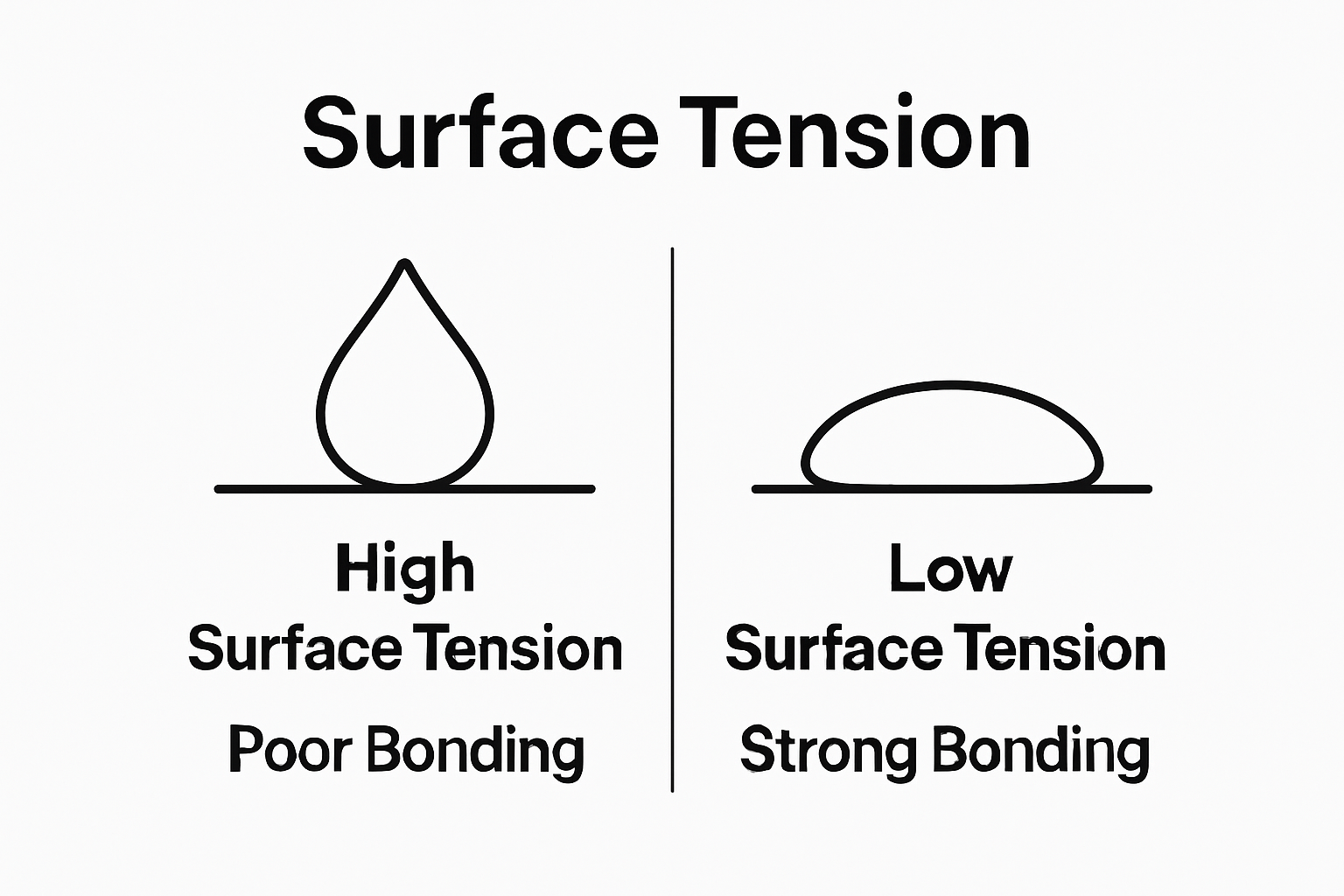
For instance, in flexographic and digital printing processes, even slight variations in surface tension can dramatically impact print resolution and overall image clarity. Print professionals often use specialized tools like dyne test pens to measure and validate surface energy levels across different printing materials.
By understanding and manipulating surface tension, printing experts can develop more predictable and high-performance ink formulations that meet increasingly sophisticated industry demands.
The Role of Ink Bonding in Printing and Coatings
Ink bonding represents a sophisticated process that determines the quality, durability, and performance of printed materials across numerous industrial applications. Understanding the intricate mechanisms of ink adhesion is crucial for achieving superior print results and maintaining the integrity of printed surfaces.
Fundamentals of Ink Adhesion
Ink bonding occurs at the molecular level, where complex interactions between ink components and substrate surfaces create a permanent connection. According to research published in the Royal Society of Chemistry, successful ink bonding depends on multiple critical factors, including surface energy, molecular compatibility, and chemical interactions.
The bonding process involves several key mechanisms:
- Chemical interaction between ink molecules and substrate surface
- Mechanical interlocking of ink particles within substrate pores
- Electrostatic and van der Waals forces that enable molecular attachment
- Thermal and physical curing processes that solidify ink placement
Importance Across Different Printing Technologies
Various printing technologies require specialized ink bonding strategies. Digital printing, flexographic processes, and screen printing each demand unique approaches to ensure optimal adhesion. Precise surface preparation and ink formulation become critical in achieving consistent, high-quality results.
In industrial applications like digital textile printing, ink bonding determines not just visual quality but also the durability and washability of printed materials. Manufacturers must carefully engineer ink compositions to create strong molecular bonds that withstand mechanical stress, environmental conditions, and repeated use.
Professionals in graphic arts and manufacturing continuously refine ink bonding techniques, recognizing that successful adhesion represents the intersection of chemistry, physics, and material science. By understanding and manipulating these complex molecular interactions, they can develop increasingly sophisticated printing solutions that meet evolving industry demands.
Factors Influencing Ink Surface Tension and Bonding
Understanding the complex interplay of factors that impact ink surface tension and bonding is crucial for achieving high-quality printing results. These interactions involve sophisticated molecular mechanisms that determine print quality, durability, and performance across various substrates and printing technologies.
Chemical Composition and Molecular Interactions
The chemical makeup of ink plays a pivotal role in determining surface tension and bonding characteristics. According to research in surfactant science, additives such as surfactants, copolymers, and dispersing agents significantly influence ink behavior at the molecular level.
Key molecular factors that impact ink performance include:
- Molecular weight of ink components
- Polarity of chemical structures
- Presence of specific functional groups
- Intermolecular hydrogen bonding capabilities
- Electrostatic interactions between ink and substrate
Environmental and Substrate Considerations
External conditions and substrate properties dramatically affect ink surface tension and bonding. Temperature, humidity, and substrate surface energy create a complex environment that determines ink adhesion and spread.
Printing professionals use specialized tools like dyne test pens to measure and validate surface energy levels, ensuring optimal ink performance. These diagnostic tools help identify potential bonding challenges before production begins.
Printing environments require careful management of multiple variables. A slight change in ambient temperature or substrate composition can significantly alter ink behavior, making precise control essential for consistent, high-quality output. By understanding and manipulating these intricate factors, manufacturers can develop more reliable and sophisticated printing solutions that meet increasingly demanding industry standards.
Below is a comparison table that summarizes how different factors influence ink surface tension and bonding in printing, helping readers quickly identify which aspects are most critical for quality and performance.
| Factor | Effect on Ink Surface Tension | Effect on Ink Bonding | Practical Relevance |
|---|---|---|---|
| Chemical Composition | Determines molecular cohesion | Enables chemical compatibility | Key for ink formulation and durability |
| Surfactants/Additives | Lowers surface tension | Enhances wetting and adhesion | Used to optimize droplet formation |
| Substrate Surface Energy | Affects ink spread and wetting | Determines adhesion quality | Measured by dyne test pens |
| Temperature | Alters ink viscosity and tension | Can impact bonding strength | Environmental control for consistency |
| Humidity | Influences drying and flow | Affects curing and adhesion | Requires monitoring for reliable output |
| Mechanical Interlocking | N/A | Provides physical bonding | Important for porous substrates |
| Electrostatic/van der Waals Forces | N/A | Enables molecular attachment | Adds to long-term print durability |
Practical Implications of Improving Ink Surface Tension
Improving ink surface tension is not merely a theoretical exercise but a critical strategy with far-reaching implications across multiple printing technologies and industrial applications. By fine-tuning this fundamental property, manufacturers can achieve significant enhancements in print quality, efficiency, and product performance.
Performance and Quality Optimization
According to research in inkjet printing science, modifying surface tension can dramatically influence droplet formation and printing characteristics. When surface tension is precisely controlled, printing processes experience remarkable improvements in several key areas:
- Enhanced droplet velocity and stability
- Reduced satellite droplet formation
- More consistent ink spread and coverage
- Improved print resolution and edge definition
- Minimized color bleeding and migration
Economic and Industrial Impact
The economic implications of optimized surface tension extend beyond print quality. Precise surface tension management translates into tangible benefits for manufacturers in digital textile printing and other advanced printing sectors.
Industrial applications benefit from improved surface tension through:
- Reduced material waste
- Lower production costs
- Enhanced product durability
- Increased printing speed
- Greater substrate compatibility
By understanding and strategically manipulating surface tension, printing professionals can develop more sophisticated, reliable, and cost-effective printing solutions that meet the increasingly complex demands of modern manufacturing and design industries.
The following table provides an overview of how optimized ink surface tension and bonding impacts performance and economics within different printing and industrial applications.
| Benefit | Print/Manufacturing Outcome | Industrial Impact |
|---|---|---|
| Enhanced droplet formation | Sharper images, reduced color bleeding | Higher product quality |
| Improved ink adhesion | Greater durability, longer-lasting prints | Fewer defects, reduced rework |
| Consistent substrate wetting | Even coverage, uniform color reproduction | More predictable production |
| Reduced material waste | Efficient ink use, minimal overspray | Lower operating costs |
| Increased printing speed | Faster production cycles | Higher throughput |
| Greater substrate compatibility | Enables printing on diverse materials | Expands market opportunities |
Real-World Applications Across Various Industries
Ink surface tension and bonding technologies extend far beyond traditional printing, playing pivotal roles in diverse industrial sectors that demand precision, reliability, and advanced material performance. Understanding these applications reveals the profound impact of molecular interactions across cutting-edge technologies.
Electronics and Advanced Manufacturing
In the electronics industry, precise surface tension control becomes critical for developing flexible electronic components. According to research on nanomaterial printing, specialized ink formulations enable the creation of intricate conductive films and sensors by carefully managing droplet formation and substrate adhesion.
Key electronic applications include:
- Printed circuit board manufacturing
- Flexible display technologies
- Nanoscale sensor development
- Conductive ink deposition
- Semiconductor component fabrication
Diverse Industrial Implementations
Surface tension optimization finds remarkable applications across multiple sectors. Digital textile printing represents a prime example where precise ink bonding determines fabric quality, color retention, and durability.
Industrial sectors benefiting from advanced surface tension technologies encompass:
- Automotive paint and coating systems
- Medical device manufacturing
- Packaging and labeling industries
- Aerospace component production
- Renewable energy technologies
By mastering molecular interactions and surface energy principles, manufacturers can develop increasingly sophisticated materials and production techniques that push the boundaries of technological innovation across global industries.

Achieve Flawless Ink Performance with Professional Color Management
Are you struggling with unpredictable ink surface tension or inconsistent ink bonding that affects your print quality and production reliability? The article highlights how even minor issues with droplet formation, substrate wetting, or ink adhesion can cause costly color errors and project delays. Mastering these molecular interactions is not just for extraordinary results but also for customer satisfaction and long-lasting prints.
Upgrade your workflow now with trusted color management solutions and advanced Pantone color reference tools. These resources help you pinpoint surface tension problems and ensure color accuracy across every print run. Fast USA shipping and multiple payment options mean you never have to compromise on deadlines or quality. Visit Kolorguide.com today to discover how easy it is to elevate your control over ink bonding and achieve unparalleled precision on every project. Take the next step toward seamless printing and see the difference that professional-grade tools can make.
Frequently Asked Questions
What is ink surface tension and why is it important?
Ink surface tension is a physical property that describes the cohesive forces at the liquid’s surface. It influences how ink spreads, adheres, and performs on printing substrates. Lower surface tension allows for better spread, while higher tension can cause beading, affecting print quality.
How can I measure ink surface tension?
Ink surface tension can be measured using a dyne test pen, which evaluates surface energy levels on different substrates to ensure optimal ink performance and bonding.
What factors influence ink bonding in printing?
Ink bonding is influenced by chemical composition, molecular interactions, surface energy, substrate properties, and external conditions such as temperature and humidity. These factors collectively determine the quality and durability of printed materials.
Why is it essential to control surface tension in different printing technologies?
Precise control of surface tension is critical across various printing technologies (e.g., digital, flexographic, screen printing) to achieve uniform ink distribution, minimal bleeding, optimal substrate wetting, and consistent color reproduction.
Recommended


About author
Related posts

Discover why registration is important for businesses in the printing, packaging, plastics, and technology industries. Learn how it protects and boosts your company’s growth. Continue reading

Explore essential printing press terminology to enhance your knowledge as a graphic designer or industry professional. Comprehensive insights included. Continue reading