WHEN NOT TO BUY DYNE TEST PENS
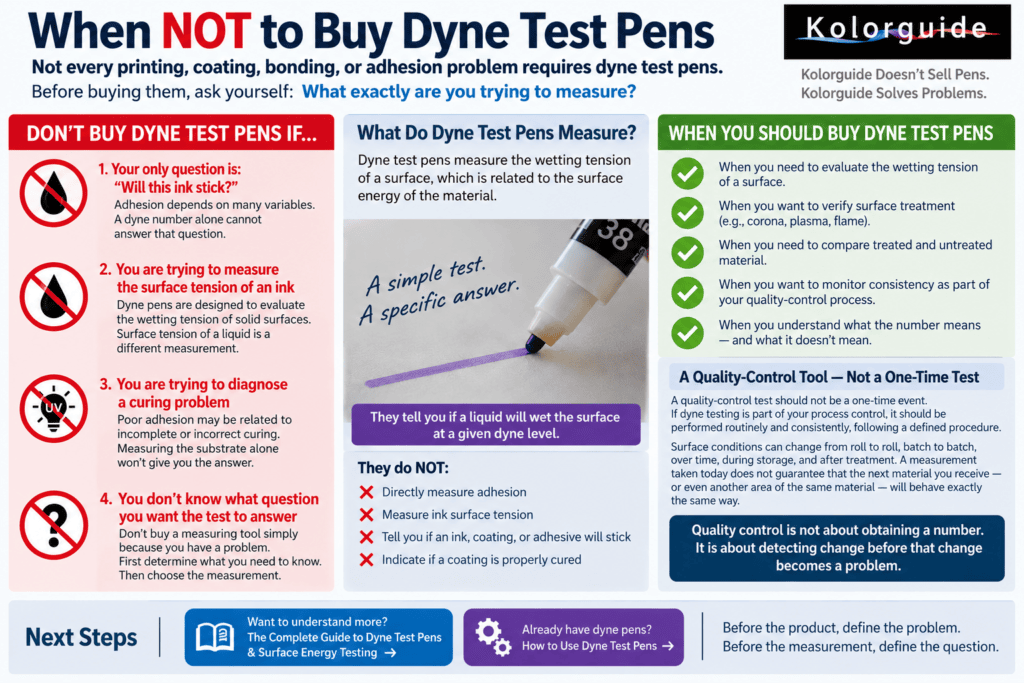
Not every adhesion, printing, coating, or bonding problem requires dyne test pens.
If you are thinking about buying a set, there is one question you should answer first:
What exactly are you trying to measure?
Dyne test pens are useful tools. But they measure something very specific: the wetting tension of a surface.
They do not directly measure adhesion.
They do not measure ink surface tension.
They do not tell you whether an ink is properly cured.
And a 40-dyne reading does not mean that your ink, coating, or adhesive will necessarily stick.
So, when should you NOT buy dyne test pens?
1. When your only question is: “Will this ink stick?”
Dyne testing can provide useful information about the surface, but adhesion depends on more than one variable: the substrate, ink or coating, contamination, curing, treatment, chemistry, and process conditions can all play a role.
A dyne number alone cannot answer that question.
2. When you are trying to measure the surface tension of an ink
Dyne pens are designed to evaluate the wetting tension of solid surfaces.
Surface tension of a liquid is a different measurement.
Same units. Different property.
3. When you are trying to diagnose a curing problem
Poor adhesion can sometimes look like a surface-energy problem when the actual problem is incomplete or incorrect curing.
If curing is the problem, measuring the substrate alone won’t give you the answer.
4. When you don’t know what question you want the test to answer
This may be the most important one.
Don’t buy a measuring tool simply because you have a problem.
First determine what you need to know.
Then choose the measurement.
So, when DO you need dyne test pens?
Dyne test pens make sense when you need a quick, practical way to evaluate surface wetting tension, compare treated and untreated material, monitor surface treatment, or check consistency as part of your quality-control process.
If that’s what you need to measure, dyne test pens may be exactly the right tool.
But before buying them, understand what the number means — and what it doesn’t mean.
Already know you need dyne test pens?
→ How to Use Dyne Test Pens
Want to understand surface energy and dyne testing first?
→ The Complete Guide to Dyne Test Pens & Surface Energy Testing
**Before the product, define the problem.
Before the measurement, define the question.**
An Important Note About Quality Control
A quality-control test should not be a one-time event.
If dyne testing is part of your process control, it should be performed routinely and consistently, following a defined procedure.
Surface conditions can change from roll to roll, batch to batch, over time, during storage, and after treatment. A measurement taken today does not guarantee that the next material you receive — or even another area of the same material — will behave exactly the same way.
The purpose of quality control is not simply to obtain a number.
It is to detect change before that change becomes a problem.
Esa última frase me gusta muchísimo para Kolorguide:
Quality control is not about obtaining a number. It is about detecting change before that change becomes a problem.
Kolorguide Doesn’t Sell Pens. Kolorguide Solves Problems.