Can One UV Lamp Cure Everything?
Can One UV Lamp Cure Everything?The Short Answer: No.
Complete Guide to UV Curing – Chapter 2
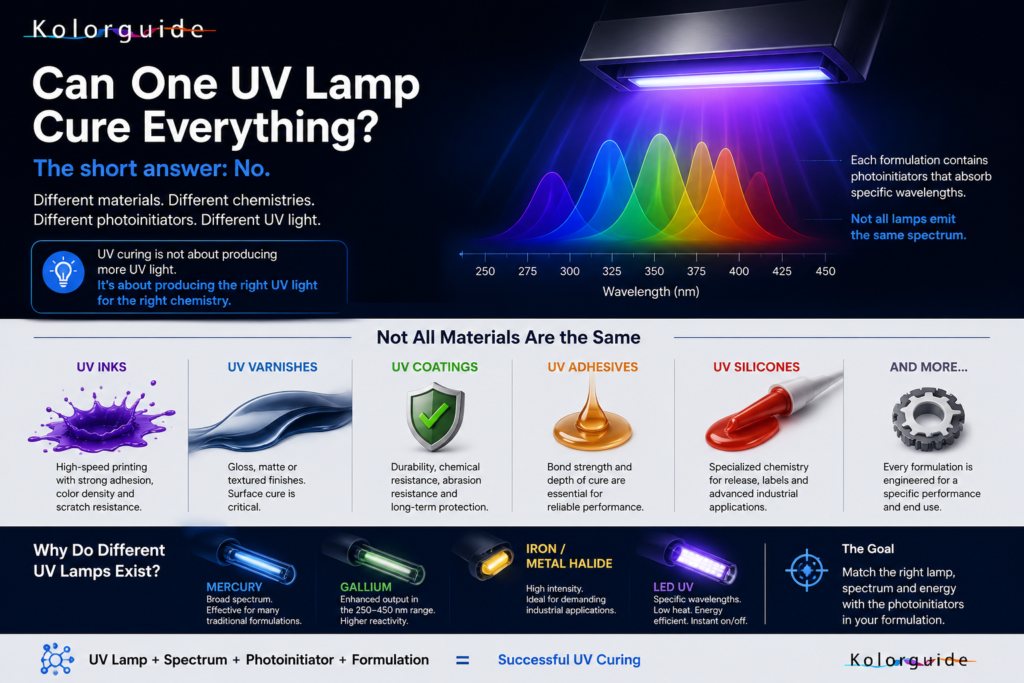
If every UV lamp produces ultraviolet light, why do manufacturers offer Mercury, Gallium, Iron, Metal Halide and LED UV lamps?
The answer is simple:
Not all UV-curable materials are designed to respond to the same light.
Each UV formulation is engineered with specific photoinitiators that absorb particular wavelengths and require different levels of UV energy to initiate polymerization. A lamp that performs exceptionally well for one application may not be the best choice for another.
Understanding this relationship is one of the most important concepts in UV curing.
Why One UV Lamp Cannot Cure Every Material
Although UV inks, varnishes, coatings, adhesives and silicones all cure by exposure to ultraviolet light, they are not the same chemistry.
Each product has been formulated to achieve different performance characteristics, including:
- Adhesion
- Gloss
- Chemical resistance
- Abrasion resistance
- Flexibility
- Cure speed
- Depth of cure
- Food or medical compliance
To achieve these properties, formulators select different combinations of resins, oligomers, monomers and, most importantly, photoinitiators.
Those photoinitiators determine which wavelengths of UV light are required for efficient curing.
Different Materials. Different Requirements.
UV Inks
Designed for high-speed printing while maintaining excellent color density, adhesion and scratch resistance. Different pigments and ink systems may require different UV spectra for optimal cure.
UV Varnishes
Often optimized for gloss, matte finishes or protective overprint applications. Surface cure is especially important to avoid blocking, fingerprinting or reduced appearance.
UV Coatings
Industrial coatings frequently require outstanding chemical resistance, abrasion resistance and long-term durability. These applications may require higher UV doses and carefully selected photoinitiators.
UV Adhesives
Unlike printing inks, many UV adhesives must cure through thicker sections or between transparent substrates. Depth of cure becomes a critical factor.
UV Silicones
UV-curable silicones are specialized systems used in applications such as release liners, labels and advanced industrial processes. Their curing behavior differs significantly from conventional UV inks.
The Missing Link: Photoinitiators
Many people believe the UV lamp cures the material.
It doesn’t.
The lamp provides ultraviolet energy.
The photoinitiator absorbs that energy and starts the chemical reaction that transforms the liquid formulation into a solid polymer.
Without the correct photoinitiator, even the most powerful UV lamp cannot produce an efficient cure.
Why Do Different UV Lamps Exist?
Different lamps produce different spectral outputs.
That is why the industry developed technologies such as:
- Mercury Lamps
- Gallium Lamps
- Iron (Metal Halide) Lamps
- LED UV Systems
Each technology was developed to better activate specific photoinitiators or improve curing performance for particular applications.
The objective is not simply to generate UV light.
The objective is to generate the right UV light for the formulation being cured.
Engineering Insight
Successful UV curing is never determined by a single component.
It is the result of matching four elements:
UV Lamp → UV Spectrum → Photoinitiator → Formulation
If one of these elements is mismatched, curing performance can be compromised regardless of lamp power.
Key Takeaway
There is no universal UV lamp.
The best UV lamp is the one that delivers the wavelengths required by the photoinitiators in a specific formulation.
Understanding this relationship explains why different UV lamp technologies exist and why selecting the correct lamp is essential for reliable curing.
Next Chapter
Chapter 3
What Is a Photoinitiator, and Why Is It the Real Engine Behind UV Curing?
In the next chapter, we’ll explore the molecules that actually initiate the curing reaction and discover why understanding photoinitiators is essential to understanding the entire UV curing process.
UV curing is not about producing more UV light. It is about producing the right UV light for the right chemistry.