No products in the cart.
Return To Shop
Digital vs Offset Printing: Choosing the Right Process for Your Industry
Every business faces the classic crossroads when deciding how to print their next big project. Offset printing can drop your per-unit cost by over 50 percent on runs above 1,000 units, while digital printing rules the world of small batches and speedy turnarounds. Most people focus only on price or production speed. The surprising truth is that the method you choose can completely change your design flexibility, the quality of your final product, and even the environmental footprint your brand leaves behind.
Table of Contents
- Understanding Digital Vs Offset Printing Methods
- Key Advantages And Limitations For Each Process
- Choosing The Best Printing Option By Industry
- Cost, Quality, And Sustainability Comparisons
Quick Summary
| Takeaway | Explanation |
|---|---|
| Digital printing excels in short runs. | Ideal for projects requiring quick turnaround, lower costs, and customization, especially under 1,000 units. |
| Offset printing is cost-effective for large volumes. | Best suited for print runs over 1,000 units, offering lower per-unit costs as volume increases. |
| Evaluate project specifications carefully. | Consider quantity, budget, timeline, and print quality to select the most appropriate printing method. |
| Digital printing allows variable data capabilities. | Enables personalized printing, making it perfect for targeted marketing materials and direct mail campaigns. |
| Assess sustainability in printing decisions. | Balance production costs with environmental impact, favoring methods that reduce waste and energy use. |
Understanding Digital vs Offset Printing Methods
In the dynamic world of print production, understanding the nuanced differences between digital and offset printing methods is crucial for professionals seeking optimal results. These two primary printing technologies offer distinct approaches to transforming digital designs into physical printed materials, each with unique characteristics that make them suitable for different applications.
Core Operational Principles
Digital printing and offset printing represent fundamentally different approaches to image reproduction. According to New Mexico State University Extension, digital printing involves direct transfer of digital files onto printing surfaces using advanced electronic imaging technologies. Laser or inkjet printers apply toner or liquid ink directly onto paper or other substrates, creating images through precise electronic color placement.
Offset printing, conversely, employs a more traditional mechanical process. This method involves transferring ink from metal plates to a rubber blanket and then onto the printing surface. The intricate process allows for exceptional color consistency and image clarity, particularly for large volume print runs. Offset printing relies on the fundamental principle that oil-based inks and water do not mix, enabling precise ink transfer through a complex series of mechanical interactions.
Application and Performance Considerations
The choice between digital and offset printing depends on multiple critical factors. Digital printing excels in scenarios requiring quick turnaround, variable data printing, and smaller quantity productions. Its primary advantages include rapid setup, cost effectiveness for short runs, and remarkable flexibility in customization.
Offset printing becomes more economically viable for larger print volumes, typically above 1000 units. The initial plate creation costs are higher, but per-unit pricing decreases significantly with increased volume. This method provides superior color accuracy, sharper image reproduction, and compatibility with a broader range of specialized paper stocks and substrates.
Professionals must carefully evaluate project specifications such as quantity, budget, timeline, and desired print quality when selecting between these two printing methodologies. Learn more about advanced color management techniques to complement your printing strategy and ensure optimal results across different production approaches.
Understanding the intricate details of digital versus offset printing empowers graphic designers, marketing professionals, and production managers to make informed decisions that balance technical requirements, budgetary constraints, and creative vision. Each printing method offers unique strengths, and selecting the right approach can significantly impact the final printed product’s visual impact and overall effectiveness.
Key Advantages and Limitations for Each Process
Choosing between digital and offset printing requires a comprehensive understanding of their respective strengths and constraints. Professionals must carefully analyze these factors to optimize print production strategies and achieve desired outcomes.
Digital Printing Advantages and Constraints
Digital printing has revolutionized print production with its remarkable flexibility and efficiency. According to University of Scranton research, this method offers significant advantages for short-run projects. Its primary strengths include rapid turnaround times, low setup costs, and exceptional customization capabilities. Digital printing enables variable data printing, allowing for personalized materials with unique content for each printed piece.
However, digital printing is not without limitations. Research from the University of Pittsburgh highlights several constraints that may impact production decisions. Digital prints can experience challenges with paper texture compatibility, limited paper size options, and potential ink cracking at fold lines. The color reproduction, while generally good, may not match the exceptional color depth and consistency achieved through offset printing.
Offset Printing Strengths and Production Considerations
Offset printing remains the gold standard for high-volume, high-quality print productions. Its strengths lie in delivering superior color accuracy, sharp image reproduction, and compatibility with an extensive range of paper stocks and specialized substrates. Rochester Institute of Technology’s study indicates that offset printing provides more consistent print quality, particularly for complex color reproduction and large print volumes.
The primary limitations of offset printing include higher initial setup costs and longer production preparation times. Creating metal plates and calibrating the printing press requires significant upfront investment, making it less economical for smaller print runs. Professionals must carefully calculate the break-even point where offset printing becomes more cost-effective than digital alternatives.
To help you clearly compare the strengths and challenges of digital and offset printing, here’s a summary table highlighting their key advantages and limitations.
| Feature/Factor | Digital Printing | Offset Printing |
|---|---|---|
| Ideal Volume | Short runs (under 1,000 units) | Large runs (over 1,000 units) |
| Setup Costs | Low | High |
| Turnaround Speed | Fast | Slower (due to plate/setup) |
| Customization/Personalization | Excellent (variable data, unique pieces) | Limited |
| Color Accuracy | Good, improving | Superior (especially for complex colors) |
| Substrate Flexibility | Some limitations (particularly with texture and size) | Broad range, including specialized papers |
| Cost per Unit | Higher for large runs | Drops significantly with quantity |
| Suitability | Marketing materials, direct mail, prototyping | Commercial printing, packaging, art books |
Strategic Decision Making in Print Production
Navigating the complexities of digital versus offset printing demands a strategic approach. Factors such as project volume, budget, timeline, and desired print quality must be meticulously evaluated. Explore our comprehensive guide on color management techniques to enhance your understanding of print production nuances.
For projects under 1,000 copies, digital printing often provides the most efficient and cost-effective solution. Conversely, larger print volumes exceeding 1,000 units typically favor offset printing, where per-unit costs decrease significantly. Graphics professionals, marketing teams, and production managers must collaborate to select the most appropriate printing method that aligns with project specifications and organizational objectives.
Ultimately, understanding the intricate balance between digital and offset printing technologies empowers organizations to make informed decisions that optimize print quality, control costs, and achieve remarkable visual communication results.
Choosing the Best Printing Option by Industry
Selecting the optimal printing method requires a nuanced understanding of industry-specific requirements and technological capabilities. Different sectors demand unique approaches to print production, making the digital versus offset printing decision critical for achieving desired quality, cost-effectiveness, and performance.
Manufacturing and Industrial Applications
In manufacturing sectors such as automotive, electronics, and packaging, print requirements vary significantly. University of Pittsburgh research indicates that offset printing often dominates in industries requiring high-volume, consistent color reproduction with specialized substrate compatibility. Technical documentation, product labels, and complex packaging materials typically benefit from offset printing’s superior color accuracy and material flexibility.
Electronics and precision manufacturing demand extremely high-quality print resolution. Digital printing provides advantages for small-batch prototype documentation, quick-turnaround technical specifications, and customized component labeling. The ability to rapidly produce variable data prints makes digital printing particularly valuable for industries requiring frequent design modifications or serialized component tracking.
Marketing and Branding Sectors
Marketing professionals face unique challenges in selecting print technologies. According to University of Scranton’s Printing Services analysis, digital printing excels in scenarios demanding personalized marketing collateral. Variable data printing enables highly targeted materials with individualized content, making it ideal for direct mail campaigns, personalized promotional materials, and short-run brochures.
For large-scale branding initiatives requiring consistent color reproduction across substantial print volumes, offset printing remains the preferred choice. Brands seeking uniform color representation across marketing materials benefit from offset printing’s exceptional color matching capabilities and ability to maintain image integrity across thousands of printed units.
Textile and Creative Industries
The textile and creative sectors represent particularly fascinating domains of print technology application. Learn more about digital textile printing innovations to understand the transformative potential of these technologies. Digital printing has revolutionized textile production, enabling complex pattern designs, rapid prototyping, and on-demand customization that traditional offset methods cannot efficiently achieve.
Creative industries like graphic design, publishing, and fine art printing require meticulous attention to color reproduction and material compatibility. Offset printing continues to dominate high-end art book production, gallery catalogs, and large-format artistic prints where color fidelity and substrate quality are paramount. Meanwhile, digital printing offers unprecedented flexibility for limited edition prints, artist portfolios, and rapid design iterations.
Professionals must conduct thorough cost-benefit analyses considering factors beyond immediate print requirements. Project scale, budget constraints, turnaround times, and long-term production strategies all play crucial roles in determining the most appropriate printing methodology.
The following table offers a quick guide to which printing method works best for select industries based on requirements outlined in the article.
| Industry/Sector | Preferred Method | Reasoning/Applications |
|---|---|---|
| Manufacturing & Packaging | Offset Printing | High volume, color consistency, specialized substrates |
| Electronics & Prototyping | Digital Printing | Small batches, quick turnarounds, variable data |
| Marketing & Direct Mail | Digital Printing | Personalization, short runs |
| Large-Scale Branding | Offset Printing | Uniform color, cost-effective for high volume |
| Textile & Creative Industries | Digital Printing | Complex patterns, rapid prototyping, customization |
| Fine Art/Art Books | Offset Printing | Color fidelity, substrate quality |
| Limited Edition Art/Portfolios | Digital Printing | Flexibility, short-run efficiency |
By understanding the unique strengths of digital and offset printing across various industries, organizations can make informed decisions that optimize print quality, control production costs, and enhance overall communication effectiveness.
Cost, Quality, and Sustainability Comparisons
Comparing digital and offset printing involves a multifaceted analysis of cost efficiency, print quality, and environmental sustainability. Understanding these critical dimensions helps professionals make informed decisions that balance economic constraints with performance requirements and ecological considerations.
Economic Considerations and Cost Efficiency
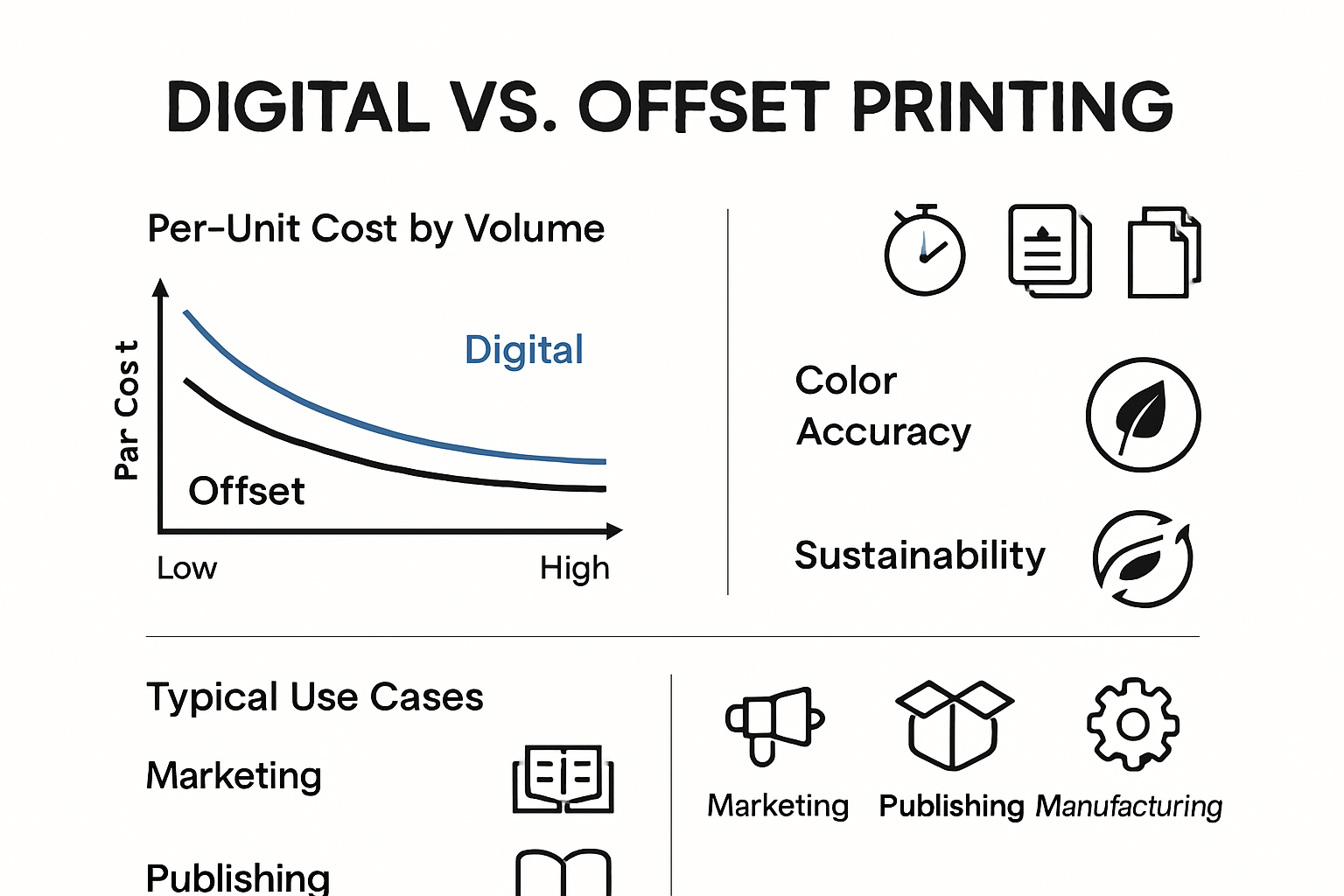
University of Scranton’s Printing Services research reveals the nuanced economic landscape of printing technologies. Digital printing offers substantially lower upfront costs, making it economically attractive for short print runs and projects requiring minimal initial investment. The absence of plate creation expenses and faster setup times translate to reduced preliminary expenditures.
Offset printing demonstrates superior cost-effectiveness for large volume productions. While initial setup costs are significantly higher, the per-unit price decreases dramatically as print quantities increase. Organizations planning extensive print campaigns often find offset printing more financially prudent when producing thousands of identical documents or marketing materials.
Print Quality and Performance Metrics
Print quality represents a critical determinant in technology selection. The Society for Imaging Science and Technology’s study highlights fascinating variations in print quality across different media types. Offset prints consistently outperform digital prints on coated media, providing superior color depth and image sharpness. Conversely, digital prints often excel on uncoated media, offering remarkable flexibility and consistent reproduction.
Modern digital printing technologies have dramatically narrowed the quality gap with offset printing. Advanced color management techniques and improved digital print heads enable near-photographic reproduction capabilities. However, offset printing still maintains a marginal advantage in color accuracy, particularly for complex graphic designs and high-resolution imagery.
Environmental Sustainability and Technological Efficiency
Sustainability has emerged as a crucial consideration in print production. The Journal of Technology Studies emphasizes the importance of adopting environmentally responsible printing practices. Digital printing demonstrates several ecological advantages, including reduced material waste, lower chemical consumption, and more efficient energy utilization compared to traditional offset methods.
Offset printing continues to evolve, incorporating more sustainable practices such as vegetable-based inks and recycled paper stocks. Learn more about sustainable printing innovations to understand how print technologies are adapting to environmental challenges.
Professionals must conduct comprehensive assessments that consider not just immediate production costs, but long-term environmental impact, material efficiency, and overall carbon footprint. The most responsible choice involves balancing economic feasibility with ecological considerations.
Ultimately, selecting between digital and offset printing requires a holistic evaluation of project-specific requirements, budget constraints, quality expectations, and sustainability goals. By understanding the intricate trade-offs between these technologies, organizations can make strategic decisions that optimize both financial performance and environmental responsibility.

Frequently Asked Questions
What are the main differences between digital and offset printing?
Digital printing uses electronic imaging to transfer designs directly onto materials, making it ideal for short runs and customization. Offset printing involves transferring ink from plates to a rubber blanket, allowing for greater color accuracy and quality, particularly in large volumes.
When is digital printing the best choice for a project?
Digital printing is best suited for projects that require quick turnaround times, customization, and small quantities, typically under 1,000 units. It is highly effective for personalized marketing materials and direct mail campaigns.
What are the cost considerations when choosing between digital and offset printing?
Digital printing generally has lower upfront costs suitable for short runs, while offset printing offers decreased per-unit costs for larger quantities over 1,000 units due to higher initial setup costs. Evaluating the project volume is crucial for cost-effectiveness.
How does print quality differ between digital and offset printing?
Offset printing typically provides superior color accuracy and image clarity, especially for complex designs and high-volume productions. Digital printing has improved significantly but may not match the color depth and sharpness of offset prints, particularly on coated paper.
Ready to Master Color Accuracy in Every Print Project?
Struggling to choose between digital and offset printing for your next campaign? The article highlights just how much the right process can impact your print quality, color consistency, and budget. If you are dealing with demanding clients or tough deadlines, color management becomes even more critical. Unmanaged color means wasted material and missed opportunities, especially when matching brand guidelines or producing personalized pieces. That is where reliable color guides and management tools transform your workflow.
Do not let guesswork determine your brand’s reputation. Elevate your results with Pantone color guides, swatches, and professional software from Kolorguide.com. Our color solutions ensure precise results whether you print digital, offset, or both. Plus, shop with confidence thanks to fast USA shipping and a trusted customer rating. Explore our Pantone color tools to streamline your next project and deliver with absolute confidence. Visit Kolorguide.com now to get started.
Recommended
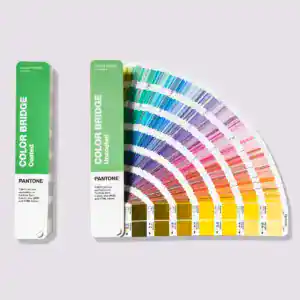
Pantone Color Bridge Set | Coated & Uncoated GP6102B
Original price was: $436.00.$428.00Current price is: $428.00.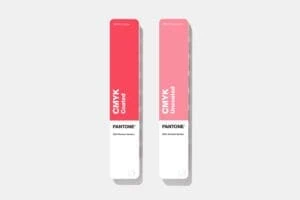
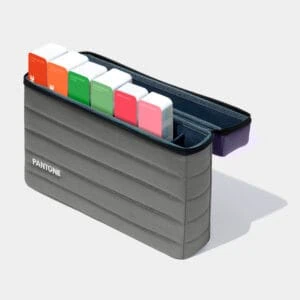

Pantone Portable Guide Studio GPG304B By Kolorguide
Original price was: $1,079.00.$944.99Current price is: $944.99.



About author
Related posts

Explore digital printing on glass, its significance, applications, and how it works for industries like marketing, architecture, and design. Continue reading

Explore digital printing on glass, its significance, applications, and how it works for industries like marketing, architecture, and design. Continue reading

Dive into the Pantone color guide for comprehensive insights on its significance and application in design and branding. Continue reading

Discover what is digital prepress, why it matters in printing, packaging, plastics, and more. Learn the process and its benefits for your industry today. Continue reading