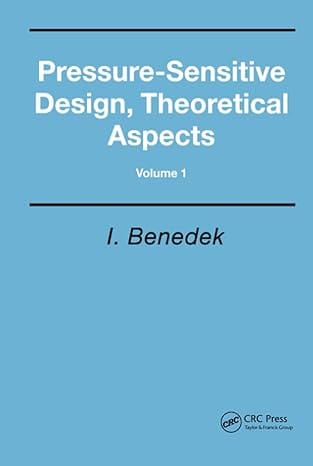

Pressure-Sensitive Design – Theoretical Aspects (Volume 1) ISBN: 9789067644396
Original price was: $593.79.$345.00Current price is: $345.00.
Pressure-Sensitive Design – Theoretical Aspects (Vol. 1) offers a comprehensive scientific foundation for understanding pressure-sensitive adhesives (PSAs). Covering macromolecular chemistry, polymer physics, rheology, and contact mechanics, this volume explains how pressure sensitivity originates at the molecular level and how it drives adhesive performance in real-world applications. Essential for professionals in adhesives, coating technology, material science, and product formulation.
This authoritative volume provides an in-depth exploration of the theoretical foundations behind pressure-sensitive adhesive (PSA) design. As interest in PSA formulation continues to grow, this book expands on the first edition (Pressure-Sensitive Formulation, VSP, 2000) and introduces a dedicated scientific framework for designing next-generation pressure-sensitive materials.
This volume explains the core principles of macromolecular chemistry and polymer physics that govern pressure sensitivity, bridging theory with industrial relevance. Readers will understand how molecular interactions, viscoelastic behavior, and contact mechanics determine adhesion performance and product behavior.
Advances in coating technology, in-line coating, and polymer synthesis are also examined, highlighting how modern manufacturing methods enable precise and efficient PSA material design. With pressure-sensitive products now competing both with and without adhesive layers, the book outlines the expanding range of material formulations needed in today’s market.
Key Topics Covered
Fundamentals of pressure-sensitive adhesion
Macromolecular chemistry and polymer design
Polymer physics and viscoelastic response
Rheology of pressure-sensitive systems
Contact mechanics and adhesion theory
Advances in coating technologies and in-line processes
Design pathways for next-generation PSA products
Ideal For
Adhesive formulators
Material scientists
Polymer engineers
Coating technology specialists
R&D professionals in adhesives and tapes
Universities, laboratories, and technical libraries
This is Volume 1, covering the theoretical aspects of PSA design.
Volume 2 focuses on practical formulation techniques and real-world product applications.
| Weight | 1 kg |
|---|---|
| Dimensions | 20 × 20 × 4 cm |


Related products

Pressure-Sensitive Design and Formulation, Application (Volume 2)
Original price was: $425.00.$148.50Current price is: $148.50. Add to cart
Handbook of Adhesives and Sealants in Construction 1st Edition
Original price was: $604.47.$385.00Current price is: $385.00. Add to cart
PET PACKAGING TECHNOLOGY (SHEFFIELD PACKAGING TECHNOLOGY S.) by DAVID W. BROOKS (EDITOR) GEOFF A. GILES (EDITOR) (2002-05-04
Original price was: $278.00.$73.50Current price is: $73.50. Add to cart20 in stock
Colloids and Colloid Assemblies: Synthesis, Modification, Organization and Utilization of Colloid Particles 1st Edition by Frank Caruso (Editor)
Original price was: $650.00.$625.00Current price is: $625.00. Add to cart

Pressure-Sensitive Formulation 1st Edition by Istvan Benedek
Original price was: $233.00.$158.50Current price is: $158.50. Add to cart