
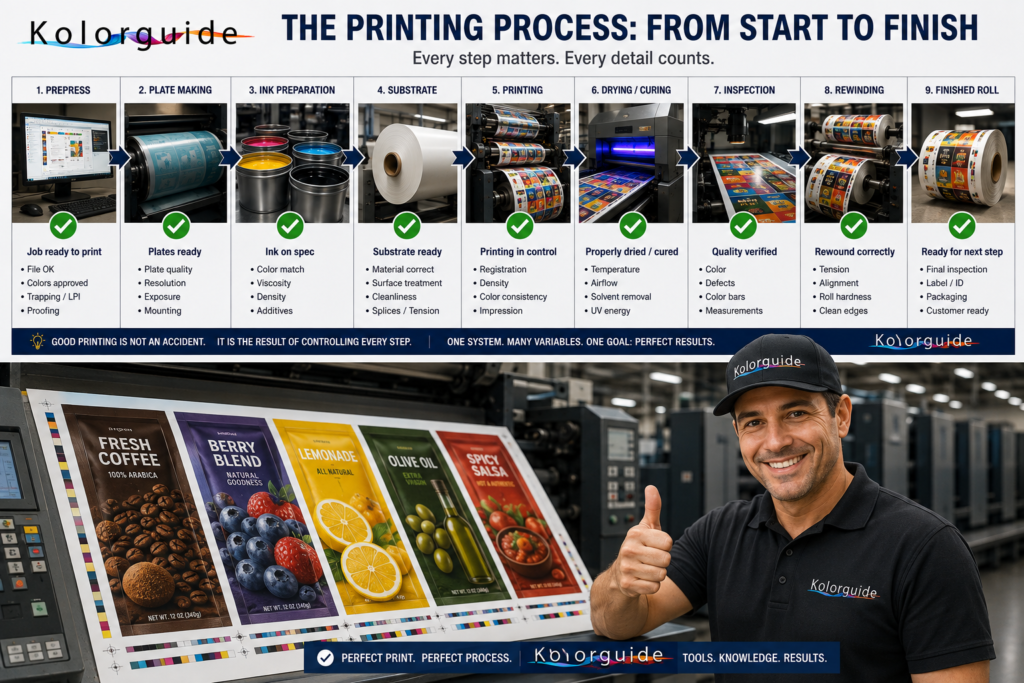
 When printing fails, where should you look?[/caption]
When Printing Fails, Where Should You Look?
Viscosity? Surface tension? Surface energy? Ink formulation? Press speed? Temperature? Humidity? Curing? Contamination?
The viscosity is correct.
The dyne level looks right.
The ink is the same ink you used yesterday.
The substrate is the same.
And yet…
the ink won’t stick.
Where should you look?
Because viscosity is not surface tension.
Surface tension is not surface energy.
Wetting is not adhesion.
And adhesion is not controlled by one number.
Printing is a system.
When printing fails, troubleshooting means understanding which part of that system changed — and sometimes the answer is at the interface between several of them.
1. VISCOSITY — Can the Ink Flow and Transfer?
Viscosity describes a fluid’s resistance to flow.
In printing, viscosity can influence:
Ink transfer
Metering
Anilox behavior
Film thickness
Leveling
Print consistency
Press performance
A Zahn cup, for example, can be used as a practical method for monitoring viscosity under controlled conditions.
But viscosity primarily answers a flow and process question.
An ink can have the correct viscosity and still wet the substrate poorly.
And it can have the correct viscosity, wet beautifully…
and still fail adhesion.
There is another important variable here:
Temperature.
Viscosity is temperature-dependent.
The same ink measured at different temperatures can behave differently.
Therefore, saying:
“The viscosity is correct.”
may be incomplete unless we also know:
At what temperature?
2. SURFACE TENSION & SURFACE ENERGY — Will the Ink Wet the Surface?
Now we move from flow to the interaction between a liquid and a solid.
The ink has surface tension.
The substrate has surface energy.
Their relationship strongly influences whether the ink will spread over the substrate or pull away from it.
A low-surface-energy polyethylene or polypropylene film, for example, may require corona, plasma, flame or another surface treatment before printing.
Dyne testing can provide valuable information about the wetting condition of that surface.
But here is an important distinction:
A dyne test evaluates wetting behavior.
It does not directly measure adhesion.
A surface may show apparently adequate wetting characteristics.
The ink may spread beautifully.
And the ink can still fail adhesion.
Wetting and adhesion are related.
They are not the same thing.
3. INK FORMULATION — What’s Actually in the Ink?
Now suppose viscosity is correct and wetting appears adequate.
Can the ink itself still be responsible?
Absolutely.
Two inks can have similar viscosity.
They can have similar surface tension.
They can be printed on the same substrate under apparently identical conditions.
And one may adhere while the other fails.
Why?
Because an ink is much more than a viscosity or surface-tension number.
Depending on the system, its formulation may include:
Binders or resins
Pigments
Solvents or water
Surfactants
Wetting agents
Defoamers
Waxes
Slip additives
Adhesion promoters
Crosslinkers
Photoinitiators
Other functional additives
The binder matters.
The resin or binder becomes a major component of the final ink film.
Its chemistry and compatibility with the substrate can therefore have a major influence on adhesion.
An ink may flow correctly.
It may wet correctly.
But if the binder/substrate interaction is poor, adhesion can still fail.
Surfactants create another interesting situation.
A surfactant may reduce the surface tension of the ink and improve wetting.
The ink spreads better.
Problem solved?
Not necessarily.
Better wetting does not automatically mean better adhesion.
That distinction is fundamental.
4. THE SUBSTRATE — What Are We Really Printing On?
The ink is only one side of the interface.
The substrate is the other.
It might be:
PE
PP
BOPP
PET
Paper
Coated paper
Paperboard
Aluminum
Glass
Metal
A coated surface
A previously printed surface
But simply identifying the substrate is not enough.
Its condition matters.
Surface treatment can decay.
Additives can migrate.
Release agents may remain.
Oils may be present.
Dust can settle.
Fingerprints can contaminate a surface.
Moisture can condense.
Processing residues can remain.
So perhaps the troubleshooting question should not simply be:
“What is the substrate?”
It should also be:
“What is actually on the substrate?”
5. WHAT IS ACTUALLY ON THE SURFACE?
This deserves its own question because adhesion happens at an interface.
Consider:
Dust
Oils
Fingerprints
Moisture
Condensation
Migrated additives
Release agents
Processing residues
Anti-set-off powder
All of these can change the interface.
Anti-set-off powder is a perfect example.
Its purpose is useful: to help prevent freshly printed sheets from transferring ink to adjacent sheets in the stack.
But what happens when that sheet later needs to be:
Overprinted?
Coated?
Laminated?
Glued?
Varnished?
Excess powder remaining on the surface may interfere with the next process.
The coating, adhesive or ink may not be interacting only with the surface we think is there.
It may also be interacting with a layer of powder between the two materials.
That leads to one of the most important troubleshooting questions in this entire discussion:
What is physically present at the interface right now?
6. ENVIRONMENT — The Variable We Often Forget
Suppose the ink has not changed.
The substrate has not changed.
The press has not changed.
Can the result still change?
Yes.
Because the environment may have changed.
Temperature
Temperature can affect:
Ink viscosity
Flow
Transfer
Evaporation
Drying behavior
Substrate temperature
The same ink may behave differently at different temperatures.
This also brings us back to viscosity:
A viscosity value without a temperature reference may tell only part of the story.
Humidity
Relative humidity can influence:
Paper and paperboard moisture
Dimensional stability
Water-based ink drying
Static behavior
Surface condition
Paper and board are particularly sensitive because they exchange moisture with the surrounding environment.
Condensation
Imagine a roll, sheet or component stored in a cold environment and then moved into a warm, humid production area.
Moisture can condense on its surface.
We may think we are printing on plastic, metal or another substrate.
But at the microscopic interface…
we may actually be printing over a film of moisture.
Airflow
Air movement can influence evaporation and drying.
So the environment is not something happening outside the printing process.
The environment is part of the printing process.
7. PRESS SPEED — Same Ink. Same Substrate. Different Result.
Now consider another situation:
At 100 m/min, everything works.
At 200 m/min, adhesion fails.
Same ink.
Same substrate.
Same nominal dyne level.
What changed?
Time.
Increasing press speed can reduce the time available for:
Ink transfer and leveling
Solvent evaporation
Water removal
Interstation drying
Film formation
UV exposure
Curing before downstream processing
In a UV system, for example, increasing press speed can affect the energy delivered to the ink film if the curing system does not compensate appropriately.
And now we can have a particularly confusing situation:
The ink transferred.
The ink wetted.
The print looked perfect.
And the ink still came off.
The apparent adhesion problem may actually have originated somewhere else in the process.
8. DRYING & CURING — Is the Ink Really Finished?
Getting ink onto the substrate is not the end of printing.
For water- and solvent-based systems, evaporation and film formation matter.
For UV systems, polymerization and adequate cure matter.
Final performance can be influenced by:
Film thickness
Temperature
Airflow
Solvent balance
Water removal
UV wavelength
UV irradiance
UV dose
Lamp condition
Photoinitiator chemistry
Press speed
Time before testing
A print can look dry.
A print can feel dry.
That does not necessarily mean that the ink film has developed all of its intended final properties.
So again:
Appearance is not proof of adhesion.
9. THREE MEASUREMENTS. THREE DIFFERENT QUESTIONS.
Now we can see why troubleshooting with a single instrument can be misleading.
Zahn Cup
Question: How does the ink flow?
A Zahn cup provides information related to viscosity and process consistency.
It does not measure surface energy.
It does not measure adhesion.
Dyne Test
Question: How does a test liquid wet the surface?
A dyne test provides information related to wetting tension and surface condition under the conditions of the test.
It does not directly measure ink adhesion.
Tape Test
Question: Does the applied ink or coating remain attached under the conditions of the test?
Now we are investigating adhesion performance.
Three tools.
Three measurements.
Three different questions.
Flow.
Wetting.
Adhesion.
Confusing them can send troubleshooting in completely the wrong direction.
10. WHEN PRINTING FAILS, WHERE SHOULD YOU LOOK?
Instead of immediately asking:
“What’s wrong with the dyne level?”
or:
“What’s wrong with the ink?”
look at the complete system.
INK
Viscosity
Surface tension
Resin/binder chemistry
Pigmentation
Solvent/water balance
Surfactants
Additives
Adhesion promoters
Crosslinkers
Photoinitiators
SUBSTRATE
Surface energy
Surface chemistry
Material type
Surface treatment
Treatment decay
Migrated additives
SURFACE CONDITION
Dust
Oil
Fingerprints
Moisture
Condensation
Release agents
Processing residues
Anti-set-off powder
PROCESS
Ink transfer
Film thickness
Press speed
Temperature
Drying
UV curing
Time before testing
ENVIRONMENT
Ambient temperature
Relative humidity
Airflow
Storage conditions
Material acclimatization
And sometimes the problem does not belong to any one category.
It exists in the interaction between them.
THERE MAY BE NO SINGLE “CORRECT NUMBER”
This may be the most important lesson.
A viscosity number cannot guarantee adhesion.
A dyne number cannot guarantee adhesion.
A press-speed setting cannot guarantee adhesion.
A curing measurement alone cannot guarantee adhesion.
Even using the “correct ink” cannot guarantee adhesion if the interface or process has changed.
The numbers are valuable.
The measurements are valuable.
But each measurement answers a different question.
Troubleshooting begins by asking the right question of the right measurement.
THE INTERFACE IS WHERE THE ANSWER LIVES
Viscosity tells us something about how the ink flows.
Surface tension tells us something about the liquid.
Surface energy tells us something about the substrate.
Dyne testing tells us something about wetting behavior.
Temperature and humidity tell us something about the environment in which the interaction occurs.
Press speed, drying and curing tell us something about the process.
Surface contamination tells us what may actually be sitting between the materials.
But adhesion emerges from the interaction of the complete system.
Adhesion is not a property of the ink alone.
It is not a property of the substrate alone.
Adhesion is the result of an interface.
So when printing fails, perhaps the first question should not be:
“What’s the dyne level?”
Perhaps it should be:
“What is actually happening at the interface?”
Because:
Viscosity is not surface tension.
Surface tension is not surface energy.
Wetting is not adhesion.
And one number rarely tells the whole story.
